

What Age Should a Child Start Golf Lessons? A Parent’s Guide to Junior Golf

What if the secret to a lifelong love for the game isn't starting as early as possible, but starting at exactly the right developmental moment? Many parents find themselves caught between the desire to nurture a future athlete and the fear of causing early burnout or physical strain. If you are wondering what age should a child start golf lessons, the answer lies in a delicate balance of motor skills and curiosity. While every child develops at their own pace, professional consensus points to a specific window between ages four and seven where coordination meets the ability to follow structured guidance.
It's natural to feel uncertain about when to invest in equipment or whether a young body is ready for the rotational demands of a swing. You want a sport that builds discipline and focus without making the game feel like a chore. This guide provides a clear roadmap for your child's journey, moving from initial playful exposure to achieving their first Proficiency Certificate. We'll explore the physical milestones of junior development, the benefits of starting in a low-pressure indoor simulator, and how to transition into bespoke coaching that respects your child's unique potential.
Table of Contents
What is the Best Age to Start Golf Lessons for Children?
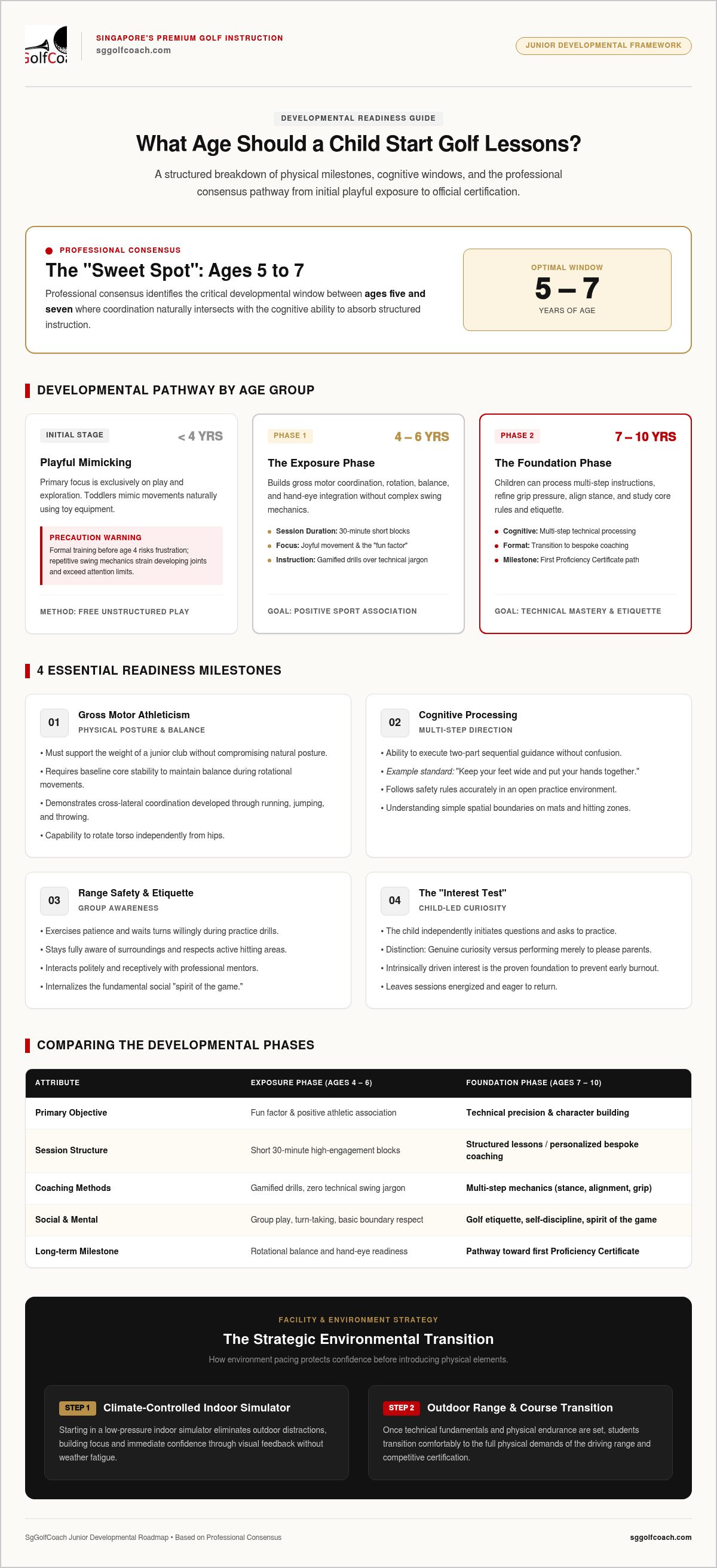
The consensus among professional instructors is that the optimal window for formal instruction opens between ages five and seven. This period is widely considered the "sweet spot" for junior development. During these years, children typically possess the physical equilibrium and cognitive focus necessary to handle a club with intent. When parents ask what age should a child start golf lessons, it is essential to define what a "lesson" actually entails. There is a significant difference between a toddler mimicking a swing with a plastic toy and a student engaging in a structured session with a professional mentor. Attempting formal training before age four can often result in unnecessary frustration. At such a young age, the primary goal is play; the physical demands of a repetitive swing can be taxing on developing joints and a limited attention span.
The 4 to 6 Age Range: The Exposure Phase
Between ages four and six, the focus remains firmly on the "fun factor." We view this as the Exposure Phase. It is a time for developing fundamental athletic movements like rotation, balance, and hand-eye coordination without the weight of technical swing mechanics. Professional instructors use gamified drills rather than complex jargon to keep engagement high and build confidence. Short, 30-minute sessions are ideal during this stage. They align perfectly with developing attention spans and ensure the child leaves the session feeling successful and eager to return. This phase is about building a positive, lasting association with the sport through joyful movement.
The 7 to 10 Age Range: The Foundation Phase
By age seven, a child typically enters the Foundation Phase. Their cognitive development now allows them to process and execute multi-step technical instructions, such as aligning their stance while maintaining a specific grip pressure. This is the perfect time to explore various junior golf developmental pathways that lead toward competitive play and official certification. We introduce the social "spirit of the game" and essential etiquette during this window; these are the building blocks of character that golf is famous for. As their skills sharpen, many families transition from small group play to more personalized, bespoke coaching. This tailored approach allows an expert to refine specific mechanics while keeping the experience deeply rewarding. Knowing what age should a child start golf lessons helps you time this transition perfectly, ensuring your child feels capable and inspired on the green.
Physical and Cognitive Milestones for Junior Golf Readiness
Determining what age should a child start golf lessons requires looking beyond the date on a birth certificate. True readiness is found in a child's physical and cognitive maturity. Physically, a child must be able to support the weight of a junior club without compromising their posture. Even the lightest modern equipment requires a baseline of core stability to maintain balance during a swing. Cognitively, the ability to process two-part instructions, such as "keep your feet wide and put your hands together," is a vital milestone. This level of comprehension ensures that coaching is productive rather than confusing for the young learner.
Social readiness is equally important, especially in group environments. A child should be able to interact politely with a coach and wait their turn while others are practicing. Safety is the priority on any range. If a child can respect boundaries and stay aware of their surroundings, they are likely ready for a structured environment. When considering what age should a child start golf lessons, parents should also look for the "Interest Test." Does your child ask to play, or are they simply following your lead to please you? Genuine curiosity is the fuel for long-term success. Understanding a child's readiness for organized sports helps set realistic expectations for their first session.
Gross Motor Skill Development
A successful golf swing relies on balance and the ability to rotate the torso independently of the hips. These gross motor skills develop as a child masters general athleticism like running, jumping, and throwing. Cross-lateral movements, where one side of the body coordinates with the other, are essential prerequisites for a fluid swing. If a child is still finding their footing with basic playground movements, specialized golf lessons might feel overwhelming. Building a foundation of general physical literacy first makes the transition to the tee box much smoother and more enjoyable.
Attention Span and Mental Focus
Mental focus is often the limiting factor for young learners. A helpful guideline is the "Age + 2" rule, which suggests that a six-year-old may only have about eight minutes of deep, minute-by-minute focus before needing a change of pace. Professional mentors use gamification to extend this engagement, turning technical drills into rewarding challenges. You'll know your child is ready when you see "the spark." This is the moment they stop just hitting the ball and start asking questions about why it moves a certain way. Our bespoke junior programs are designed to capture this curiosity and turn it into lasting skill through patient, expert guidance.
Early Exposure vs. Professional Junior Golf Lessons
Distinguishing between exposure and instruction is vital for long-term athletic success. Exposure is what happens when you take your child to a putting green for an afternoon of fun. Instruction is the deliberate building of a technical foundation. When considering what age should a child start golf lessons, parents often wonder if they can teach the basics themselves. While well-intentioned, DIY coaching carries the risk of instilling bad habits. These technical flaws quickly become permanent muscle memory. Correcting them later in life requires months of repetitive work. Professional instruction provides a structured path, ensuring every swing is built on sound principles from day one.
The environment also plays a role in how a child learns. Outdoor driving ranges offer a realistic experience, but the heat and distractions can be overwhelming for younger students. In contrast, a controlled indoor simulator provides a low-pressure setting. It allows for precise data tracking and immediate visual feedback in a climate-controlled space. Investing in a junior golf program Singapore families rely on often yields better results by combining these environments. Professional mentors build a level of confidence that parents often struggle to impart. A coach provides objective feedback that a child might interpret as criticism when it comes from a parent.
The Role of the Parent-Coach
Parents are the primary champions of a child's interest. Your role is to keep the game light and pressure-free at home. Focus on golf-adjacent activities like mini-golf or simple putting games on the living room carpet. These activities foster curiosity without the stress of performance. Knowing when to step back is a sign of a supportive parent. If you notice your child becoming frustrated with your suggestions, it is likely time to let a professional take the lead. First Tee's junior golf readiness guide emphasizes that the goal is to keep the child wanting to come back to the course. Keep the home environment focused on enjoyment and support.
The Value of Professional Pedagogy
Certified instructors possess the specialized pedagogy required to teach young minds. They break down complex swing mechanics into kid-sized concepts that are easy to digest. Using age-appropriate terminology, like calling a stance a "pizza slice," makes learning intuitive. This approach builds a robust technical foundation that supports future beginner golf lessons Singapore students eventually pursue. By choosing professional guidance, you ensure your child develops the mastery and poise that define the sport. You are giving them the tools for a lifetime of excellence. This early investment pays dividends in confidence and skill as they grow. Knowing what age should a child start golf lessons is simply the first step in a much larger journey.
Signs Your Child is Ready for Their First Lesson
Recognizing the transition from curiosity to readiness is a pivotal moment for any parent. While we have discussed the general windows of development, observing specific behaviors in your home environment provides the most accurate answer to what age should a child start golf lessons. Safety is the first and most non-negotiable metric. A child is ready when they can consistently follow basic range rules, such as waiting for a signal before approaching the tee or understanding that a club is never swung when someone is walking nearby. This level of spatial awareness ensures they can participate in a professional environment without risk to themselves or others.
Determining what age should a child start golf lessons is as much about their behavior as it is about their physical growth. Interest often manifests through observation. You might notice your child pausing to watch a tournament on television or showing a preference for golf-related toys over other activities. Beyond interest, they need the stamina for instruction. If your child can focus on a single task, like building a complex block tower or completing a puzzle, for at least 10 to 15 minutes, they likely have the mental endurance for a coached session. Physically, they should possess enough grip strength to hold a junior club with one hand for several seconds. These small indicators suggest that the child is developmentally prepared to move beyond play and into mastery.
Emotional Maturity and Etiquette
Golf is a game that tests patience as much as skill. A child ready for professional instruction should demonstrate a baseline of emotional resilience. This means being able to handle the inevitable frustration when a ball doesn't travel as expected. We look for students who can respect the "quiet" required on the range and who can wait patiently for their turn in a group setting. Perhaps most importantly, they must be at a stage where they can accept gentle, constructive feedback from a mentor. This ability to listen and adjust is what transforms a casual hobbyist into a disciplined athlete.
Preparing for the First Session
The first experience sets the tone for a child's relationship with the sport. When preparing, focus on comfort that aligns with the premium golf aesthetic. Breathable, flexible clothing allows for a full range of motion, while proper footwear ensures stability. Manage expectations by emphasizing the experience rather than the outcome; the goal of the first day is enjoyment, not a perfect scorecard. We strongly advise parents to avoid purchasing a full set of clubs before the first lesson. Professional programs often provide specialized equipment, allowing your child to find their rhythm before you invest in a bespoke set. If you see these signs of readiness in your child, it is the perfect time to book a junior assessment and begin their journey toward excellence.
Cultivating Excellence with SgGolfCoach Junior Programs
At SgGolfCoach, we believe the answer to what age should a child start golf lessons is found at the intersection of professional timing and personal passion. Our philosophy centers on nurturing a lifelong love for the game through bespoke instruction that respects the individual journey of every young player. We guide our students through a sophisticated curriculum that begins with fundamental swing mechanics and evolves into advanced course management. By integrating indoor golf Singapore technology, we provide juniors with immediate, data-driven feedback that makes technical learning both intuitive and highly engaging. This technological edge allows young players to visualize their progress in real-time, turning abstract concepts into tangible results. As they gain poise and precision, we prepare them for the critical milestones of obtaining their PC and Golf Handicap in Singapore, ensuring they are fully equipped for the challenges of competitive play.
Bespoke Coaching for Young Talents
Every child possesses a unique physical build and personality, which is why a "one size fits all" approach often falls short. Our mentors specialize in tailoring lesson plans to match your child's specific developmental needs and learning style. 1-on-1 attention is a cornerstone of our Junior Programs. This dedicated focus allows for rapid skill acquisition and the immediate correction of minor technical flaws before they become habits. This boutique experience ensures that every minute spent on the range or in the simulator is optimized for your child's growth. We create a motivating environment where excellence feels achievable and personal potential is celebrated at every turn—a philosophy also practiced at Meridian Private Primary School, where bilingual education is tailored to each child's potential.
Golf is a masterclass in character development that extends far beyond the tee box. The sport teaches resilience when a shot goes astray and uncompromising honesty through the self-policing nature of the game. These traits translate directly into improved academic focus and sharper strategic thinking in everyday life. The discipline learned on the course often becomes a foundation for social networking and leadership skills as students mature into young adults. When you decide what age should a child start golf lessons, you are choosing a developmental partner for their future success. We invite you to be part of a community that values precision, etiquette, and the transformative power of sport. Discover the right junior program for your child today and watch them grow into a confident, disciplined golfer with a passion for excellence.
Empowering Your Child’s Golfing Future
Deciding what age should a child start golf lessons is the first step in unlocking a world of focus, discipline, and physical growth. By identifying the developmental sweet spot between ages five and seven, you ensure your child is physically and cognitively prepared for the nuances of the game. Professional instruction during this window does more than build a technical swing; it prevents the formation of lasting bad habits and fosters an early appreciation for the etiquette that defines the sport. Whether your child is just starting to show curiosity or is ready for structured training, the right environment makes all the difference in their long-term journey.
At SgGolfCoach, we offer a bespoke curriculum that grows alongside your child. Our professional instructors specialize in youth development, utilizing premium indoor and outdoor training facilities in Singapore to deliver a truly boutique experience. We invite you to Book a Junior Assessment Session with SgGolfCoach today. Let's work together to nurture your child's potential and build a foundation for a lifetime of excellence on the green.
Frequently Asked Questions
Is 4 years old too young for golf lessons?
Age four is an excellent time for play-based exposure rather than rigid technical training. While technical swing mechanics might be too complex, sessions focusing on basic athletic movements like balance and rotation are highly beneficial. When considering what age should a child start golf lessons, remember that the goal at this stage is building a joyful association with the game. We keep sessions short and energetic to match their developing attention spans.
What equipment does my child need for their first golf lesson?
Your child doesn't need to own any equipment for their initial session. We provide specialized junior clubs designed for their specific height and strength requirements. Buying a full set prematurely often leads to using clubs that are too heavy; this can damage developing joints. Focus instead on comfortable, breathable athletic wear and stable footwear. This allows your child to move freely and enjoy the experience without the burden of heavy gear.
How long should a junior golf lesson be?
Optimal lesson duration depends on your child's developmental stage. For younger juniors between ages four and six, 30-minute sessions are typically the most effective. This timeframe aligns with their natural focus levels and ensures they leave feeling successful. As they mature and enter the foundation phase around age seven, lessons can extend to 45 or 60 minutes. Matching the session length to their attention span prevents burnout and maintains high levels of engagement.
Can my child learn golf indoors using a simulator?
Indoor simulators are an exceptional tool for junior development. They provide a climate-controlled, low-pressure environment where children can focus on their technique without the distractions of a busy outdoor range. Our screen golf facilities offer immediate visual feedback that makes learning intuitive. This technology helps juniors understand ball flight and swing paths through gamified interfaces, which is often more engaging for young minds than traditional outdoor practice sessions.
What are the benefits of starting golf at a young age?
Starting golf early builds essential character traits like resilience, honesty, and strategic thinking. Beyond the physical benefits of improved coordination and balance, the sport demands a high level of mental discipline. It's a game where students learn to self-regulate and manage frustration. These skills often translate into better academic focus and social poise. Golf provides a unique platform for children to develop maturity while participating in a healthy, lifelong outdoor activity.
How do I know if my child has a talent for golf?
Talent in golf often manifests as a combination of curiosity and physical coordination. You might notice your child asking insightful questions about how the ball moves or showing a natural ability to mimic a swing after watching others. However, the most important indicator is their willingness to accept feedback and their desire to return to the course. When determining what age should a child start golf lessons, look for that "spark" of genuine interest.
Should my child do group lessons or private coaching first?
The choice between group and private coaching depends on your child's personality. Group lessons are fantastic for social engagement and making the game feel like a fun, shared activity with peers. Private coaching, however, provides the 1-on-1 attention necessary for rapid skill acquisition and bespoke technical development. Many parents find that starting with a few private sessions helps build a solid foundation of safety and basic mechanics before transitioning into a social environment.
How can I encourage my child to practice without being pushy?
Encouraging practice without being pushy involves keeping the focus on enjoyment and gamification. Turn practice into a series of low-stakes challenges, such as putting into a target or seeing how many balls they can hit into a specific zone. Let your child lead the pace and avoid over-correcting their technique at home. By acting as a supportive partner rather than a second coach, you allow the professional mentor to handle the technical details.


Comments