

Age to start learning golf: A safe, gradual start for children

The best age to start learning golf is usually between four and eight, with six often considered a good age for formal lessons. Some children can begin around five if the sessions suit their development. The right time depends less on a birthday than on whether golf feels enjoyable and manageable for your child.
It’s natural to want lessons that are safe, engaging and suited to your child’s stage of development. Interest in golf, the ability to follow simple instructions and a willingness to try new activities can all help indicate readiness. This article explains how to recognise those signs, what age-appropriate sessions can involve and how early instruction can support coordination, patience and enjoyment. Starting later is welcome too: golf can grow with a child’s interests, at a pace that feels right for them.
Table of Contents
At what age should my child start playing golf?
Children commonly begin golf between four and eight, while six is often considered a good age for formal lessons. Readiness matters as much as age: interest, following simple instructions and enjoying new activities all help make for a positive start.
Typical starting ages
The usual starting window is four to eight, with some children beginning around five. Treat this range as a guide, not a deadline: attention, interest and development vary from child to child.
For children aged four to six, introductory lessons generally focus on fun and may last 20 to 30 minutes. A child who can follow a simple direction, such as waiting for a turn, may be ready to try. Children in this age range can often focus for 15 to 30 minutes, so short activities and breaks can help the session suit their attention.
Six is often viewed as a good age for formal instruction, but a keen four-year-old may enjoy a playful introduction. A child who shows little interest can wait. If you’re wondering about the best age to start learning golf, use ages four to eight as a guide, then consider whether your child is curious and comfortable joining a lesson.
Equipment should fit the child, rather than make them adapt to adult-sized clubs. A club that is too long or heavy can make it harder to balance and swing comfortably. In a beginner session, appropriately sized clubs and balls help keep the focus on simple movements and enjoyment. Some clubs make beginner equipment available, so families may not need to buy clubs and balls straight away. The instructor can guide equipment use to suit a child’s size and coordination.
Golf also gives children repeated chances to build confidence and practise social skills. A child can learn to wait while another player takes a turn, encourage a classmate after a missed shot, and celebrate a small improvement. These everyday moments make the group setting part of the learning experience, not just a place to practise swings. According to First Tee, children can develop perseverance, integrity and respect through golf whether they start at age 7 or 17.
Starting as a child or an adult
Starting as a child can make golf a familiar activity early, but adults can begin whenever they feel ready. Neither path is better for everyone; the right choice depends on interest, available time and personal goals. Children may enjoy playful discovery and shared sessions, while adults may prefer focused instruction tied to a specific aim.
Professional lessons help beginners practise consistently, with a clear focus for each session, guided feedback and a skill to build on next. For example, an instructor can identify one swing movement to work on and revisit it at the next lesson, rather than leaving a beginner to guess what to practise. A steady lesson rhythm helps children recognise achievable progress, while adults benefit from instruction tailored to their learning pace.
Age-appropriate junior sessions
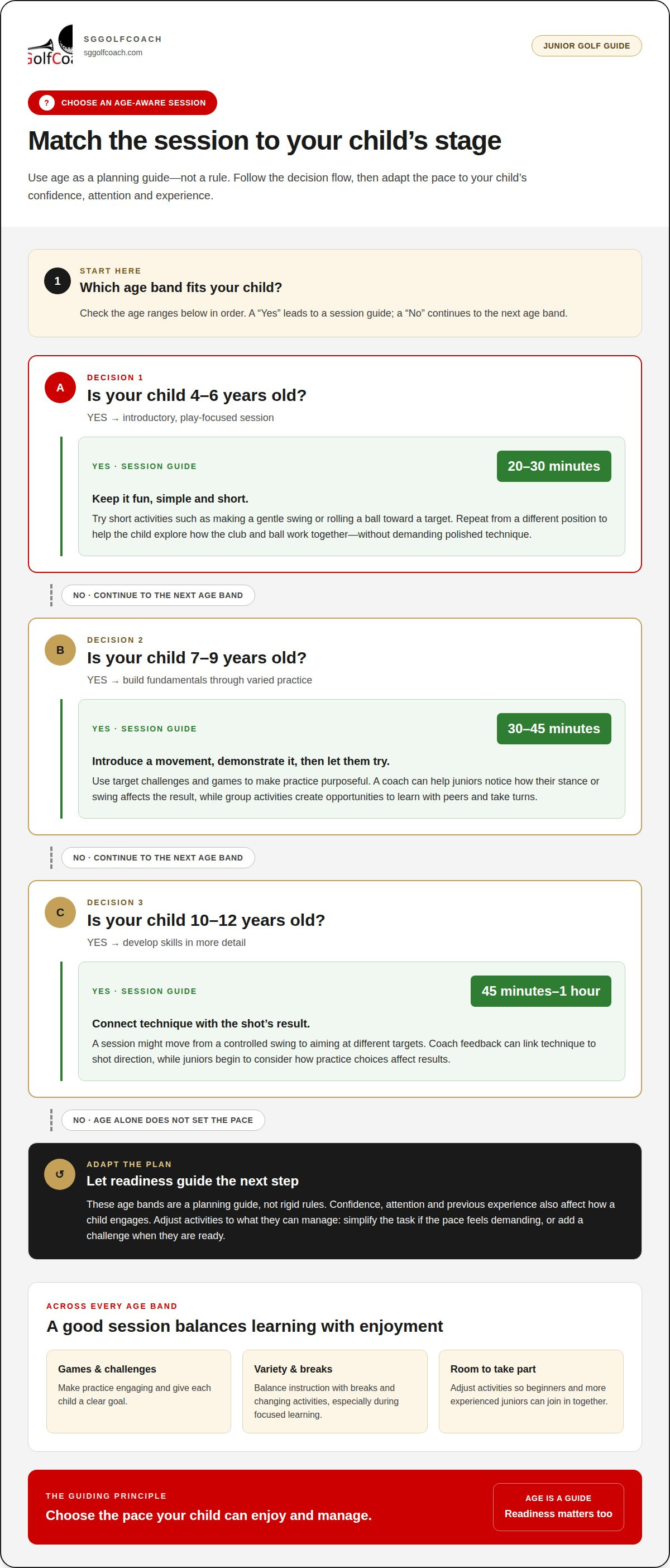
A useful junior session matches its pace and activities to the child’s age and stage. A four-year-old may need playful exploration, while a ten-year-old can work on more deliberate skill development. The age bands below are a planning guide, not rigid rules: confidence, attention and previous experience also affect how a child engages.
For ages four to six, instruction is usually introductory and focused on fun. Lessons often last 20 to 30 minutes, allowing time for short activities without making the session feel like a long practice. A coach might invite a child to make a gentle swing, roll a ball towards a target, then try again from a different position. The focus is on discovering how the club and ball work together, rather than demanding a polished technique.
Children aged seven to nine are ready to build fundamentals through varied practice. Sessions often last 30 to 45 minutes, giving room to introduce a movement, demonstrate it and let children try. For example, a coach can set up a simple target challenge, then help each junior notice how their stance or swing affects the result. Games keep repetitions purposeful, while group activities let children learn alongside peers and take turns.
At ages ten to twelve, lessons can develop skills in more detail and often last 45 minutes to an hour. A session might move from practising a controlled swing to aiming at different targets, with feedback connecting technique to the shot’s direction. Older juniors can also begin to understand how practice choices affect results. The coach still needs to balance instruction with breaks and variety, so focused learning does not become a sequence of rigid drills.
Across all three age groups, games, challenges and group activities can make practice more engaging than drills alone. A target challenge, for instance, gives each child a clear goal while allowing for different levels of success. An inclusive, supportive session welcomes children with varied backgrounds and abilities; activities can be adjusted so beginners and more experienced juniors can take part together. This matters in Singapore, where children may have different levels of exposure to golf.
Progression should reflect what a child can manage, not their birthday alone. A younger beginner may enjoy repeating a simple target game, while a more experienced junior may benefit from refining a particular swing movement. If the pace feels too demanding, simpler activities can restore enjoyment; if a child is ready for more, the coach can add a challenge. This flexible approach keeps lessons relevant as skills and interests change.
For families considering a structured start, junior golf sessions can provide age-aware instruction through activities designed around young learners.
Safety and progressive curricula
A safe junior lesson combines attentive supervision with a clear learning progression. Children need to know where to stand, when to swing and how to respond to the instructor. A structured curriculum helps introduce those expectations alongside golf skills, rather than treating safety as a separate reminder. For families in Singapore, the teaching environment and the instructor’s approach both matter.
Junior golf sessions should be delivered by appropriately qualified adults and follow safeguarding guidelines. For parents, a practical standard is responsible adult supervision alongside safeguarding practices. A coach can explain the session’s boundaries, show a child where to wait and give clear directions before practice begins. Children then have a consistent example to follow instead of having to guess when it’s their turn.
Safe practice also depends on predictable routines. Before a child swings, the instructor can organise the group so participants have room to practise and know when to take a turn. For example, a junior waiting for a target attempt should stand in the designated waiting area, not beside the person swinging. Clear turn-taking helps children focus and reduces confusion when several learners share a practice space.
A progressive curriculum introduces skills in a manageable sequence. An instructor might begin with how to hold a club and take a balanced stance, then introduce a controlled swing and a simple target. Once a child understands the activity, the next lesson can revisit it before adding a challenge. Each step builds on an earlier skill, so instruction feels coherent instead of introducing several unfamiliar techniques at once.
Progression should also reflect how a child responds. If a junior struggles to keep their balance during a swing, the instructor can simplify the movement and practise that element before adding distance or direction. If the child performs it comfortably, a target challenge can introduce a fresh focus. These adjustments help maintain concentration and safety without expecting every child to learn at the same pace.
Golf’s shared spaces call for clear communication. A coach can explain where to wait, when to approach a ball and how to pause while another child practises. For example, the group can listen for the instructor’s signal before changing stations. Simple, repeated directions make expectations easier to remember, especially for beginners learning club control and group routines at the same time.
Get into Golf states that all affiliated golf clubs listed on its programme have SafeGolf accreditation. That applies to the clubs listed there, not every golf venue in Singapore. More broadly, a carefully staged lesson gives children room to develop technique while learning safe habits. Parents can look for clear supervision, communicated boundaries and a progression suited to their child’s current skills.
Benefits of early golf instruction
Early lessons give children a guided way to explore golf, develop foundational skills and decide how they want to play. The main risks are making practice too demanding or treating early participation as a commitment to competition. A gradual approach keeps instruction aligned with a child’s interest, attention and changing goals.
A coach can introduce basic movements in a clear sequence, such as grip, stance and a controlled swing. This gives a beginner a starting point for understanding how body position affects a shot. Instead of repeating movements without direction, the child gets feedback on one skill at a time. Each lesson can build on a familiar movement before adding another challenge.
Early instruction can help children become comfortable learning through practice. For example, a junior might aim at a target, notice where the ball lands, then adjust the next swing with guidance. The value lies in connecting an attempt with feedback, not in expecting every shot to succeed. Small, specific goals make progress easier to recognise, such as staying balanced through a swing or aiming towards a chosen target.
Golf offers a flexible path as a child’s interests develop. Some juniors may enjoy occasional recreational play, while others may later choose to pursue competitions. They don’t need to decide on a goal at their first lesson. An instructor can focus on enjoyable fundamentals first, then introduce more structured practice as the child shows interest and readiness. A child who prefers casual play can keep learning without competition becoming the measure of success.
There are practical downsides to watch for. A lesson that moves too quickly can leave a beginner struggling to follow instructions, while repeated pressure to improve can make practice feel like an obligation. For example, if a child becomes frustrated during a target activity, the instructor can simplify the challenge or return to a familiar movement. Enjoyment and participation are useful signals for adjusting the session.
Early golf should leave room for other interests, school and rest. A junior’s routine needs to fit family life, not crowd it out. The instructor can keep lesson goals focused, while parents can treat golf as one of a child’s wider pursuits. That balance supports steady participation without making a young learner feel responsible for rapid results.
First Tee says children develop perseverance, integrity and respect through golf whether they start at age 7 or 17. The lesson for families is that these qualities are not limited to an early start. Instruction can introduce golf’s habits and values, while a child’s own motivation shapes what follows. Starting young creates an opportunity, not a requirement to pursue elite play.
Physical fitness and coordination
Golf combines controlled movement with walking, balance and attention to a moving ball. Lessons can make physical activity purposeful for a child: practise a stance, swing smoothly, then follow the shot with their eyes. These movements invite coordination without requiring a beginner to master a complex technique straight away. An instructor can also adapt activities to the child’s comfort and ability.
A golf swing brings several movements together. The child places their feet, holds the club, turns their body and moves their arms in sequence. A coach can break the action into manageable parts, helping the junior notice balance and control before focusing on where the ball travels. For example, practising a gentle swing without hitting a ball can draw attention to posture and a steady finish.
Hand-eye coordination comes into play as children judge the ball’s position, guide the club and observe the result. A simple target activity gives this skill a clear context: the junior aims, swings, then sees whether the ball moved towards the intended area. The next attempt offers a chance to adjust. This connects visual attention with movement, rather than asking children to repeat a swing without purpose.
Golf also invites children to make small decisions about space and direction. A coach might ask a junior to aim towards a visible target, notice the ball’s path and describe what happened. That combines movement with observation and simple problem-solving. As the child becomes familiar with the activity, the instructor can change the target or adjust the challenge, keeping the focus on controlled movement rather than force.
Walking is another part of playing golf. An 18-hole round burns about 1,200 calories, according to UW Medicine. That figure describes a full round, not a short junior lesson, so it should not be applied to every child’s session. The amount of movement depends on the format and time spent playing. A beginner’s introduction can focus on safe swings and basic movement before progressing to longer play.
In Singapore, a coach can also structure practice indoors, where screen golf offers a different setting for working on movement and swing control. The physical focus remains on posture, balance and a coordinated swing, even though the setting changes. For younger learners, short, purposeful activities can help maintain attention; an instructor can pause or simplify an exercise when a movement feels unfamiliar.
For a child ready to develop movement skills through guided practice, explore junior golf coaching as a way to connect golf fundamentals with age-appropriate instruction.
SgGolfCoach: Screen Golf Booking
SgGolfCoach offers Screen Golf Booking for families who want to explore golf indoors. It can suit a child who is curious about the game or a beginner looking for a structured place to practise. For ongoing instruction, Junior Programs offer a learning route for young players, while Adult Lessons support those starting later.
The right next step depends on the learner’s goal. Families looking for guided junior instruction can consider Junior Programs, while those seeking an indoor golf experience can choose Screen Golf Booking. Players who want to track their progress may also find PC & Handicap useful as their play develops.
Contact SgGolfCoach to discuss which option best fits your family’s golf goals.
Give your child room to grow with golf
The best age to start learning golf is when your child is ready to enjoy the experience. Let curiosity guide the next step and allow their interests to shape how golf fits into family life. Early lessons don’t need to set a long-term target; they can simply open the door to a new skill, a shared activity and the satisfaction of gradual progress.
As your child’s confidence and goals change, their learning can change too. SgGolfCoach offers Junior Programs for young learners, Adult Lessons for those beginning later, and Screen Golf Booking for indoor golf experiences. Choose the option that best suits who will be learning and what they hope to explore next.
If you’re ready to discuss a suitable starting point for your child, contact SgGolfCoach about junior lessons. A thoughtful first step can make golf feel welcoming, enjoyable and worth returning to.
Frequently Asked Questions
What Is the Best Age to Start Golf for Young Players?
For most young players, the best age to start learning golf is between four and eight, with readiness guiding the exact timing. A child who is curious, follows simple directions and enjoys trying activities may be ready for an introductory lesson. If interest is still developing, there’s no need to make a birthday a deadline. Golf remains open to older children and teenagers too.
What is the best age for children to start learning golf?
Six is often considered a good age for formal golf lessons, although children can begin around five with instruction suited to their development. A child might explore the game earlier, while a more structured lesson can wait until they’re ready to participate comfortably. For example, notice whether your child can take turns and respond to a coach’s simple direction.
Can toddlers or preschoolers learn golf safely?
Preschoolers can be introduced to golf through simple, closely supervised activities, but formal instruction should match their ability to listen and participate. A young child might enjoy watching a coach demonstrate or taking turns in a gentle, basic activity. Keep the focus on familiarity rather than technique. For toddlers, brief exposure alongside a responsible adult is more suitable than expecting them to follow a structured lesson.
What golf skills and lessons are suitable for different age groups?
For younger beginners, lessons can introduce how to hold a club, stand comfortably and make a controlled movement. As children gain experience, instruction can progress to aiming, swing consistency and understanding how movement changes a shot. A coach can vary the task for each learner: one child might practise balance, while another works on directing the ball towards a target.
Are there age limits or safety rules for junior golf lessons in Singapore?
Age guidance is not the same as a legal age limit, and no specific nationwide minimum age should be assumed. For safety, junior sessions should include appropriately qualified adult supervision and follow safeguarding guidelines. Children also need clear instructions about where to wait and when to take a turn. A suitable lesson matches the activity to the child’s ability to listen, participate and follow those directions.
Comments