

Realistic Golf Goals for Beginners: A Practical 2026 Guide

Your first golf goal doesn’t have to be a lower score. It could be cleaner contact or a steadier routine. Realistic golf goals for beginners focus on skills and habits you can influence, rather than expecting every round to show immediate improvement.
It’s common to wonder whether progress should be measured by technique or your scorecard. If practice isn’t quickly changing your results, it can be hard to know what to work on next or how often to practise. Early progress may show up in smaller ways, such as more consistent contact, a better understanding of course etiquette or feeling more comfortable over a putt.
This practical 2026 guide will help you choose achievable milestones for your starting point, track progress beyond your total score and build a flexible practice habit you can sustain. You’ll learn how to set process-focused goals, decide what to practise first and keep sessions purposeful without making golf feel like another obligation. We’ll also look at milestones to work towards over time and how tailored coaching or screen golf can support your learning, while keeping enjoyment at the heart of the game.
Table of Contents
What realistic golf goals for beginners actually look like
Realistic golf goals for beginners are specific, personally meaningful and flexible enough to fit the time you can genuinely practise. “Get better at golf” is a worthwhile ambition, but it doesn’t tell you what to do next. A clearer goal might be to use the same balanced setup before each practice shot or to notice whether your contact feels more consistent during a session. The aim is steady direction, not a perfect result every time.
It also helps to distinguish outcome goals from process goals. An outcome goal, such as lowering your score, describes a result affected by several factors. A process goal focuses on an action you can control, such as checking your stance before swinging. Scores still matter, but pairing them with process goals gives you something specific to work on between rounds. Golf’s traditions have developed over time; the History of Golf offers an interesting perspective on how the game has evolved.
Why score alone is a difficult first benchmark
Early scores can be shaped by more than technique. Penalties, unfamiliar course conditions and inconsistent contact can all add strokes, even when you’ve improved one part of your game. A round with several difficult holes may look disappointing on the scorecard, while a more comfortable round may flatter your current level.
One score is a snapshot, not a verdict. Note where contact felt reliable, whether you remembered your setup routine and which situations felt challenging. Use these observations to guide your next practice, not to judge your ability.
What a useful first goal includes
Choose one action you can see or repeat. For example: “During my next practice session, I’ll pause to check my balance and alignment before each shot.” This is more useful than “hit every shot well” because it gives you a clear behaviour to focus on without demanding a perfect outcome.
Fit the goal to your actual schedule. If you practise when time allows, choose an action you can work on in a single session rather than promising yourself a routine you can’t maintain. After a few practice sessions, review what felt manageable and what you noticed. Keep the goal if it’s still useful, or adjust it as your experience grows.
Controllable goals help beginners recognise progress beyond the scorecard by making small improvements in decisions, routines and skills visible. Beginners develop at different rates, so there’s no universal timeline for mastering a movement or reaching a particular score. Choose your next goal based on what you’re learning now, then build from there.
How to set realistic golf goals for beginners step by step
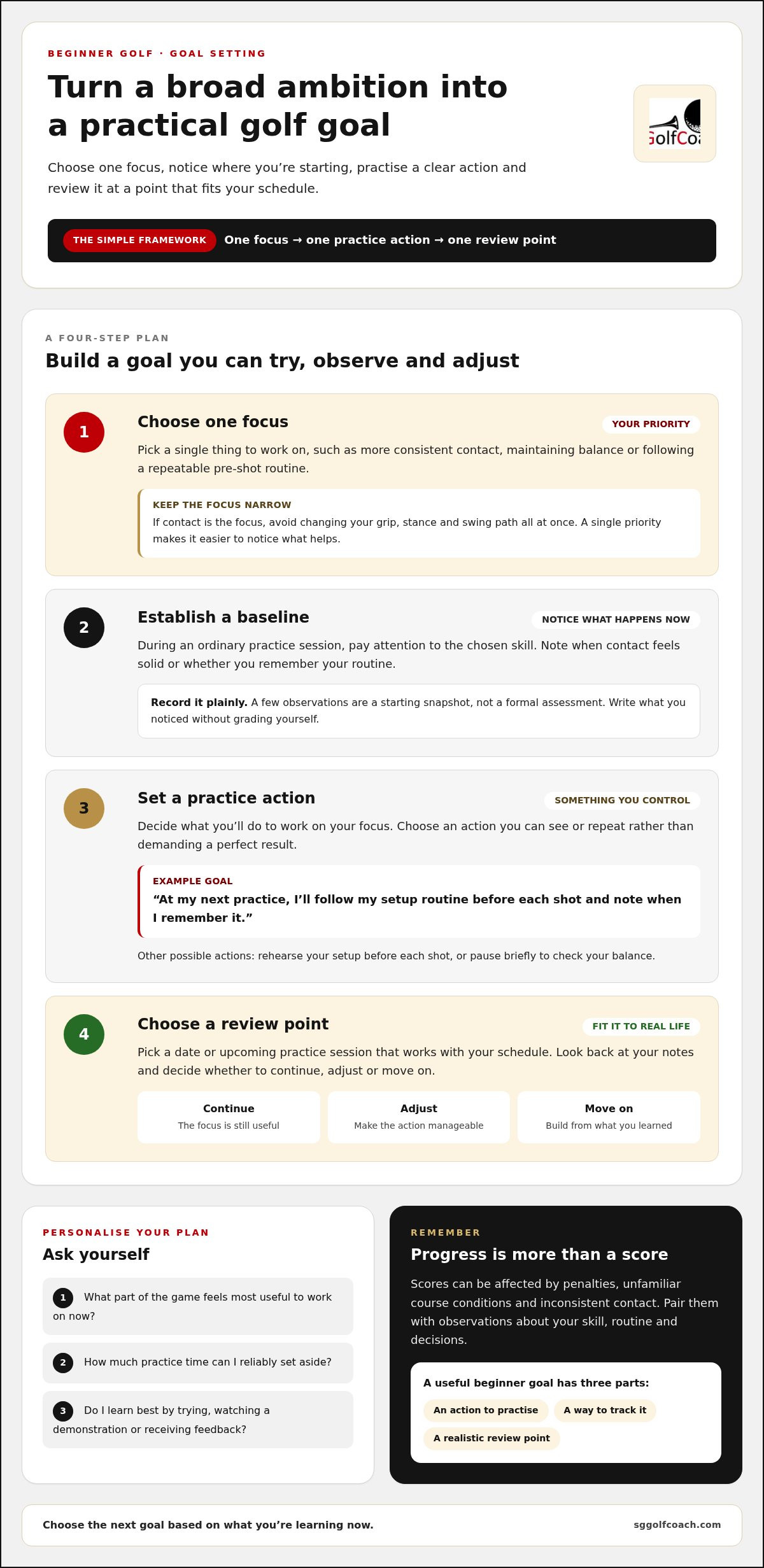
Turn a broad ambition into a simple plan you can try, observe and adjust. The best realistic golf goals for beginners reflect your current experience, the time you can make for practice and the way you prefer to learn. Use this sequence as a starting point, not a universal formula.
Choose one focus. Pick a single priority, such as making more consistent contact, maintaining balance or following a repeatable pre-shot routine.
Establish a baseline. During a normal practice session, notice what happens now. Record a few observations, such as when contact feels solid or whether you remember your routine. This is a starting snapshot, not a formal assessment.
Set a practice action. Decide what you’ll do to work on the focus. For example, rehearse your setup before each shot or pause briefly to check your balance.
Choose a review point. Pick a date or upcoming practice session that fits your schedule. Review your notes and decide whether to continue, adjust or move on.
Choose one starting point before adding more goals
Keep the first goal narrow. If contact is your focus, avoid trying to change your grip, stance and swing path at the same time. Otherwise, it becomes difficult to tell what helped. Establish a baseline with a few minutes of ordinary practice, paying attention to the chosen skill. Write down what you noticed in plain language, without grading yourself.
Make the goal specific and reviewable
“Get better” gives you no clear action to practise. Try: “At my next practice, I’ll follow my setup routine before each shot and note when I remember it.” Set the review point around the sessions you realistically expect to fit in. Your goal can evolve as your comfort and experience grow.
Personalise the plan by asking yourself three questions: What part of the game feels most useful to work on now? How much practice time can I reliably set aside? Do I learn best by trying a movement, watching a demonstration or receiving feedback? Your answers help make the goal relevant rather than borrowed from another golfer. Treat a sample goal as an illustration, then adjust the action and tracking method to suit your starting point.
A beginner’s goal is an action to practise, a method to track it and a review date that fits real life. If you’d value help choosing a focus or understanding what you notice during practice, tailored golf coaching can provide structured support. SgGolfCoach offers adult and junior lessons, including individual and group coaching, to help you work on your fundamentals and shape a practice focus around your needs.
Which beginner golf milestones matter beyond lowering your score?
A useful progress check looks beyond the final number on a scorecard. Skill, routine and course-management milestones can show what’s becoming more familiar, while scores offer a broader view of how those elements come together. Each measure has limits, so use them as complementary clues rather than a pass-or-fail test.
Look for patterns, not perfection. If you’re repeating the same avoidable mistake less often or recovering more calmly after a poor shot, that may signal learning even before your total changes. Record a brief note about what happened and the conditions you remember. The context will help when you look back, without turning each round into a judgement.
Skill and routine milestones you can control
Choose a milestone you can notice directly. You might record how often contact felt solid during a practice session or whether you used your comfortable setup routine before each shot. These observations can help you see consistency developing. They don’t guarantee a certain ball flight or score; the milestone is the deliberate action, not a promised result.
That distinction keeps realistic golf goals for beginners grounded in learning. If repeated errors become less frequent, note the change and consider what helped. Avoid making a fixed score or handicap the definition of success. Your next meaningful milestone depends on your experience and what you’re working on.
When scores and handicap become useful measures
Scores can become more informative when you record them across comparable rounds and note relevant context, such as course conditions or unfamiliar challenges. A single round can vary for reasons beyond your underlying skill, so look for a broader pattern rather than reading too much into one result.
A handicap can serve as a longer-term reference as you play and record rounds, but it isn’t an entry requirement for learning golf. If you’re exploring formal progression, SgGolfCoach’s PC & Handicap offering is a path to consider. Keep skill and routine observations alongside score records; together, they give you a more rounded picture of your development.
How to build a beginner golf practice plan you can maintain
A useful practice plan gives each session a purpose without demanding that golf take over your schedule. Choose a frequency that fits your real week, whether that means regular shorter visits or practice whenever you have a suitable window. Consistency matters more than designing an ambitious routine that quickly becomes difficult to keep.
Keep the structure simple: warm up, name one skill to focus on, practise it in manageable blocks, then pause to reflect. For example, a session might focus on balance. Begin with a few comfortable movements, practise shots while paying attention to your balance, and finish by noting when it felt steady. You don’t need to track every swing. One useful observation can give your next session a clear starting point.
Plan a focused practice session
Before you begin, state the focus in plain language, such as “keep my setup comfortable” or “notice when I make solid contact.” Divide practice into blocks that suit your attention and available time. Take a short pause or change activities if you lose focus. Finish with one note about what you noticed and one next step, such as keeping the same focus or making it simpler.
Choose a practice setting that fits the skill. A driving range can suit work on full-shot contact and noticing how your swing feels. Indoor screen golf offers another setting for practising shots in a simulated golf environment. Neither setting needs to define your whole routine. Choose the one that supports your goal and feels practical for that session.
Adjust the plan when progress feels slow
If improvement feels hard to spot, check whether your goal is clear and within your control. “Practise better” is difficult to act on; “pause to check my balance before each shot” gives you a behaviour to observe. Then consider whether you have too many competing priorities. Narrowing your focus can make practice more purposeful without adding sessions.
Fit practice around your life rather than measuring yourself against an ideal schedule. If a planned session doesn’t happen, resume when you can instead of treating the interruption as failure. A brief note after each session can help you see what you’re working on, even when the scorecard hasn’t changed.
Screen golf can also give you an indoor setting for purposeful practice. SgGolfCoach offers screen golf practice for golfers who want to include it in their routine. The right plan is one you can return to, adjust and enjoy. Build around realistic golf goals for beginners by choosing a manageable focus, a suitable practice setting and a brief reflection to guide what comes next.
How coaching can help beginners shape their next golf goal
Independent practice can take you a long way, especially when you know what you’re working on and how you’ll notice change. But it’s easy to feel stuck if you’re unsure which skill matters most or if several pieces of swing advice seem to compete. An instructor can help you focus on one manageable priority, observe what happens during practice and decide what to work on next.
That support is about making learning clearer, not promising a particular score or timeline. Progress depends on many factors, including your experience, practice and chosen goals. Coaching can help you build a more considered plan while you remain in charge of the pace and direction.
When professional feedback may be useful
Consider feedback if you leave practice unsure what to repeat, change several parts of your swing at once or find that your notes don’t point to a clear next step. An instructor can help distinguish a useful observation from a distracting detail and turn it into a focused practice priority.
For example, if you notice inconsistent contact, a coach can help you identify a suitable area to work on instead of adding several new swing cues. The aim is to leave with a clearer understanding of what to practise and what to observe. This can make realistic golf goals for beginners feel more personal and manageable, but lessons remain an option, not a requirement.
Choose a next step that fits your learning style
If your current goal feels clear and your practice routine is working for you, continue independently. Keep observing what happens and adjust your focus as your needs change. If you learn more comfortably with direct feedback, professional instruction is another way to build your fundamentals and make sense of what you notice.
Individual coaching can be tailored to your specific questions and priorities. Group instruction offers a shared learning environment, while adult and junior lessons can reflect the learner’s needs and experience. Neither format guarantees a score or a set pace of improvement; both can provide guidance as you develop your own approach.
SgGolfCoach provides professional instruction for adults and juniors, with individual and group coaching. Choose the format that feels encouraging and practical for you, and use coaching to shape a next goal around what you want to learn. Keep the focus on progress that suits the golfer you are today.
Let your next goal keep the game enjoyable
Your golf journey doesn’t need to follow anyone else’s pace. Let curiosity guide what you explore next, and allow your ambitions to grow as the game becomes more familiar. A goal can be worthwhile even if it doesn’t immediately change your score; it can help you feel more at ease, make a decision with greater confidence or simply enjoy returning to play.
Keep realistic golf goals for beginners personal, and give yourself permission to revise them. Some periods of learning may bring noticeable changes, while others are about keeping golf in your life and enjoying the challenge. Either way, each session can help you understand what makes the game rewarding for you.
Ready for guidance as you decide what to work on next? Explore professional golf coaching with SgGolfCoach and choose a next step shaped around your goals and enjoyment of the game. Stay patient, stay curious and enjoy the progress you make along the way.
Frequently Asked Questions
What is a realistic golf goal for a complete beginner?
A realistic golf goal for a complete beginner is to learn one useful part of playing, such as recognising basic etiquette or making comfortable contact with the ball. Choose something you can practise safely and notice for yourself. For example, aim to finish a practice session feeling familiar with your setup, rather than expecting every shot to travel straight. A small, relevant goal makes starting feel more manageable.
How long does it take a beginner golfer to improve?
There’s no fixed timeline for improvement because golfers begin with different experience, coordination, practice opportunities and learning preferences. You may notice one skill becoming more familiar while another still feels challenging. Rather than waiting for a particular date or score, look for changes you can describe, such as feeling more comfortable with a club or making a decision with less hesitation. Progress can be gradual and uneven.
Should beginners set a target golf score?
Beginners can set a score target, but it’s best treated as a longer-term reference rather than a test of whether you belong on the course. First, collect scores from rounds you’ve completed and notice what tends to add strokes, such as penalty shots or difficult holes. A score becomes more useful when viewed in context. Avoid comparing your early results with another golfer’s experience or expectations.
How often should a beginner practise golf?
Two or three focused practice sessions a week can be a useful starting point if that fits your schedule, but it isn’t a rule. A shorter, attentive session can be more worthwhile than planning a routine that competes with work, family or rest. If you can practise less often, choose a manageable focus and return to it when possible. Protect enjoyment and avoid treating missed sessions as failure.
Can a beginner improve at golf without playing full rounds?
Yes. Full rounds aren’t the only way to develop as a golfer. A beginner can work on contact at a practice area, spend time on putting or chipping, or use indoor screen golf to practise in a simulated setting. These activities help you develop familiarity without the demands of completing a course. Playing rounds can add experience later, but you don’t need to wait for them to begin learning.
What should I do if I stop improving at golf?
If progress feels stalled, step back and look for a specific source of difficulty rather than adding more practice or changing everything at once. Notice whether fatigue, uncertainty or a challenging skill is getting in the way. Simplify your focus and give yourself room to practise comfortably. If you’re still unsure what to work on, a golf instructor can offer another perspective and help you identify a suitable next step.


Comments