

Learn Golf with Confidence: A Beginner’s Roadmap for 2026

What if learning golf feels simpler once you know what to practise first? If you’re searching for “golf learn,” you may be unsure whether to begin with your grip, your swing or the rules. That uncertainty is normal. You don’t need to master every technique at once or spend hours practising to build a confident foundation.
A clear sequence helps you focus on the basics, make practice more purposeful and recognise progress without getting lost in technical detail. This guide explains what to learn first, how to shape a repeatable beginner routine and how to tell whether your practice is helping.
Supportive instruction can bring structure and useful feedback to your progress. One-to-one coaching, group classes and screen-golf experiences each offer a different way to learn and practise, so you can choose an approach that suits you as you build your skills.
Table of Contents
Learn Golf from the Ground Up: What Beginners Need First
You don’t need to master every club, shot and rule before you can enjoy golf. Build your skills in stages, giving each new idea time to feel familiar before adding another. A sound start is less about copying a perfect swing and more about learning to set up, make controlled contact and respond calmly when a shot doesn’t go as planned.
For a beginner, learning means developing repeatable fundamentals, making sensible choices and growing confidence through practice. A search for “golf learn” can bring up plenty of tips, but not every tip deserves your attention at once. Start with the basics. Later, goals such as lowering scores or working towards a handicap can shape what you practise. The history, rules, and basic play of golf can also help you understand how individual shots fit into the wider game.
Set priorities around what you want from golf. If you’re learning mainly to enjoy recreational play with others, feeling comfortable with basic shots and simple decisions may matter most. If you’re aiming to improve competitively, consistent practice and closer attention to performance can become more important over time. Neither approach requires you to rush.
What should a beginner learn first?
Begin with grip, posture, alignment and balance. These foundations help you prepare consistently, so you can focus on how the club meets the ball instead of changing several things at once. Reliable contact matters before distance: controlled shots give you a useful base for developing speed and exploring more complex swing mechanics later.
Putting and short-game skills belong in your learning plan, too. They help you manage shots close to the target, where a full swing isn’t needed. Give these areas regular attention rather than treating putting as an afterthought.
Setup: Practise holding the club comfortably and standing in a balanced posture.
Contact: Focus on making controlled, repeatable contact rather than hitting as far as possible.
Short game: Get familiar with putting and shorter shots around the green.
Set a realistic first goal for learning golf
Choose one goal you can observe during practice, such as finishing each swing in balance or making controlled contact with a short shot. Keep it small enough to focus on clearly. After a session, note what felt repeatable and what you want to work on next.
Beginner golf learning is the gradual practice of setup, contact, short-game skills and basic decisions to build confidence and consistency. This gives you a progress goal before a score goal. A score can be difficult to interpret while you’re still learning different shots; a balanced finish or more reliable contact offers a clearer measure of what you’re developing.
Let your first goal guide your next practice session, not define your entire ability. Once one foundation feels more familiar, choose another skill to build on it.
The Beginner Golf Learning Sequence: Build Skills in the Right Order
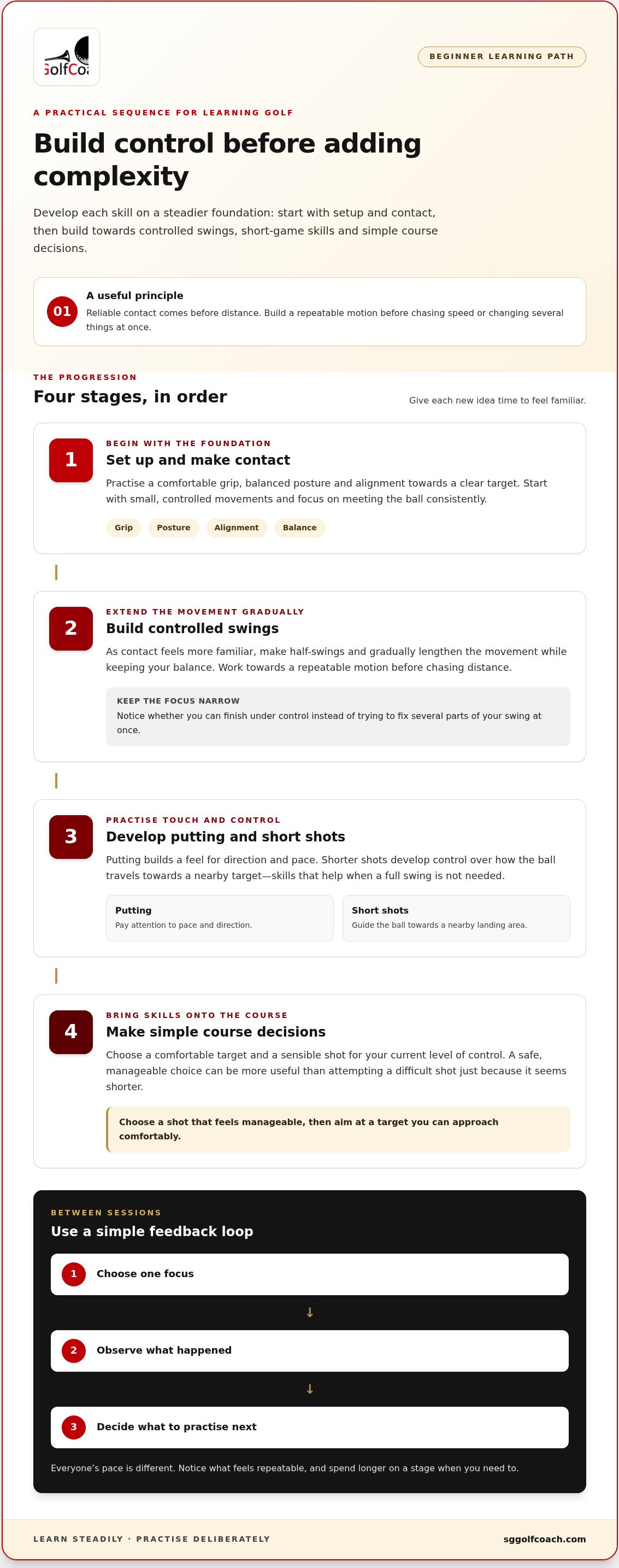
A useful sequence turns practice into a connected process: each skill gives you a steadier base for the next. For beginners searching “golf learn,” the aim isn’t to rush through a checklist or copy an advanced swing. Develop control gradually, notice what happens, then use that feedback to guide your next session. Everyone’s pace is different, and it’s fine to spend longer on one stage.
Set up and make contact. Practise a comfortable grip, balanced posture and alignment towards a clear target. Start with small, controlled movements and focus on meeting the ball consistently.
Build controlled swings. As contact becomes more familiar, make half-swings and gradually lengthen the movement while keeping your balance. Work towards a repeatable motion before chasing distance or changing several parts of your swing.
Develop putting and short shots. Putting builds a feel for direction and pace; shorter shots develop control over how the ball travels towards a nearby target. Both skills help you handle situations a full swing can’t solve.
Make simple course decisions. Practise choosing a comfortable target and a sensible shot for your current level of control. A safe, manageable choice can be more useful than attempting a difficult shot just because it seems shorter.
Start with setup, balance, and consistent contact
Think of setup as your preparation: hold the club securely without squeezing, stand in a posture that lets you move comfortably, and aim the clubface before you swing. Begin with a small half-swing, then check whether you stayed balanced and made controlled contact. As that feels more repeatable, lengthen the movement. Sound fundamentals should come before advanced swing changes because a stable starting point makes new adjustments easier to assess.
Keep your focus narrow. If you’re working on balance, notice whether you can finish under control instead of trying to fix your grip, swing path and distance at the same time. That makes each practice effort easier to understand.
Add putting, short game, and course awareness
Putting and short shots ask for different kinds of touch. On a putt, pay attention to pace and direction; on a short shot, notice how the club sends the ball towards a nearby landing area. Then bring that control into basic decisions: choose a target you can aim at comfortably and a shot that feels manageable. The official rules of golf can help you understand the framework as you begin playing.
Keep a simple feedback loop between sessions: choose one focus, observe what happened, and decide what to practise next. For example, if your half-swing felt balanced but contact varied, keep working on contact rather than adding a new swing thought. Progress isn’t always linear; you may need to revisit a stage as you develop.
When you’re ready to track formal progress, SgGolfCoach’s PC and handicap guide covers that next topic. If structured feedback would help you work through the stages, golf coaching and instruction can give your practice a more individual focus.
Learn Golf Your Way: Compare Solo Practice, Group Learning, and Coaching
If “golf learn” is your starting search, you’ll find several ways to build skill. The right format depends on what helps you stay focused: independent repetition, learning alongside others, individual feedback or an indoor setting. You can combine approaches, too. Solo practice can reinforce a clear focus, while coaching can help you notice habits that are difficult to identify on your own.
Use this comparison to consider how each format fits your learning preferences, rather than looking for one option that suits everyone.
When does independent practice work well?
Practising on your own can be useful when you have one specific focus, such as keeping your finish balanced or making controlled contact with a short shot. Repeat the same task, then jot down what felt consistent and what you want to revisit. Brief notes help you return with a purpose instead of changing several things at once.
There is a limit, though. Without another perspective, it can be harder to recognise a recurring technique issue, especially if a movement feels comfortable but keeps producing the same result. Feedback can help when you’re unsure what to adjust or find yourself repeating a problem.
What do coached and screen-golf sessions add?
One-to-one coaching offers personalised instruction and feedback focused on your learning needs. Group classes bring shared guidance and the chance to learn alongside other players. Screen golf offers an indoor experience for practice or social play. Each can complement independent work in a different way, depending on whether you value individual attention, a group setting or an indoor option.
If you’d like structured support, explore SgGolfCoach’s learning options to find an approach that fits your goals. For more detail on lesson formats and beginner instruction, see the beginner golf lessons guide.
Create a Beginner Golf Practice Plan You Can Sustain
A useful practice plan doesn’t need to be complicated or take over your week. It should help you arrive with a clear intention, stay focused while you practise and leave knowing what to work on next. If “golf learn” is your goal, a repeatable routine makes each session easier to review, even when progress feels gradual.
Use this four-part cycle as a guide, adjusting the amount of practice to your schedule and energy:
Choose one focus. Pick a single skill, such as balanced finishes, controlled contact or putting direction. Avoid trying to change several parts of your game at once.
Warm up. Start with comfortable movements and easier shots to settle into the session before concentrating on your chosen task.
Practise deliberately. Repeat a specific exercise, pausing for a short break when your attention or movement quality begins to slip.
Reflect. Record one success, one challenge and the focus you want to carry into your next session.
Focused repetitions make a session easier to review and adjust. You’re not simply hitting balls; you’re paying attention to one question, such as whether you can finish in balance or send a short putt along your intended line.
Use a repeatable structure for each practice session
Keep the routine familiar, but let the skill change as you develop. After warming up, stay with your chosen focus long enough to notice a pattern, then pause rather than continuing mechanically. For example, if you’re practising putting, pay attention to whether the ball starts in the direction you intended. End by writing down what felt steady and what you’d like to revisit, keeping the note brief enough to use next time.
Across a week, you might plan one session around full swings and another around putting or short shots, with rest or play in between as your schedule allows. Treat this as an adaptable example, not a formula for reaching a particular level. If you have time for one practice session, you can still include a few focused putts or short shots.
Measure progress without fixating on scores
Early practice is easier to evaluate through observable habits than through a scorecard. Note whether you stayed balanced, made controlled contact, aimed consistently or repeated a movement more comfortably. Compare those observations across sessions instead of drawing conclusions from one difficult day. A challenging practice can still be useful if it shows you what needs attention.
If your notes keep pointing to the same issue and you can’t identify a useful adjustment, instruction can offer a fresh perspective. Individual feedback can help bring structure to what you practise, while a tailored approach can keep the focus aligned with your needs. Explore golf coaching with SgGolfCoach to add guided feedback to your practice routine.
Turn Your Golf Learning Goals into a Supported Next Step
Once you have a practice rhythm, consider what would make your next stage more rewarding. Perhaps you want to feel more at ease with the fundamentals, learn in company, receive focused feedback or understand handicap development. There isn’t one right route for every player. The best next step matches your current goal and gives you a practical way to keep learning.
A useful golf learn plan can change as your priorities shift. You might start with foundational skills, then add shared practice or individual coaching as you discover what helps you stay engaged. SgGolfCoach provides instruction for adults and juniors, with options suited to different stages and learning preferences.
Match instruction to your current learning goal
If you’re new to golf, adult lessons or junior programmes can introduce foundational skills in a supportive learning environment. Group classes suit learners who enjoy practising alongside others, while one-to-one coaching offers individual instruction and feedback. For a more tailored approach to your development, bespoke coaching can focus learning around your needs.
Use your current goal to narrow the choice:
Build fundamentals: Start with instruction that helps you develop the basics and gives you a clear focus for practice.
Learn socially: Group classes bring a shared setting for learning and practising with others.
Work on individual priorities: One-to-one coaching or bespoke coaching can provide a more personal focus.
Explore formal progress: PC and handicap offerings can support learners interested in this aspect of golf.
These options can complement one another. A group setting might make learning more sociable, while individual coaching can help you focus on a particular question from your practice. You don’t need to choose a permanent route; pick the form of support that makes sense for your current stage.
Keep the learning journey personal and enjoyable
Progress isn’t only about technique or scores. Enjoyment, confidence and feeling comfortable with the game matter too. Screen golf provides an indoor option for practice or social play, making it another way to spend time with golf while developing your interest. Balance it with instruction and independent practice according to what keeps you motivated.
For adults and juniors alike, supportive instruction can help turn broad ambitions into manageable learning priorities. If you’re unsure what to work on next, describe the skill or experience you’re aiming for and use that goal to guide your choice of lesson, class or coaching format.
Choose one achievable next step, then explore SgGolfCoach’s coaching options to find a learning approach that fits your goals.
Take Your Next Step with Confidence
Your next step doesn’t need to be ambitious to matter. Choose one skill or experience you’d like to explore, then give yourself room to learn at a sustainable pace. A thoughtful golf learn journey can grow from a single question you bring to practice, with enjoyment and curiosity alongside your progress.
SgGolfCoach offers professional instruction for adults and juniors at different levels, with one-to-one coaching, group classes and bespoke coaching to suit different learning preferences. Screen-golf experiences offer an indoor setting for practice or social play, so learning can fit more than one mood or goal.
You don’t have to map out every stage before you begin. Start with the kind of support that feels right now, and let your next goal take shape as you gain experience. Explore SgGolfCoach’s coaching options and take your next step in golf.
Every confident player starts somewhere. Make your next step a simple one, and enjoy the game as you grow.
Frequently Asked Questions
Is golf difficult to learn as a complete beginner?
Golf has many skills to develop, but you can approach them progressively. If “golf learn” is what brought you here, start with a comfortable grip, setup, balance and basic contact rather than advanced swing mechanics. For example, make your first goal a balanced finish on a controlled swing. Once that feels familiar, choose another achievable focus. There’s no need to judge your progress against another player’s pace.
Can I learn golf without buying a full set of clubs?
Yes. You can begin learning basic movements without mastering every club in a full set. A small number of suitable clubs can give you a chance to practise different types of shots, then you can learn how each club is used as your experience grows. Focus on understanding the movement and purpose of each one, rather than feeling you need a complete bag before you start.
How often should a beginner practise golf?
Choose a rhythm you can maintain rather than an ambitious schedule that quickly becomes difficult. Short, focused sessions can be useful if you have limited time: pick one skill, practise with attention, then note what you noticed. Frequency depends on your availability, goals and how you respond to practice. If you feel tired or frustrated, pause and return with a clearer focus.
Can you learn golf at home without a driving range?
You can rehearse some fundamentals at home without hitting balls. In a clear, safe space, practise your posture, balance and a controlled movement without a ball. Make sure there’s plenty of room, and never swing near another person, windows or fragile objects. Home practice can help you become familiar with movement, but contact, distance control and decisions involving a course need practice in an appropriate golf setting.
When should a beginner work towards a golf handicap?
A handicap represents playing ability, but it doesn’t need to be your first goal as a new golfer. Start by becoming more comfortable with playing and learning how scores are recorded; then consider whether you’re ready to pursue registration. The process can involve specific requirements, so avoid guessing at the steps. For guidance on PC and handicap matters, see the PC and golf handicap guide.
Is group golf learning suitable for someone who has never played?
Yes, group learning can suit a complete beginner who enjoys a shared setting and gains confidence by practising alongside others. The amount of individual feedback and the pace may differ from one-to-one coaching, so think about how you prefer to learn. If you enjoy listening, observing and trying skills with a group, classes may feel engaging; if you want more individual attention, consider a different format.


Comments