

Preventing Common Golf Injuries With Safer Swing Technique

The swing that feels effortless can still place repeated demands on your body. Preventing common golf injuries starts with understanding how they happen: overuse, poor swing mechanics, limited mobility or strength, and skipping a warm-up can all contribute to strain. A more controlled technique, supported by preparation and fitness, can help you play with greater confidence.
It’s easy to focus on the ball and score, especially when you’re keen to practise. But sound movement matters too. This guide explains how golf injuries develop and how a purposeful warm-up, regular strength and flexibility work, gradual increases in play, and thoughtful swing adjustments can help reduce common risks. You’ll also learn which areas are often affected and why a swing that suits your body matters more than simply swinging harder. With a measured approach, you can build your game while giving your body the care it needs.
Table of Contents
1. Warm-ups and stretching
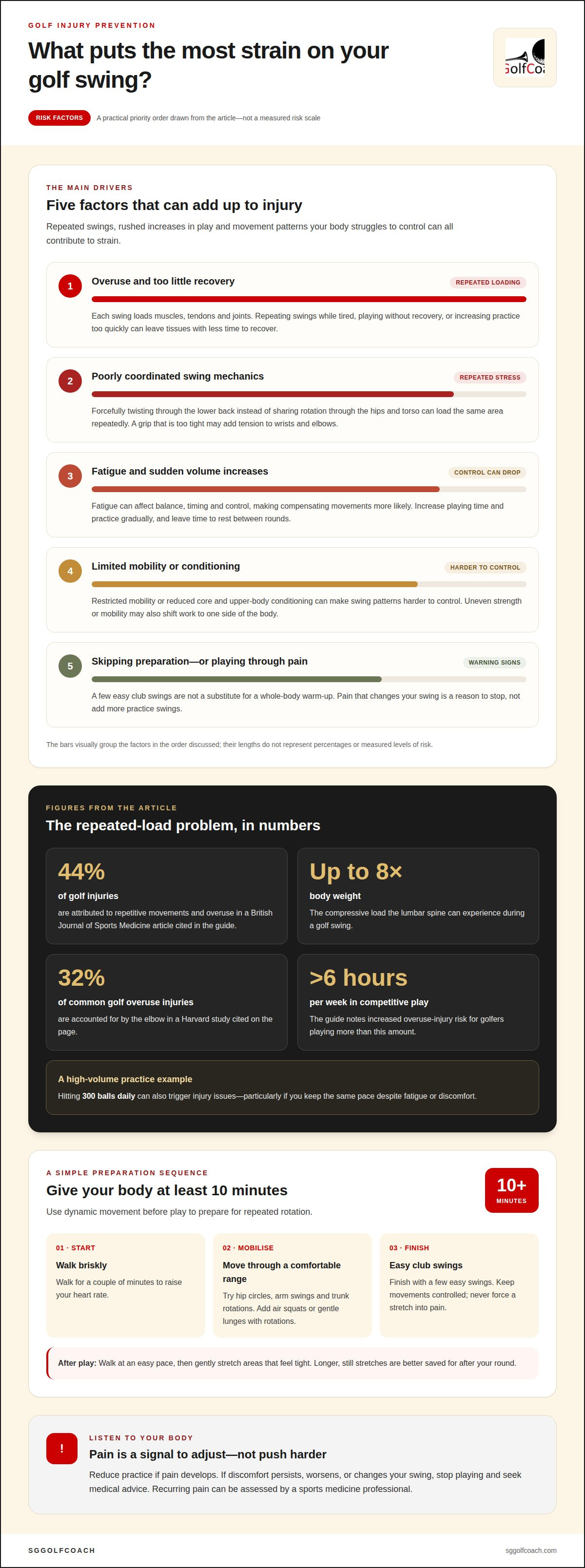
Begin with at least 10 minutes of warm-up before a round or practice session. A few easy club swings shouldn’t replace whole-body preparation. Start by walking briskly for a couple of minutes, then move through the shoulders, back, hips and legs. This raises your heart rate and prepares each muscle for the repeated rotation of a golf swing.
Before play, move your joints and muscles through a comfortable range of motion. Hip circles, arm swings and trunk rotations are simple options. Add air squats or gentle lunges with rotations to prepare your legs and torso, then finish with a few easy swings. Keep movements controlled, and never force a stretch into pain.
Walk briskly for a couple of minutes to raise your heart rate.
Make hip circles, arm swings and trunk rotations to mobilise your body.
Finish with a few easy golf-club swings before hitting balls.
Dynamic movement is a better fit for a warm-up than static stretching. Save longer, still stretches for after your round, when your body is no longer preparing for repeated swings. For a simple cool-down, walk at an easy pace, then gently stretch areas that feel tight, such as your shoulders, back, legs or arms. Move gradually rather than bouncing or pulling sharply.
Pay particular attention to preparing your shoulders, since the swing repeatedly moves your arms across and around your body. Controlled arm circles and cross-body movements can help prepare your shoulders’ range of motion. A thorough warm-up can also help stabilise your core and reduce the incidence of shoulder injuries. If your shoulder hurts during an easy practice swing or when lifting a club, don’t stretch further to push through the pain.
For preventing common golf injuries, make your warm-up consistent and suited to your mobility. If your hips feel stiff, add more gentle hip circles; if your upper back feels tight, include controlled trunk rotations. Don’t copy any movement that causes sharp pain. If discomfort persists, worsens or changes your swing, stop playing and seek medical advice. A sports medicine professional can assess recurring pain and guide a safe return to golf.
A useful routine should prepare the whole body, with dynamic movements and exercises suited to the individual golfer. Lunges with rotations, air squats and banded shoulder exercises are examples of resistance exercises that can be incorporated. Dynamic stretches such as hip and arm circles can increase blood flow to muscles and prepare golfers for play. After playing, gently stretch areas that feel particularly stiff, keeping the movement comfortable.
Finding time to prepare can be difficult, but a study of Victorian golfers found that less than three per cent warm up properly before playing, while nearly half do not warm up at all. A consistent routine suited to your needs can help you arrive at the first tee better prepared for the demands of play.
2. How do golf injuries happen?
Golf injuries often develop through overuse or poor swing mechanics. Repeating a motion when tired, increasing practice too quickly or swinging with limited mobility can place extra strain on your body. A sudden impact, such as being struck by a ball, can also cause an acute injury.
Overuse builds gradually. Each golf swing loads muscles, tendons and joints, and repeated practice gives those tissues less time to recover. According to a British Journal of Sports Medicine article, repetitive movements and overuse cause 44% of golf injuries. The lumbar spine can experience compressive loads of up to 8 times a golfer’s body weight during a swing, making repeated rotation and forceful movement demanding.
Practice habits matter. Golfers who play more than six hours per week in competitive play face increased risk of overuse injuries. Hitting 300 balls daily can also trigger injury issues, particularly when a player maintains the same pace despite fatigue or discomfort. Golfer’s elbow is one possible result of repeated strain around the elbow, while wrists, shoulders and the lower back can also be affected.
Increase the duration and frequency of play gradually, especially when returning after a break. Leave time to rest between rounds, and reduce practice if pain develops rather than adding swings to “work through” discomfort. Tendons need time to adapt to repeated demands, and recovery helps limit accumulated strain.
Poorly coordinated movement can make swing mechanics a source of extra stress. For example, forcefully twisting through your lower back instead of sharing rotation through your hips and torso may repeatedly load the same area. A grip that is too tight can also increase tension in your wrists and elbows. Restricted mobility or reduced core and upper-body conditioning can make these patterns harder to control.
Higher-handicap golfers may take more swings to complete a round, increasing their exposure to repeated movement. Fatigue can affect balance, timing and control, making compensating movements more likely. Uneven strength or mobility may also shift work to one side of the body; repeated practice swings can load the same hip, knee or ankle. Notice when your technique changes as you tire, and stop if pain alters your swing. Persistent or worsening pain needs medical assessment, not another practice session.
3. Common lower-back, shoulder, elbow, and wrist injuries
Lower-back, shoulder, elbow and wrist problems are common in golf because the swing repeatedly loads these areas. The elbow accounts for 32% of common golf overuse injuries in a Harvard study cited on the page. Golf-related tendon pain can affect either side of the elbow, while wrist discomfort can make gripping or controlling the club difficult. Symptoms during playing deserve attention, especially if they change your swing.
Repeated rotation or strain can lead to lower-back pain, while a shoulder injury can make lifting a club or reaching into a golf bag uncomfortable. For example, pulling a club from the bag may hurt more than swinging it. To help reduce the risk of back and shoulder injuries, use a controlled swing, build core and upper-body conditioning, and warm up before play. Stop if pain worsens during a swing.
Golfer’s elbow and lateral epicondylitis refer to tendon pain around the elbow. Golfer’s elbow commonly describes pain on the inner side; lateral epicondylitis affects the outer side. Repetitive gripping and swinging can aggravate either area. You may notice discomfort when gripping a club or repeating a motion, but pain alone doesn’t establish the cause. An assessment can distinguish tendon irritation from other problems.
Wrist and hand discomfort can also affect your ability to maintain a firm, controlled grip. Squeezing the club tightly may add stress to your wrists and elbows, so hold it securely without gripping too hard. For elbow discomfort, resting from painful activity, gentle stretching, icing after a round and using a brace are approaches used to protect the area. Persistent symptoms need more than a grip adjustment or another practice session.
Stop playing if pain affects your swing, keeps returning or persists beyond a day or two. An ache that doesn’t settle quickly with rest and ice also warrants medical evaluation. Persistent lower-back pain needs assessment, since arthritis, spinal disc issues or spinal stress fractures can be involved. Don’t keep repeating the movement in the hope that it will feel better.
After an injury, protect the affected area and avoid activities that cause pain while it heals. For a minor injury, apply ice for no longer than 20 minutes at a time; icing can be repeated as often as every 2 hours. Don’t return to sport until you’ve completely recovered and received clearance from a health care professional. Resume gradually, rather than immediately returning to a demanding round or practice routine.
4. Fitness, strength and flexibility
A balanced golf fitness routine develops strength, mobility, flexibility and balance. Focus on your core, hips and back, which help stabilise your swing and manage repeated rotation. Regular exercise also prepares your body for walking the course, while gradual increases in activity give tendons time to adapt. Build these elements into your routine rather than relying on one exercise to do everything.
Start with controlled trunk and balance movements. For supine trunk rotations, lie on your back with knees bent, then lower them gently to one side. Hold for 3 seconds, return to centre, and repeat 5 times on each side. For a side plank, keep your body aligned and hold for 30 seconds; complete 3 repetitions on each side. These exercises train trunk control without adding golf swings.
Bird dogs add coordination to core work. From hands and knees, extend one arm and the opposite leg, then return with control. Repeat 5 times on each side, keeping your torso steady instead of twisting. Stop the movement if you can’t maintain a comfortable position. Combine this with flexibility and balance training, so strength doesn’t come at the expense of controlled movement.
A rowing-style exercise can also support lower-back care. Secure an elastic band around a stable object, hold both ends and pull them back and forth in a rowing motion. Keep the movement smooth and avoid jerking the band. Strengthening your back, hips and core can support a stable swing, while walking is a practical way to build general fitness for golf. If you stay active through daily walks with a family pet, resources like Canine Longevity Academy offer vet-led guidance to support senior dog mobility and long-term health. Increase playing time gradually, allowing recovery between demanding sessions.
Forearm strength supports the repeated gripping and wrist action involved in golf. Squeeze and release a tennis-sized ball for about 5 minutes to exercise the forearm muscles. For an elastic-band hand curl, wrap a band around the fingers and palm, then open the hand against its resistance. Complete 10 repetitions per set, for 3 sets, 3 or 4 times a week.
Wrist flexion and extension can complement that work. Rest your forearm on a surface, move your hand upward for 2 seconds, then lower it for 4 seconds. Repeat 10 times on each wrist for each movement. Keep the motion measured rather than forcing extra range. If an exercise brings on pain, stop and seek appropriate treatment advice before continuing. A consistent programme that combines these movements with rest can help reduce the strain associated with overuse injuries.
5. Golf technique and injury prevention
Technique matters because a golf swing repeats a coordinated movement under load. Practise finishing in balance: rotate through your hips and torso, keep your grip firm but relaxed, and don’t force extra speed. If you lose balance or struggle to control the club, reduce your effort and reset before the next swing. Efficient movement is more useful than repeating a strained motion.
Beginners benefit from learning controlled movement before increasing their practice volume. Older golfers can include resistance, flexibility and balance training to support their ability to play. If you have an existing condition, the safest activity depends on your symptoms and movement limits; discuss training changes with a doctor or sports medicine professional before increasing activity. No single swing pattern or exercise suits every body.
Practical safety habits help prevent avoidable impact injuries on a Singapore golf course. Stay aware of nearby players before swinging, and don’t take a practice swing where you could hit another golfer. Before playing, check that people are clear of your intended shot. In a golf cart, keep your hands and feet inside. These steps protect others as well as you.
Equipment can support comfort, but it can’t replace sound technique. A push cart reduces the need to carry your golf bag. Choose footwear that fits securely and feels comfortable when walking, so discomfort doesn’t distract you from balance and movement. Keep your club under control during practice swings and leave enough space between yourself and others. If equipment changes how you stand or swing, pause and reassess rather than forcing the movement.
Make practice purposeful. Choose one movement to refine, such as a balanced finish, and repeat it at a controlled pace before adding more force. A golf instructor can help identify a grip or swing habit that places unnecessary strain on your body. For tailored guidance, work on safer swing technique through professional golf coaching.
Practise with a bucket of balls and work on your technique before a round. Focus on sound mechanics and slow your swing; a slower swing can help prevent injury. Improving your swing technique can help prevent golfer’s elbow and lateral epicondylitis. A golf instructor can help you develop proper technique and refine your swing mechanics. Keep practice focused on sound movement rather than trying to swing faster.
The direction of weight shift matters during repeated practice swings. For right-handed golfers, repeated swings shift weight to the left and may intensify pain in the left hip, knee or ankle; the reverse applies to left-handed golfers. Work on your swing mechanics to help avoid injury, keeping proper technique in mind as you practise. A golf instructor can help you refine these mechanics. Practising with a bucket of balls before a round gives you a chance to work on technique, while slower swings can help reduce injury risk.
SgGolfCoach: Screen Golf Booking
SgGolfCoach offers Screen Golf Booking for golfers who want an indoor setting to practise and develop their swing. If repeated practice brings discomfort, pause and address the cause rather than trying to play through pain. Adult Lessons can help players refine their movement, while Junior Programs support younger golfers as they learn. PC & Handicap is also available for players working on their playing records.
Screen practice and coaching can complement warm-ups, fitness work and recovery, but they don’t replace medical care for an injury. If pain persists or affects everyday movement, seek medical advice before returning to golf. To discuss a suitable next step for your game, contact SgGolfCoach.
Build a more confident game
Progress in golf isn’t measured only by distance or a lower score. It also comes from developing a repeatable movement pattern that feels controlled and suits your body. A thoughtful approach to preventing common golf injuries can become part of your practice, helping you focus on steady improvement rather than forcing quick changes.
Choose one area to work on next, such as a smoother tempo or a balanced finish. Focus on that skill during practice, then notice how it feels as you play. If pain persists or affects your movement, pause and seek appropriate medical advice before returning to golf.
For guidance that supports your next step, contact SgGolfCoach for guidance. Keep building your game with patience, precision and enjoyment.
Frequently Asked Questions
How do golf injuries happen?
Golf injuries can develop gradually from repeated swings or occur suddenly after an impact or awkward movement. For example, elbow soreness that builds during repeated practice may reflect accumulated strain, while being struck by a ball can cause an acute injury. Fatigue can also change your movement and place more demand on one area. Notice whether discomfort starts during play, afterwards or after you increase your practice.
How can golfers warm up and stretch to prevent injuries?
Prepare for play with easy movements that gradually involve your whole body. After walking to the practice area, try controlled trunk turns and arm swings, then rehearse your golf motion at an easy pace before swinging with full effort. Avoid forcing a stretch or continuing through pain. After play, an easy walk and gentle stretches for tight areas can help you transition from activity to rest.
What strength and mobility exercises help prevent golf injuries?
Exercises that train balance, trunk control and shoulder movement can complement golf practice. Try a bird dog by extending one arm and the opposite leg while keeping your back steady, or use a light resistance band for controlled shoulder movements. Focus on smooth form, not maximum effort. If an exercise causes pain or makes your movement unstable, stop and seek suitable professional guidance before continuing.
How can golfers improve swing technique to reduce injury risk?
Work on a repeatable swing at a comfortable pace before adding speed. Try a few controlled half-swings and check that you can finish in balance, without forcing rotation or squeezing the club. A golf instructor can help identify movement patterns that place unnecessary strain on your body. If pain changes your swing, stop rather than practising around the discomfort.
How can golfers prevent wrist, elbow, and hand injuries?
Use a secure, relaxed grip, and avoid squeezing the club harder as you tire. During practice, break up repeated swings with recovery time, and reduce the volume if wrist or elbow discomfort appears. Pay attention to tasks beyond golf, too: gripping a heavy bag can continue to strain a sore forearm. If pain persists, keeps returning or affects daily activities, seek medical evaluation rather than relying on self-treatment alone.



Comments