

Parent-Child Golf Clinic: Learn, Play and Grow Together in 2026

What if a golf session didn’t ask a parent and child to play at the same level, but helped each find a pace that makes the game enjoyable? It’s natural to wonder whether one person’s experience might take over, or whether coaching could feel too technical for a young beginner. A well-planned parent-child golf clinic makes room for different abilities while giving families a shared way to learn, play and grow.
The best family sessions balance time together with individual goals. A coach can guide each participant at an appropriate level, using clear, encouraging instruction so children can build confidence while adults work on their own skills. In this guide, you’ll learn what to expect from a first session, how to prepare without adding pressure, and how to keep practising together afterwards. You’ll also find ways tailored adult and junior lessons, group classes and indoor screen-golf experiences can support continued learning, whether your family is just starting out or already has golf experience.
Table of Contents
What makes a parent-child golf clinic a rewarding shared experience?
A parent-child golf clinic is a shared learning experience, not a test of who can hit the straighter shot or remember the most technique. A coach can introduce a skill to everyone, then adapt the guidance to each person’s experience and goals. A beginner might focus on making comfortable contact while a more experienced player works on a specific adjustment. That keeps the activity shared without turning it into a comparison.
Taking part together gives practice a social rhythm: listen, try, take turns, and notice what each person is learning. Families might share a simple challenge, such as aiming towards a target, while celebrating effort as well as a successful shot. Enjoyment and progress can sit side by side, but neither needs to depend on the other. A family can value an enjoyable session and still set individual performance goals for later.
Golf also offers plenty to explore beyond technique. If the game’s background sparks conversation, families can browse a general overview of the history of golf together. Curiosity can make the activity more engaging, especially for a child who wants to know why different shots or clubs are used.
How shared golf can make learning more enjoyable
Small, low-pressure challenges keep everyone involved without requiring matching skill levels. For example, each person could take a turn aiming at the same target, then share one thing they noticed about their swing. The point isn’t to rank the results. It’s to give both participants a reason to pay attention, try again, and encourage each other. A coach can keep the activity consistent while offering different cues to each learner.
A shared activity can also become a simple routine after the clinic. Families might revisit the same challenge during a future practice session, or take turns choosing what to work on. Keep the goal modest and adaptable: some days may be about practising a skill, while others are simply about enjoying time together. A welcoming format can make it easier to keep practising, even when progress varies from session to session.
Who might enjoy learning golf together?
Families don’t need to arrive with equal experience. A child who’s never held a club can learn alongside a parent, caregiver, or another family member who already plays. The more experienced participant can still benefit from coaching, while the beginner gets space to explore the basics without being expected to catch up immediately.
The right starting point is interest, not polished technique. Before a session, agree that each person can learn at their own pace and that mistakes are part of trying something new. A caregiver who’s new to golf may be learning beside a child, while a more experienced adult can practise listening and encouraging rather than taking over. Shared participation leaves room for different personalities, abilities, and ambitions, with a willingness to learn together as common ground.
How should a parent-child golf clinic balance instruction and play?
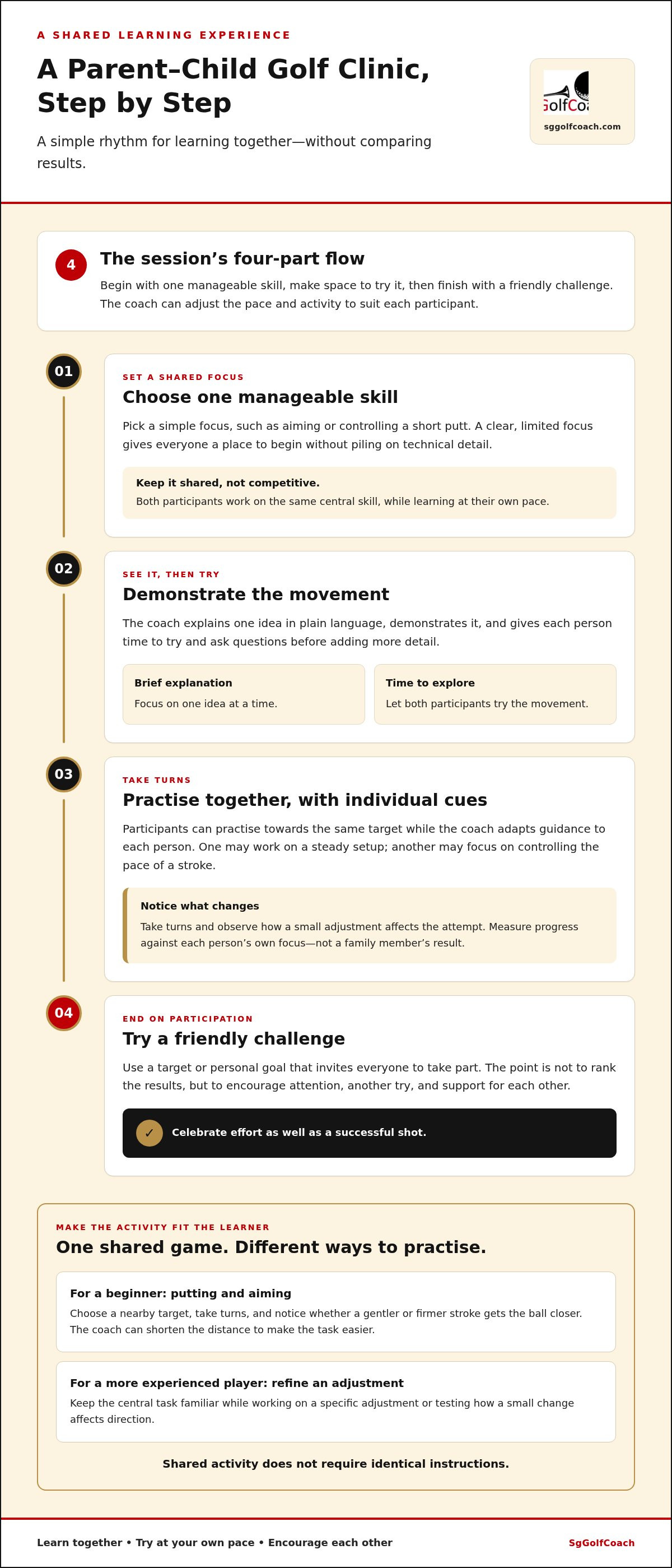
A well-balanced parent-child golf clinic gives families enough structure to learn, with enough room to enjoy the activity rather than feel tested. A useful format moves from a brief welcome to one simple skill, then into shared practice and a friendly challenge. The instructor can adjust the pace and activity to suit the participants.
Each stage has a clear purpose. The welcome helps everyone settle in and understand the focus. The coach then explains one idea in plain language, demonstrates it, and lets each person try before adding more detail. For instance, if the skill is aiming, participants might practise setting up towards a target, then take turns trying it. Keep explanations brief: seeing and trying a movement is often easier to follow than hearing several technical points at once.
Start with a shared focus. Choose one manageable skill, such as aiming or controlling a short putt.
Demonstrate, then try. Let both participants practise the same movement, with time to ask questions.
Practise together. Take turns and notice what changes when each person adjusts their approach.
Finish with a friendly challenge. Use a target or personal goal that keeps the emphasis on participation rather than comparison.
What beginner-friendly golf activities can teach
Putting offers a simple way to explore aim, pace and routine without asking beginners to manage a full swing. A family could choose a nearby target, take turns, and notice whether a gentler or firmer stroke gets the ball closer. A coach can make the task easier by shortening the distance, or add a challenge by changing the target. The goal is purposeful practice, not complicated rules.
Short-distance practice and basic aiming games work in a similar way. One participant might focus on a comfortable setup, while another tests how a small adjustment affects direction. A good progression keeps the central task familiar while changing its difficulty, so a new golfer can take part and a more experienced player still has something to refine.
How coaching can support different abilities in one session
One shared activity doesn’t require identical instructions. While both players practise towards a target, the coach might cue one to steady their setup and another to control the pace of the stroke. Each can also have a personal target: make a comfortable attempt, or focus on repeating a useful movement. This way, progress is measured against each person’s own focus, not a family member’s result.
An experienced parent can support a beginner by taking a turn, listening to the coach, and leaving technical corrections to the instructor. Praise the effort or adjustment, such as trying a softer stroke, rather than commenting only on whether the ball reached the target. For ongoing adult and junior guidance, SgGolfCoach’s golf coaching offers tailored lessons and group classes to help players develop their skills.
How do you choose a parent-child golf clinic that suits both of you?
Start with the experience your family wants. Is the priority learning side by side, developing separate skills, or enjoying the motivation of a group? A suitable parent-child golf clinic should fit that aim while making space for the child’s attention span and each participant’s experience. Look for a format that combines time together with meaningful feedback, rather than making one person’s progress the measure of success.
Use this comparison to clarify which learning style feels like the best fit:
Shared session or separate lessons: what fits your family?
A shared session suits families who want a common activity and the chance to practise together. Separate adult and junior coaching can be a better match when each person has distinct development goals or benefits from a different pace. Group classes offer another route: participants learn with others, while family members can still share an interest in golf beyond the lesson. These formats serve different priorities; one isn’t automatically better for every household.
Before choosing, consider whether the learning plan leaves room for individual feedback as well as shared practice. A child may benefit from concise instructions and variety, while an adult may want to focus on a particular part of their game. A useful format respects both needs instead of asking one participant to wait through instruction that isn’t relevant to them.
What to do when parent and child have different skill levels
Skill differences needn’t dictate the whole experience. Look for coaching that can scale one activity up or down, such as changing the distance to a target or setting distinct personal goals. This lets family members work on the same theme without being expected to produce the same result. Also consider whether the pace can keep a child engaged while giving an experienced player a meaningful challenge.
A more experienced parent can participate as a learner, not become the child’s sole instructor. Let the coach guide technique; the parent can encourage, take a turn, and keep the session relaxed. For broader guidance on supporting a child’s development, explore the junior golf program guide.
How can parents and children prepare for their first golf session?
A little preparation can help a first golf session feel more relaxed and rewarding. Before attending a parent-child golf clinic, talk about what each person hopes to get from the experience. Keep the shared goal simple, such as learning a new skill or enjoying time practising together. Each participant can also have a personal aim, so the family shares an activity without needing to learn at the same pace.
Use a short sequence to set everyone up for a positive start:
Choose a shared goal. Agree on one thing you’d both enjoy, such as trying a new skill or taking part in practice together.
Set expectations. Remind your child that trying and learning matter more than scoring or hitting perfect shots.
Share useful context. Tell the instructor about each person’s golf experience and any learning preferences, such as benefiting from demonstrations or brief instructions.
Arrive ready to listen. Give the coach room to explain and demonstrate. During coached activities, let the instructor lead technical feedback rather than correcting one another.
Reflect afterward. Talk about what felt enjoyable, what became easier, and what you might like to practise next.
Set expectations before the session begins
Children can feel pressure if they think success means hitting every shot well. Set a more welcoming standard: a good session can include curious questions, patient turns, and a willingness to try again. Parents can share their own learning aim, too. For example, one person might focus on understanding a new movement while the other practises staying relaxed. These goals allow both learners to take part without comparing results.
It’s also useful to explain that a coach may offer different guidance to each participant, even during the same activity. Let the instructor know what each person has tried before and what helps them learn. That context can make the lesson more relevant without requiring anyone to arrive with polished technique. Families looking for a step-by-step introduction can also explore this beginner golf lessons guide.
Keep the experience positive after practice
Make the conversation afterward light and specific. Ask, “What part did you enjoy?” or “What felt easier by the end?” These questions help each person notice their experience without turning the journey home into a score review. Recognise patience, focus, and effort, especially when someone tries an unfamiliar instruction or stays engaged through a challenging moment.
Then choose one manageable idea to revisit together before adding another goal. It might be a movement the coach demonstrated or a simple practice focus that both family members understand. Keep it flexible: if one person wants more repetition and the other is ready to move on, take turns choosing the focus. For ongoing adult and junior instruction, explore SgGolfCoach lessons and build on what your family discovered in the session.
How can SgGolfCoach support your family’s golf journey?
A shared clinic can be a starting point, not a requirement that every family member follows the same learning path. SgGolfCoach provides professional instruction for adults and juniors, giving each player room to work on personal goals while keeping golf as a shared interest. One family member might be learning the basics while another wants to refine a particular part of their game. Their next steps can differ and still support time spent practising together.
After a parent-child golf clinic, consider what each person found most engaging. Did you enjoy developing a skill side by side, or would separate coaching help you focus on different goals? Your answer can guide whether to continue with tailored lessons, group classes, or a mix of learning experiences.
Continue learning with coaching that fits each player
Tailored adult and junior lessons give each participant instruction suited to their development goals. That doesn’t mean learning has to become a solo pursuit. Family members can compare what they’re practising, share a simple challenge, or talk about a useful coaching cue afterward, while allowing each person to progress at a comfortable pace.
Group classes offer a different setting, where golfers learn alongside others. They can suit a player who enjoys practising with peers, while individual lessons provide a more personal focus. Families can choose the approach that feels useful for each learner rather than expecting one format to suit everyone.
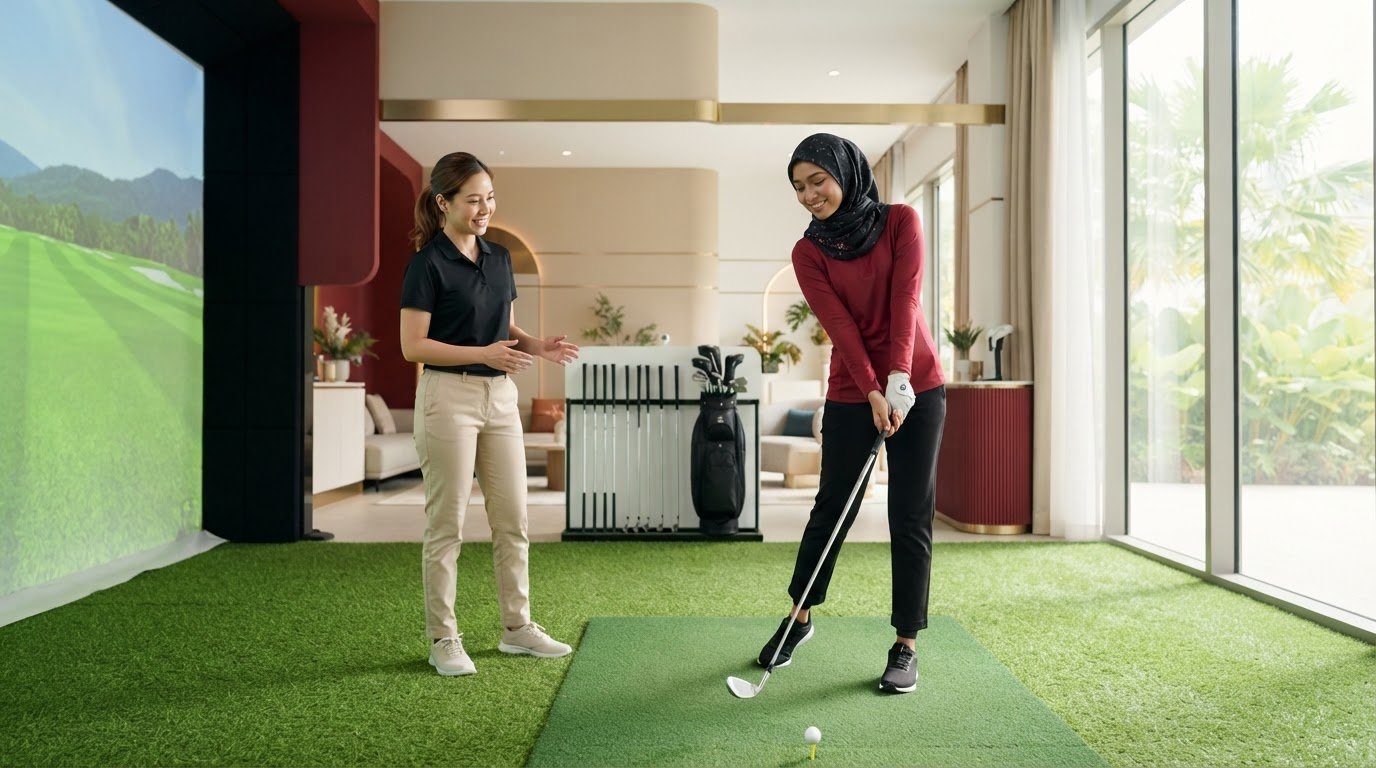
Indoor screen-golf experiences provide another setting for practice and social play. They can add variety to a family’s golf routine, particularly when participants want to play indoors. Treat this as an additional pathway, alongside coaching that fits each player’s needs.
Make the next step simple
Decide what matters most right now. If your priority is developing individual skills, adult and junior instruction can help each participant focus on a personal goal. If learning alongside others sounds more motivating, consider group classes. You can also keep your shared interest active by choosing a practice idea to revisit together between lessons.
Keep the decision practical. Each family member can name one thing they want to learn, then choose a coaching path that supports those aims. The parent doesn’t need to match the child’s pace, and the child doesn’t need to follow the adult’s priorities. Progress can be personal, with shared enjoyment providing a reason to keep golf part of family life.
When you’re ready to continue, explore golf coaching with SgGolfCoach and book online. Choose adult or junior instruction, tailored lessons, group classes, or an indoor screen-golf experience to suit each player’s goals.
Make your next golf moment a shared one
The value of a parent-child golf clinic doesn’t end with the final putt. It can give your family a starting point for a simple routine: choose one thing to practise, take turns, and notice what each of you discovers. Keep the focus flexible. Some sessions may bring a new skill; others may simply offer an enjoyable way to spend time together.
As your interests develop, let your next step reflect what feels motivating now. Perhaps one of you is ready to build confidence, while the other wants to refine a skill. Progress doesn’t have to look identical to be shared. A supportive coach can help each family member pursue a personal goal while keeping golf a common thread.
Whenever you’re ready to keep learning, explore golf coaching with SgGolfCoach and book online. Start with curiosity, celebrate each person’s effort, and give your family room to grow into the game together.
Frequently Asked Questions
Is a parent-child golf clinic only for fathers and sons?
No. A parent-child golf clinic is about an adult and child sharing a golf experience, not a specific family arrangement or gender pairing. A mother, father, caregiver, or another participating adult may take part with a child. What matters most is being ready to join in, offer encouragement, and let each learner find a comfortable pace.
Can grandparents join a parent-child golf clinic?
Grandparents can share golf activities with children, too. If you’re attending a clinic, follow its stated participation format. A grandparent can help a child feel at ease by joining activities and allowing the instructor to lead technical guidance. A relaxed, curious attitude can make the experience enjoyable across generations.
How long should a child practise golf between family sessions?
There’s no single practice duration that suits every child. Let their interest and energy guide the session: for example, practise putting towards a target, then stop when attention begins to fade. A clear endpoint can help practice feel manageable rather than like a test. If a child asks to continue, you can extend the activity; if not, leave room for another day.
What should a parent do if a child gets frustrated during golf practice?
Pause and respond to the frustration before deciding whether to continue. Acknowledge what feels difficult, then offer a reset, such as a drink of water, a brief break, or a simpler version of the activity. Avoid adding several corrections at once. If frustration continues, it’s fine to end that drill and return to it another time; practice doesn’t need to finish with a perfect result.
Does a parent need golf experience before joining a clinic with a child?
No. A parent can join as a beginner, ask the instructor to clarify unfamiliar terms, and focus on their own attempts rather than trying to teach the child. If you’ve played before, model being open to feedback by practising the coach’s suggestion yourself. This helps keep the adult’s role supportive and leaves technical instruction with the person leading the session.
Can parents and children keep practising golf indoors?
Yes. Indoor screen-golf experiences offer families another setting for practice or social play. To keep both people involved, choose a shared focus, such as taking turns on a target-based activity, and agree on what each person wants to work on. Keep expectations centred on participation and choose activities that suit both players.
What if the parent and child have completely different golf goals?
Different goals can fit within a shared golf routine. Before you play, name one reason to take part together, such as spending time practising, then give each person a separate focus. A parent might work on a repeatable setup while a child explores a new movement. Afterwards, ask what each person wants to keep practising. This lets you plan the next session without forcing identical progress.


Comments