

Golf PC Test Singapore: 2026 Practical Guide

Passing the golf PC test isn’t about hitting perfect shots. It’s about showing that you can play safely, understand essential etiquette and rules, and manage yourself on the course. If you’re unsure whether the test is mainly practical or theory-based, or how it differs from a Handicap Index, start by checking the requirements for the assessment pathway you plan to follow. Formats can vary between organisers.
This guide explains what the Singapore Proficiency Certificate (PC) is designed to assess and how it differs from a Handicap Index, which measures playing potential for competition. You’ll find a practical preparation plan covering playing skills, rules knowledge, safety and course etiquette. The aim is to help you prepare for the requirements that apply to your assessment, not assume every test follows the same format.
We’ll also cover sensible next steps after passing. Focused practice and tailored coaching can help you work on specific skills and feel more prepared. Keep the goal in perspective: demonstrating safe, independent play, not flawless golf.
Table of Contents
What Is the Golf PC Test in Singapore, and What Does Passing Mean?
A Proficiency Certificate (PC) recognises that a golfer has demonstrated readiness to play independently under the relevant assessment pathway. Passing the golf PC test shows basic playing competence. It doesn’t mean every shot will be accurate or that every course will grant the same access. The purpose is to establish a foundation for safe, considerate participation.
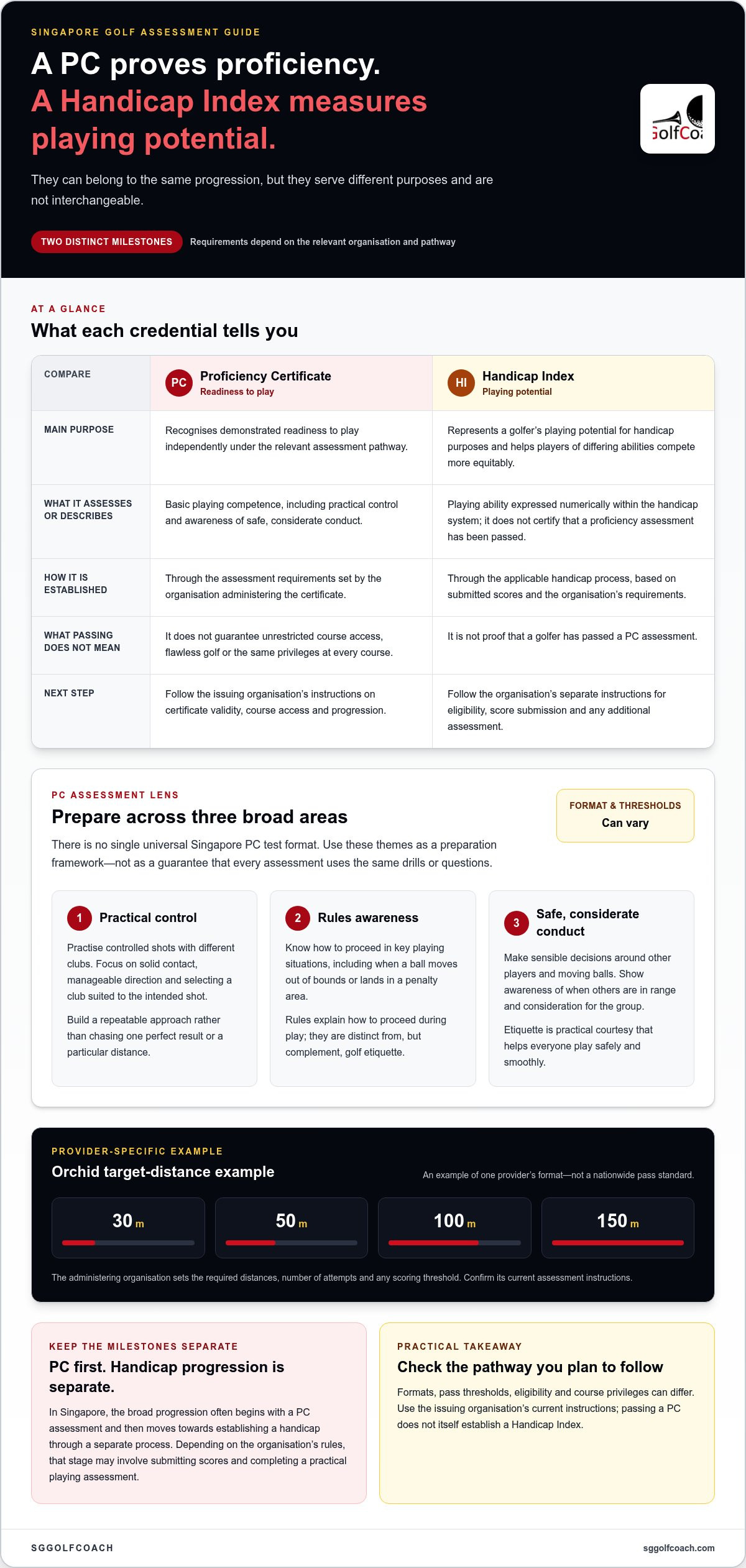
A PC recognises basic readiness to play under a particular pathway; a Handicap Index represents a golfer’s playing potential for handicap purposes. These credentials may form part of the same progression, but they aren’t interchangeable. A PC relates to proficiency or access, while a Handicap Index is based on submitted scores and supports fair competition.
How Does a PC Differ from a Golf Handicap?
The PC focuses on whether you can demonstrate essential competence, including practical control and awareness of how to behave safely around other players. A Handicap Index, by contrast, describes playing ability numerically within the handicap system. It helps players of differing abilities compete more equitably; it doesn’t certify that someone has passed a proficiency assessment.
The privileges attached to a PC and the steps for establishing a handicap depend on the relevant golf organisation and pathway. Don’t assume that a certificate automatically provides unrestricted course access or creates a Handicap Index.
Why Is the PC Test Part of a Golfer’s Progression?
Golf is played around other people, moving balls and shared course space. Basic competence matters because players need to make sensible decisions, follow safety practices and show consideration for the group. Familiarity with the rules and etiquette of golf helps you make those decisions with confidence, alongside the practical skills covered by the relevant PC pathway.
An assessment gives you a structured opportunity to demonstrate that foundation. Practical ability matters, but so does knowing when others are in range, following basic playing conventions and considering the group’s experience. Since formats and pass thresholds aren’t universal, use the issuing organisation’s current instructions to understand what its assessment requires.
In Singapore, the broad progression often begins with a PC assessment and then moves towards establishing a handicap through a separate process. That next stage may involve submitting scores and completing a practical playing assessment, depending on the applicable organisation’s rules. Treat these as distinct milestones: passing the PC doesn’t itself establish a Handicap Index. Requirements, eligibility and course privileges may differ between pathways, so refer to the organisation administering your certificate for the current steps. The Singapore PC and golf handicap guide provides broader context on how the two fit together.
PC assessment: Demonstrate proficiency under the relevant pathway.
Handicap progression: Follow the organisation’s separate instructions for eligibility, score submission and any additional assessment.
Keeping these stages separate makes preparation more focused. Work towards the PC’s practical and knowledge expectations first, then plan your next step around the requirements for your pathway.
What Skills and Knowledge Does the Singapore Golf PC Test Assess?
There isn’t one universal Singapore PC test format. The administering organisation sets the components, assessment conditions and pass thresholds, so use its current instructions as your guide. You can still prepare around three broad areas: practical control, basic rules knowledge, and safe, considerate conduct. The exact assessment may differ.
Readiness means more than hitting a good shot. An assessor may want to see that you can make controlled swings, understand key playing situations and behave responsibly around other golfers. Use these themes as a practice framework, but don’t assume every test uses the same drills or theory questions.
Practical Golf Skills: Build Repeatable Contact and Distance Control
Practise controlled shots with different clubs rather than chasing one perfect result. Focus on solid contact, a manageable direction and choosing a club that suits the intended shot. A shorter iron and a longer club call for different levels of swing and distance control. The aim is to develop a repeatable approach, not to force every shot to travel a particular distance.
Some assessments may include target distances. One club-specific example associated with Orchid uses targets at 30m, 50m, 100m and 150m. These targets illustrate that provider’s format, not a nationwide pass standard. The organisation administering your test sets the required distances, number of attempts and any scoring threshold.
To make practice more useful, choose a clear target and pay attention to where the ball starts and how consistently you make contact. Notice whether shots tend to finish short, stray off-line or make poor contact. Work on one adjustment at a time so you can tell whether it helps. Tailored golf coaching can help you address specific skills and build confidence, without guaranteeing a pass.
Rules, Etiquette, and Safety: Show You Can Play Considerately
The Rules of Golf explain how to proceed during play, including what to do when a ball moves out of bounds or lands in a penalty area. Golf etiquette is the practical courtesy that helps everyone play safely and smoothly. They’re distinct but complementary: knowing a rule doesn’t replace awareness of other players, and good manners don’t answer every rules question.
Prepare to recognise when it’s unsafe to play, stay aware of other groups and avoid distracting players who are preparing to hit. Be ready to move at a considerate pace, care for the course and ask for clarification calmly when you’re unsure how a rule applies. Safe play includes waiting until the group ahead is clear, not simply hitting as soon as it’s your turn.
Practical control: Make repeatable contact and select a suitable club.
Rules knowledge: Understand basic situations and know when to seek guidance.
Considerate conduct: Play safely, respect others and keep the round moving.
Use these areas to guide focused preparation, then match your practice to the assessment instructions. Bespoke golf coaching can help you target specific skills as you prepare for your PC assessment.
Which PC Test Requirements Are Consistent, and Which Can Vary?
PC information can seem inconsistent because golf organisations set their own assessment and administration details. Separate broad preparation themes from the specific rules that determine how, when and where a certificate applies. This prevents one club’s process from being mistaken for a Singapore-wide standard.
Use the common themes to guide your preparation and the right-hand column to identify what’s specific to your pathway. Before booking, review the issuing body’s current instructions. Focus on what the assessment includes, what counts as a pass and what the certificate permits. Don’t rely on a threshold or access description copied from another club’s page.
What Should You Treat as Provider-Specific?
Published examples show why this distinction matters. Orchid Country Club’s eligibility conditions and score examples describe its own pathway, not a universal PC standard. Certificate-expiry statements apply to the certificate pathways that publish them, while StarGolf’s workshop and scheduling information relates to its arrangements. These examples illustrate the range of possible requirements, but they aren’t rules for every issuer.
When preparing for passing the golf PC test, focus on the current assessment instructions for your chosen pathway rather than trying to match another provider’s exact format. Older descriptions may no longer reflect the process in use.
How Does the PC Relate to Handicap Registration?
A PC is described in Singapore golf pathways as a common step towards establishing a Handicap Index, but it isn’t the handicap itself. The Singapore Golf Association’s Centralised Handicapping System (CHS) operates within the World Handicap System framework. The stages after the PC may involve score submissions and a practical courtesy round, but procedures, eligibility and administration depend on current CHS and issuing-organisation guidance.
Keep the milestones distinct: first, meet the requirements of the relevant PC assessment; then follow the current instructions for handicap registration. Don’t assume a particular number of scorecards, a specific courtesy-round format or a PC validity period applies to every pathway. Refer to the organisation responsible for your next step before making plans around those details.
This approach gives you a practical preparation target: learn the shared foundations, then tailor your plan to the requirements that apply to your pathway.
How to Prepare for the Golf PC Test: A Practical Practice Plan
A clear plan makes preparation manageable. Start with the assessment instructions, then use practice to address your own gaps rather than copying a format that may not apply to you. Aim for steady readiness across playing skills, rules knowledge and conduct, not a guaranteed result.
Confirm the requirements. Read the administering organisation’s current guidance for eligibility, test components, equipment and arrival instructions. Note which parts are practical or theory-based, along with any stated standards, so your practice reflects the assessment you’ll take.
Assess your current skills. Use a baseline session to observe contact, direction and distance control with different clubs. Look for patterns across several shots instead of judging your ability by one unusually good or poor result.
Practise deliberately. Choose one area at a time, such as making more consistent contact with an iron or controlling the direction of a shorter shot. Include rules review and course conduct in your routine rather than leaving them until the final practice session.
Review your readiness. If possible, play a practice round or ask a coach to observe your habits and identify areas to improve. Compare your progress with the specific test instructions, then revisit anything that still feels uncertain.
Create a Focused Practice Routine Before Your Test
Make each session purposeful. Practise with a range of clubs, choose clear targets and note recurring patterns, such as inconsistent contact or a tendency to miss in one direction. A simple record helps you decide what to work on next instead of changing several things at once. Pair physical practice with short reviews of relevant rules and etiquette to keep both fresh.
Coach-led feedback can turn observations into focused adjustments. A coach can help you identify a practical skill to prioritise and build confidence through structured practice, without guaranteeing a test result. As you prepare for passing the golf PC test, aim to make sensible decisions and develop reliable habits, not eliminate every mistake.
Arrive Ready and Manage Test-Day Pressure
On the day, follow the issuing organisation’s instructions for arrival, equipment and assessment format. Give yourself enough time to settle in and understand what comes next. Use a consistent pre-shot routine: pause, choose your target, check that it’s safe to play, then swing without rushing.
A missed shot isn’t a verdict. Treat it as information, reset calmly and focus on your next decision. Safety and composure matter more than trying to recover quickly with a risky attempt.
For structured practice support, explore tailored golf coaching and work on the skills and routines that can help you approach your PC assessment with greater confidence.
What to Do Next: PC Coaching and Your Handicap Pathway
Passing the PC is a meaningful milestone: you’ve demonstrated proficiency under the relevant assessment pathway. It doesn’t guarantee unrestricted course access or an automatic Handicap Index. Your next steps depend on the certificate issuer and the requirements of the golf organisation or course you plan to use. Treat the instructions that come with your result as your guide.
After Passing: Confirm Your Certificate’s Scope and Next Steps
Note what your certificate permits and whether it has a validity period. Playing privileges can depend on the issuer and course requirements, so don’t assume a PC provides the same access everywhere. Keep any conditions or renewal instructions with your certificate and refer to them when planning where and how to play.
If you want to work towards a Handicap Index, follow the current process set by the relevant organisation. Progression may involve submitting scores and completing an additional playing assessment, but the steps and requirements can differ or change. Review the current instructions before preparing scorecards or booking an assessment. The PC and handicap are related milestones, but completing one doesn’t automatically complete the other.
With PC & Handicap support and tailored coaching, SgGolfCoach can support your learning as you move from assessment preparation to your next stage of golf. Coaching can help you strengthen skills and build confidence, while the issuing organisation’s guidance remains the reference for certificate validity, access and handicap procedures.
If You Do Not Pass: Turn Feedback into a Clearer Practice Plan
A result that falls short can still show you what to work on. Identify the area that needs attention: contact or control with a particular club, understanding a rules situation, or confidence with safe and considerate play. If feedback is available, use it to choose one or two specific goals before attempting another assessment.
For practical skills: Track how often you make controlled contact with a chosen club instead of judging progress by your best shot.
For rules knowledge: Review a specific topic and practise explaining what you would do in a common playing situation.
For course conduct: Rehearse safe decisions, awareness of other players and a steady pace during practice.
Professional instruction can help focus practice on the areas that need development. It supports improvement, not a guaranteed pass. Set a realistic routine, review your progress and follow the issuing organisation’s instructions about reassessment.
Whether you’re refining your skills after a first attempt or planning your next step after passing the golf PC test, keep your goals specific and your progress steady. Build your next step with SgGolfCoach through tailored coaching and PC & Handicap support.
Make Your Next Golf Milestone Count
Carry your preparation beyond the assessment. Whether you’re building confidence before your test or deciding how to develop your game afterwards, a clear personal goal can make each practice session more purposeful. Passing the golf PC test is one milestone in a longer golfing journey, not a measure of how far you can go.
SgGolfCoach offers PC & Handicap support and tailored coaching for adult and junior golfers. Focused instruction can help you work on the parts of your game that matter to your goals while keeping the experience encouraging and enjoyable. You don’t need to have everything mastered before taking the next step. Start where you are and build from there.
Build your confidence with SgGolfCoach and take a considered step towards your next golfing goal. With steady practice and the right support, you can continue developing at your own pace.
Frequently Asked Questions
Is the golf PC test the same at every club in Singapore?
No. A test format published by one Singapore club or academy shouldn’t be treated as the standard everywhere. Requirements may differ in eligibility, practical thresholds, workshops, schedules and certificate privileges. For passing the golf PC test, prepare using current instructions from the organisation administering your assessment. Make sure the guidance applies to your chosen pathway, then use playing ability, rules awareness and considerate conduct as broad preparation themes.
Can I take the PC test without having a golf handicap?
Usually, you don’t need a Handicap Index before pursuing a PC, since the PC is commonly described as an earlier step in the handicap pathway. Entry and registration requirements can depend on the assessment provider and current process. A pathway may set particular eligibility conditions before you can book. Read the requirements for your intended assessment rather than assuming another organisation’s rules apply.
How long does it take to prepare for a golf PC test?
There’s no fixed preparation period that suits every golfer. Someone already comfortable making controlled shots may need more time to review rules and etiquette, while a newer player may benefit from building confidence with basic swings first. Begin by identifying one practical skill and one knowledge area to improve. Track progress over repeated practice sessions, then use the test instructions to decide when you’re ready for the next step.
Do I need to bring my own golf clubs to a PC test?
It depends on the event arrangements, so don’t assume clubs or other equipment will be supplied. Read the instructions for your specific test and note any guidance on clubs, balls, arrival time and venue procedures. If the equipment information isn’t clear, use the administering organisation’s published booking or contact details to resolve it before test day. Sorting out logistics early helps you focus on the assessment.
Does passing a PC test let me play at every golf course in Singapore?
Not necessarily. A PC may provide playing privileges under the conditions set by its issuer, but a course can have its own access requirements. The certificate type, membership status or booking conditions may affect whether you can play there. Before planning a round, review the terms for that course and your certificate. Don’t assume that permission granted under one club’s pathway applies across Singapore.
What happens after I pass the PC test if I want a handicap?
Passing the PC may be one step towards a Handicap Index, but you’ll need to follow the current handicap process separately. Depending on the applicable pathway, this may involve submitting scores or completing another assessment. Review the current instructions from the relevant golf organisation before organising scorecards or making plans. Keep submission requirements and assessment details together so you can follow the next stage in the right order.
Can I retake the golf PC test if I do not pass the first time?
Retake arrangements depend on the organisation administering your test, so follow its current instructions about booking another attempt and any preparation requirements. Use assessment feedback to choose a focused improvement goal. You might practise more consistent contact with a particular club or review a rules topic you found difficult. Tailored instruction can support your practice, but it can’t guarantee a pass.


Comments