

Is My Child Talented at Golf? A Thoughtful Parent’s Checklist

What if your child’s most promising golf skill isn’t a low score, but the curiosity to try again after a difficult shot? If you’re wondering, “is my child talented at golf,” early results can seem like the clearest clue. Yet scores are only a snapshot, shaped by experience, confidence and the day itself.
It’s natural to notice a smooth swing or a surprising drive and wonder what it means. It’s just as understandable to worry about pushing too soon, or to wonder whether your child’s interest will last. This checklist can help you notice developing potential without turning a few good rounds into a label or expectation.
We’ll look at habits that support growth, how to distinguish enjoyment and effort from emerging ability, and ways to encourage progress while keeping golf fun. You’ll also find practical ways to observe your child’s learning and see when supportive coaching may help. SgGolfCoach offers tailored junior instruction through individual and group lessons.
Table of Contents
Is my child talented at golf? Start with what talent really means
How children develop golf ability: habits that reveal potential over time
Natural ability or growing skill? Avoid these common talent myths
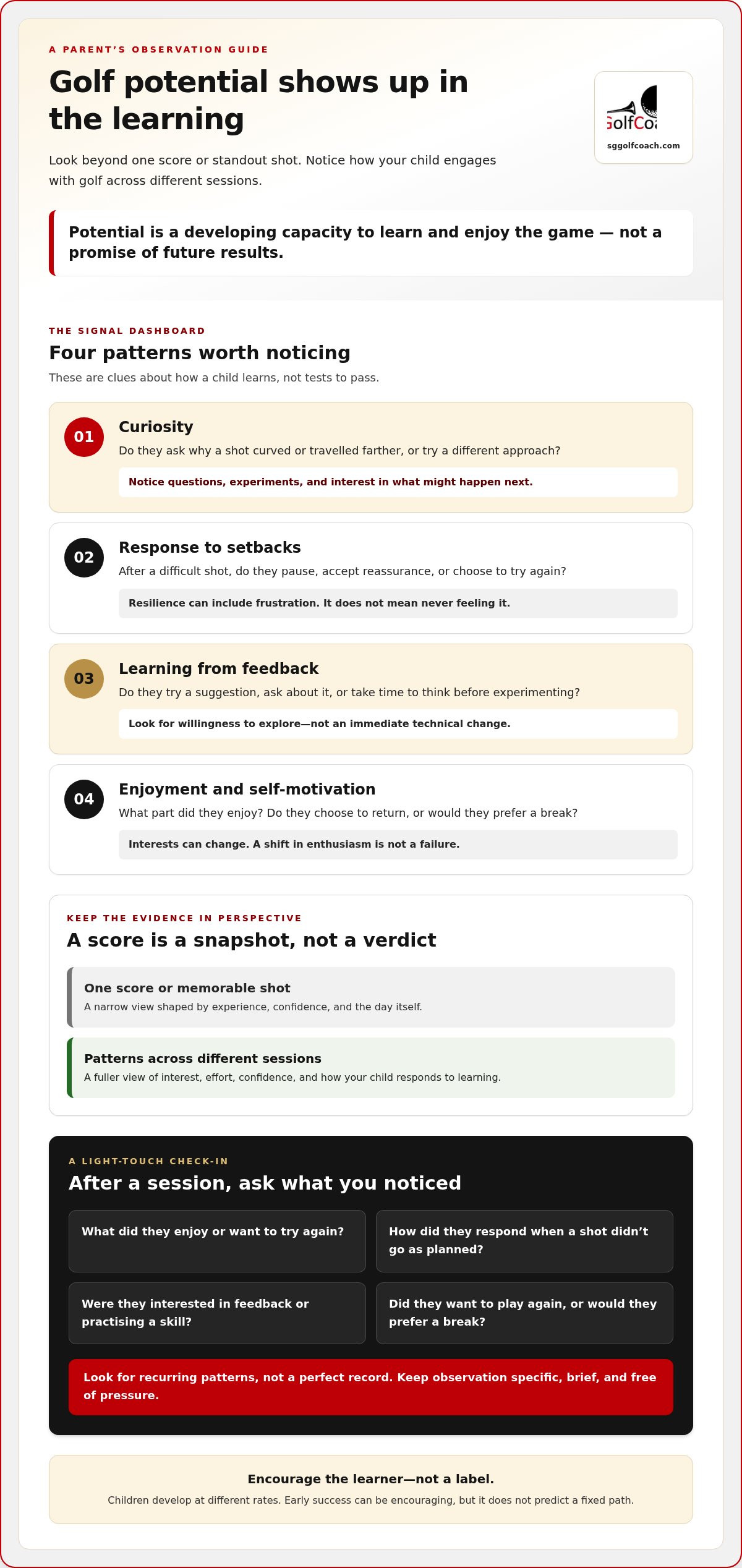
A parent’s checklist: observe golf potential without putting on pressure
How junior golf coaching can nurture potential without defining it
Is my child talented at golf? Start with what talent really means
“Is my child talented at golf?” is a natural question when a child makes a crisp strike or surprises you with a strong score. But one memorable moment can’t show how they’ll develop over time. Talent is better understood as potential that may grow through interest, practice, feedback and experience, rather than a fixed trait that predicts a particular level of achievement.
Junior golf potential is a child’s developing capacity to learn and enjoy the game, not a guarantee of future results or a label that defines them. This distinction helps parents notice promising signs without turning each round into an assessment. Golf can include casual play, learning and competition, as the overview of Junior golf illustrates, but children don’t need to follow a competitive path to show potential.
Separate what you can observe from what a score tells you. Curiosity, persistence and willingness to try feedback are behaviours you can notice over time. A low score is an outcome from one particular day, influenced by skills and circumstances that may change. Neither should become a verdict on what your child can or can’t become.
Potential is more than a natural swing
A coordinated movement or a powerful shot can help a child enjoy early success, but physical gifts alone don’t predict long-term promise. A child may also be learning to control distance, manage frustration or focus on a small adjustment. Those less dramatic moments can be just as useful to observe.
Notice whether your child asks how a shot could be different, tries again after a miss, or listens to a suggestion and experiments with it. These are not tests to pass. They’re clues about how the child engages with learning, and they may appear even when the ball doesn’t travel far or land near the target. For example, a child might ask why one shot went farther than another, then try changing their aim or setup. The learning process matters more than whether the next attempt is perfect.
Why early results can be misleading
Current performance reflects more than ability. A child who has played a course before may feel comfortable with its routine; another may be managing unfamiliar surroundings or feeling nervous. Practice and experience also affect what a child can do on a given day, so a score or impressive shot offers only a narrow view.
Children grow, coordinate movements and gain confidence at different rates. There’s no single timetable for improvement, and a temporary plateau doesn’t settle what a child may learn next. Likewise, early success is encouraging, but it doesn’t promise that progress will always be steady.
Instead of drawing conclusions from one round, pay attention across several kinds of golf experiences. After each session, you might briefly note:
What your child seemed to enjoy or want to try again.
How they responded when a shot didn’t go as planned.
Whether they showed interest in feedback or practising a skill.
Look for recurring patterns, not a perfect record. The aim is to understand what helps your child stay engaged and learn, while leaving room for their interests and abilities to develop.
How children develop golf ability: habits that reveal potential over time
Golf ability develops through more than time spent hitting balls. Practice gives a child chances to experiment, feedback can help them notice a useful adjustment, and curiosity encourages them to keep exploring. Playing in different situations gives them opportunities to apply what they’ve practised. These elements can work together, but progress won’t always look steady. A child might make a breakthrough with one skill while another takes longer to feel comfortable.
Consistent learning behaviour reveals more about developing potential than any single result. That doesn’t mean a child must practise constantly or aim for competition. Enjoyment and ambition can sit side by side: a young golfer may love improving a particular shot without wanting to measure success through tournaments. If you’re wondering, “is my child talented at golf,” consider how they engage with learning over time, not whether every session produces a visible gain.
Look for curiosity, resilience, and self-motivation
Curiosity might look like asking why a shot curved or trying a different approach to a challenge. Resilience isn’t never feeling frustrated; it can mean taking a pause, accepting reassurance, then deciding whether to try again. Notice whether your child sometimes chooses to return to golf or talks about something they’d like to practise. Those choices offer useful insight, but interests can change, and a shift in enthusiasm isn’t a failure.
Notice how your child learns from feedback
During practice, a child might hear one simple cue, try it, and discover what feels different. They may need to hear the idea again, ask questions, or experiment before it makes sense. All are normal ways of learning. Pay attention to whether they’re willing to explore the suggestion, rather than expecting an immediate technical change or judging the next shot by its outcome.
To make these observations helpful rather than pressurising, keep them light and specific. After a session, consider:
What did your child choose to explore or practise?
How did they respond to a suggestion: try it, ask about it, or take time to think?
What part of the experience did they enjoy, regardless of the score?
Did they want to play again, or would they prefer a break?
You don’t need a formal log or a running tally. A brief note now and then can help you notice whether interest, effort and confidence are growing, changing or simply fluctuating. Avoid turning every answer into a measure of promise. The purpose is to understand what makes learning engaging for your child and to support that experience.
If your child is keen to develop their skills, tailored junior golf lessons at SgGolfCoach provide constructive feedback through individual or group instruction. Treat coaching as support for learning, not a test of future ability. Keep asking what your child enjoys, and let their goals take shape at their own pace.
Natural ability or growing skill? Avoid these common talent myths
A child who swings smoothly or sends the ball a long way can look like a “natural”. That may reflect coordination, confidence or experience, and it’s worth appreciating. But one visible strength can’t reveal how a child will respond to new challenges, instruction or changing interests. The opposite is true, too: an awkward early swing doesn’t rule out development. Natural coordination can make some movements feel easier at first, while practice and guidance help children build skills in their own way.
It’s easy to overread early evidence. A low score may reflect familiarity with a course or format as much as a particular ability; a competition result captures one performance, not a child’s entire capacity to learn. Physical maturity can influence strength, reach and control at a given stage, but these differences aren’t a verdict on future potential. If you’re asking, “is my child talented at golf,” be cautious of conclusions based on a single visible advantage or setback.
Does a child need to be a natural golfer?
No. An effortless-looking swing can be encouraging, but it isn’t a requirement for learning or enjoying golf. A child whose early shots look polished may still need time to handle new situations, while another may gradually find a comfortable movement through practice. Neither path guarantees a particular future. Golf can be worthwhile as recreation, learning or competition, depending on what the child enjoys and chooses.
Why comparing children can distort what parents see
Children differ in age, golf experience, confidence and physical development, so a comparison can make a temporary difference seem more meaningful than it is. Use other players as context, not as a standard your child must meet. A more useful reference is your child’s own earlier effort: what feels more familiar now, what they’re willing to try, or how they respond to a challenge.
Try replacing fixed labels with observations. Instead of calling a child a “prodigy” after a strong round, or “not talented” after a difficult one, describe what happened: they controlled a shot well, kept practising a movement, or found a task frustrating. This language recognises the moment without assigning an identity that can create pressure to keep performing or discourage further attempts.
For a fairer view, compare like with like where possible. Think about whether the child has had a similar amount of practice, is comfortable with the setting, and feels ready to take part. Then ask what the result does and doesn’t tell you. It may show a skill that’s developing or an area where guidance could help. It can’t, by itself, settle how far that skill will go.
Keep the focus on useful next steps rather than ranking:
Notice changes in your child’s own approach, not just changes in score.
Ask what they enjoyed or found challenging, without turning the answer into a talent assessment.
Let your child’s interest guide whether golf remains casual or becomes more ambitious.
Encouragement doesn’t require predicting a future champion. It means making room for progress, enjoyment and changing goals, while recognising that every child’s development has its own shape.
A parent’s checklist: observe golf potential without putting on pressure
A useful checklist isn’t a scorecard for your child’s future. It’s a gentle way to notice what helps them enjoy golf and learn, without turning every practice or round into an evaluation. If you’re asking, “is my child talented at golf,” look for patterns across several experiences rather than trying to reach a verdict after one outing.
After practice or play, consider these prompts. You don’t need to tick every box, and a child’s answers or behaviour may change from one day to another.
Enjoyment: Did your child seem engaged, including when a shot didn’t go as hoped?
Curiosity: Did they wonder why a shot worked, or show interest in trying something differently?
Persistence: After a challenge, did they choose to try again, take a break, or move on?
Response to guidance: Were they open to a suggestion, curious about it, or in need of more time?
Interest: Would they like to play again, or would they prefer to do something else?
Observe these signs across practice and play
Notice how your child responds in different moments, not just when the game is going well. They might stay focused while practising a skill, ask what made a shot travel a certain way, or show more confidence trying something that once felt unfamiliar. Jot down a brief observation after a few sessions if it helps. Look for small changes in focus, comfort or willingness to experiment, not a rising score or a flawless performance.
Keep the parent’s role supportive
After golf, ask open questions such as, “What was the most enjoyable part?” or “Was anything tricky today?” Then listen without rushing to offer a correction or interpretation. Praise something specific, like patience after a miss or curiosity about a new idea, rather than calling your child gifted. Let their answers help guide how often golf features in family plans, and make space for their interest to change.
Try not to turn the checklist into an interview. One gentle question is often enough; a child may prefer to talk later or not at all. You can also notice whether they bring golf up on their own, while remembering that quiet interest may not always show as conversation. The aim is to understand their experience, not to collect evidence for a label.
If your child is interested in more regular instruction, the junior golf program guide can help your family explore structured junior learning. SgGolfCoach offers individual and group lessons with supportive feedback, keeping your child’s experience at the centre.
Ready to support your child’s interest with tailored instruction? Explore junior golf lessons as a constructive way to learn, not a test of talent.
How junior golf coaching can nurture potential without defining it
Coaching can give a child a welcoming structure for learning, but it shouldn’t be treated as an audition for a future in golf. If you’re still asking, “is my child talented at golf,” lessons won’t deliver a final verdict. Their value is in helping a young player explore fundamentals, receive constructive feedback and discover what they enjoy about developing a skill.
Good next steps begin with your child’s interest. They might want to feel more comfortable making contact, understand how to aim, or simply try a lesson because golf has caught their attention. You don’t need a long-term plan before starting. A clear, manageable focus gives your child room to learn and gives you a chance to notice how they feel about the experience.
What supportive junior instruction can help a child explore
Junior instruction can introduce fundamentals through guidance suited to a child’s current learning needs. Rather than expecting a perfect movement, a coach can offer a simple cue and help the child practise it. One young golfer may benefit from revisiting a basic movement; another may be ready to explore how it affects a shot. Feedback is a tool for learning, not a measure of natural talent.
Individual and group lessons offer different learning formats. Individual instruction can focus attention on a child’s specific questions, while a group setting gives children the chance to learn alongside others. Neither format guarantees a particular outcome. The aim is to help a child build skills, confidence and enjoyment at a pace that feels appropriate for them.
Choose the next step around the child
Before arranging instruction, ask what your child would like to learn or experience next. Their answer can be practical, such as wanting to make more consistent contact, or as simple as wanting to see what a lesson is like. If they’re unsure, keep the conversation open rather than making enthusiasm a condition for continued support.
Then agree on a manageable next step together. Afterward, ask what felt helpful, interesting or difficult. Their response can guide whether to continue, adjust the learning format or take a break. A change of pace doesn’t cancel out earlier interest; it gives your family more information about what suits the child now.
Parents can also support coaching by keeping expectations clear and modest. Let the coach guide practice, and resist adding extra targets after each session. At home, praise effort and willingness to learn rather than asking whether your child is improving quickly. That keeps attention on the experience they can control, not a prediction about where golf might lead.
For families considering a first step, this guide to beginner golf lessons offers a helpful introduction to starting with the basics. If your child is ready to explore tailored instruction, explore junior golf lessons at SgGolfCoach as a supportive way to learn, one step at a time.
Let your child’s next step take shape
You don’t need to decide today how far golf might take your child. A more helpful question than “is my child talented at golf” may be what they’d like to discover next. Give them space to enjoy the game, notice what sparks their interest, and share their own goals as they emerge.
If your child is ready to explore golf further, coaching can offer a thoughtful next step, with learning kept at the centre rather than a prediction about the future. Explore junior golf coaching with SgGolfCoach and support their interest through tailored instruction.
Potential doesn’t need a label to grow. With patience and the freedom to learn at their own pace, your child can build a relationship with golf that feels rewarding, whether their ambitions change or remain simply about enjoying the game.
Frequently Asked Questions
At what age can you tell if a child is talented at golf?
There isn’t a single age when a child’s long-term golf potential becomes clear. If you’re asking, “is my child talented at golf,” focus on what they’re learning and choosing to do now, rather than trying to forecast their future early. A child’s interests, confidence and physical development can shift over time. Keep expectations flexible, and let their next goals grow from what they enjoy and feel ready to explore.
Does a child need natural coordination to become good at golf?
No. Coordination can help a child manage the movements involved, but it isn’t a requirement for learning golf. Skills such as balance, timing and control can be practised gradually. For instance, a beginner might first work on making comfortable contact before trying to direct the ball towards a target. Encourage steady exploration rather than treating early ease or awkwardness as evidence of how far your child can go.
Can a child become a strong golfer if they start later?
Yes, starting later doesn’t rule out becoming a capable golfer. A child who begins after a friend may bring patience, focus or experience from other activities, and can still build golf skills through practice and instruction. Their path may look different, so avoid treating someone else’s progress as a deadline. Ask what they’d like to learn first, then help them find an enjoyable way to get started.
How often should a child practise golf?
Choose a practice rhythm that fits your child’s interest, schedule and energy rather than following a fixed quota. A short session focused on one manageable task, such as aiming at a nearby target, can feel more rewarding than practising until attention fades. Leave room for breaks and other activities. If your child starts dreading practice, reduce the pressure and talk about what would make golf enjoyable again.
Should parents encourage a talented child to compete?
Consider competition if your child is curious about it and understands that taking part is a learning experience, not a demand to win. You might begin by discussing what they hope to enjoy, such as playing with others or trying a new challenge. Afterwards, ask what they thought of the experience before deciding on another event. If they’re reluctant, keep golf enjoyable without making competition the measure of commitment.
Does loving golf mean my child has talent?
Loving golf shows that the game matters to your child, but enjoyment alone can’t predict future playing ability. It’s still valuable: interest can give them a reason to practise, ask questions or learn new skills. Let enjoyment stand on its own rather than treating it as proof that your child should pursue a particular pathway. Their preferences may also change, and that’s a normal part of finding what they like.
How can I encourage my child without putting pressure on them?
Offer choices, notice effort and keep conversations about golf open. Instead of asking whether they played well, try, “What would you like to try next time?” or “Would you like to play again soon?” Avoid setting goals on their behalf or making praise depend on results. If your child wants guidance, SgGolfCoach’s junior lessons provide a supportive learning setting; let their response help shape what comes next.


Comments