

How to Stop Slicing the Driver: A Practical, Step-by-Step Fix

What if the first fix for your driver slice isn’t a bigger swing change, but a clearer diagnosis? If your tee shots keep peeling away from the target, it’s easy to lose distance, confidence, and trust in every tip you’ve tried. Learning how to stop slicing the driver starts with checking whether the clubface points open relative to the swing path at impact, rather than changing several things at once.
That distinction matters: for a right-handed golfer, the face’s direction relative to the path largely determines the curve, while aim and setup can influence the delivery. You don’t need to rebuild your swing in one session, and a sound correction doesn’t have to trade a slice for a hook. Start with observable ball flight and a few setup checks, then make one focused adjustment and see what changes.
This guide walks you through identifying a likely cause, choosing a manageable grip, alignment, or swing-path adjustment, and practising it in stages before relying on it on the course. You’ll know what to watch for, what to leave alone, and when feedback from a coach or screen-golf session may help clarify the pattern.
Table of Contents
How to Stop Slicing the Driver Starts with Understanding the Ball Flight
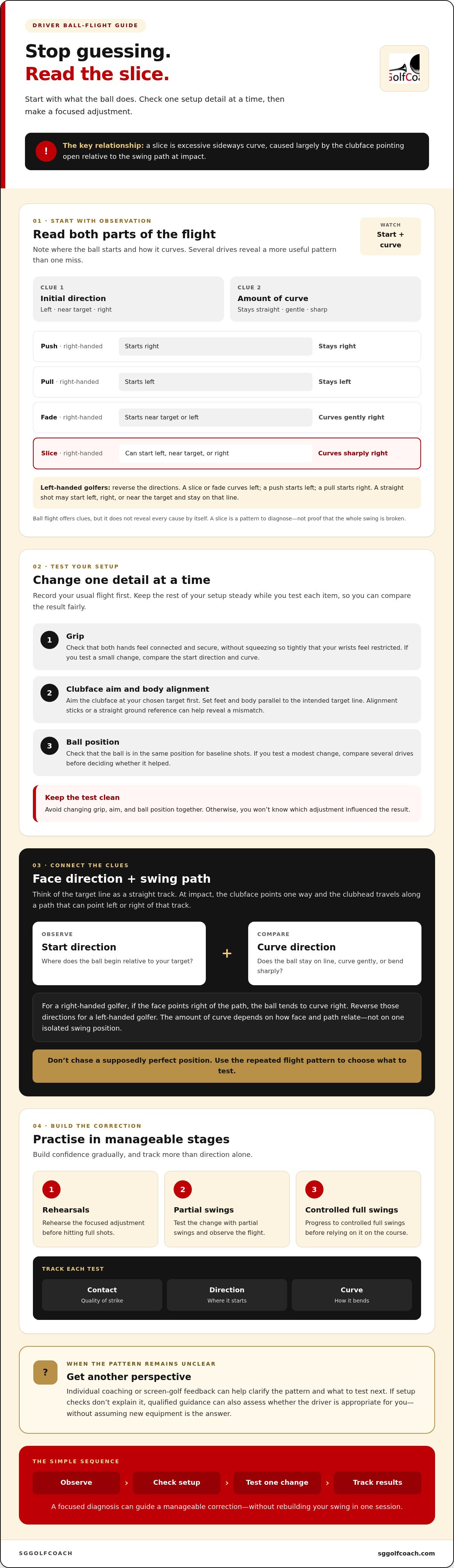
A slice is a pattern to diagnose, not proof that your whole swing is broken. It describes excessive sideways curvature, usually away from the target: right for a right-handed golfer and left for a left-handed golfer. A fade curves in the same direction but more gently.
A slice is excessive sideways curve caused largely by the clubface pointing open relative to the swing path at impact. That relationship matters more than chasing one supposedly perfect swing position. Understanding it gives you a useful starting point for how to stop slicing the driver, without guessing at a complete swing rebuild.
What makes a driver shot curve into a slice?
Picture the target line as a straight track. At impact, the clubface points in one direction while the clubhead travels along a path that can point left or right of that track. For a right-handed golfer, if the face points right of the path, the ball tends to curve right. For a left-handed golfer, reverse those directions. The amount of curve depends on how the face and path relate, not on one isolated swing position.
Where the ball starts and how it curves offer clues, but they don’t reveal every cause on their own. For a simple explanation of left-to-right flight for a right-handed golfer, see this guide to understanding the ball flight.
Is your driver shot a slice, fade, push, or pull?
For a right-handed golfer, observe both the ball’s initial direction and its final curve. A straight shot may start left, right, or near the target and stay on that line. A push starts right and stays there; a pull starts left and stays there. A fade starts near the target or left and curves gently right. A slice curves sharply right, whether it begins left, near the target, or already right.
Left-handed golfers should reverse the directional descriptions: a slice or fade curves left, while a push starts left and a pull starts right. Don’t diagnose your swing from one miss. Watch several drives and note both the start direction and curve. A repeated pattern is a more useful guide than a single unusual shot.
Check Your Grip, Aim, and Ball Position Before Changing Your Swing
Before changing your swing, check whether your setup is influencing the pattern. These are controlled tests, not guaranteed fixes. Keep your normal setup as a baseline, then alter one detail at a time. Note where several drives start and how they curve. That record gives you a fair comparison and helps prevent a new adjustment from obscuring the original miss.
Check your grip, clubface aim, body alignment, and ball position one at a time, recording the ball flight after each test for a more repeatable diagnosis. This makes the search for how to stop slicing the driver more focused. The PGA-approved slice fix also offers a step-by-step reference for working through slice corrections.
Use a grip check to assess clubface control
Your grip affects how comfortably you can return the clubface towards square at impact, but there isn’t one hand position that suits every golfer. Place both hands on the handle so they feel connected and secure, without squeezing so tightly that your wrists feel restricted. Notice whether the grip feels neutral and repeatable. If you test a small change, keep the rest of your setup steady and compare the resulting start direction and curve.
Confirm driver aim, alignment, and ball position
Set the clubface towards your chosen target first. Then position your feet and body parallel to the intended target line. It’s easy to aim the body left while the face points at the target, creating an alignment mismatch that changes how the swing feels. Alignment sticks or a straight ground reference can help you spot this without guessing.
Next, check whether you place the ball in the same position for each baseline shot. Make only a modest test change if your observation suggests ball position may be contributing, then compare several drives before deciding whether it helped. Avoid changing grip, aim, and ball position together. Otherwise, you won’t know which adjustment influenced the result.
Also consider whether the driver’s condition or fit could warrant assessment, especially if setup checks don’t explain the pattern. Rather than assuming new equipment is the answer, seek qualified guidance on whether the club is appropriate for you. If you’d value individual feedback while reviewing your setup, explore bespoke golf coaching as one option.
Match the Driver Slice Fix to Your Clubface and Swing Path
Once you’ve observed a repeatable pattern, use it to choose a small test rather than forcing a standard swing fix. For a right-handed golfer, the ball’s starting direction can offer a clue about where the face is pointing, while its curve helps show how the face relates to the swing path. Neither clue tells the whole story, so treat each pattern as a working hypothesis.
Change the clubface and swing path together, and you won’t know which adjustment changed the ball flight. Test one variable at a time, keep the motion comfortable, and compare several shots before deciding whether to continue. The PGA of America’s Five Tips to Fix Your Slice also explores common fundamentals that can contribute to a slice.
For left-handed golfers, reverse the directional descriptions: right and left swap, and the slice curves left. These are possibilities, not firm diagnoses. Strike location, setup, and delivery can affect what you see, so avoid reading too much into one shot.
Test whether the clubface is contributing to your slice
Make a few controlled half-swings and notice both the strike and the ball’s initial direction. If you test grip or face awareness, choose one modest adjustment and keep your path and alignment as consistent as you can. If the ball develops a different miss or the grip feels uncomfortable, pause and return to a neutral, repeatable setup rather than adding another correction.
Explore swing path without forcing an extreme in-to-out move
Use a target-line rehearsal to sense the club travelling less across the ball, then make a low-speed practice swing before hitting a driver. The aim isn’t to exaggerate an inside-out path. An extreme reroute can make contact less consistent or create excessive curve in the opposite direction. Keep the change measured, and let the pattern across several shots guide your next step.
Practise Driver Slice Corrections with a Repeatable Range Routine
A swing change needs a clear test, not a hurried run of full-power drives. Use the same target line and work through a simple progression, keeping one adjustment constant at a time. This helps you judge whether a change is making the ball flight more predictable, rather than simply producing one encouraging shot.
Follow a simple drill progression for driver control
Begin with slow rehearsals. Feel a balanced movement and picture the club travelling in relation to your target line, without trying to manufacture a dramatic swing change. Then hit partial shots at moderate effort, checking where each ball starts and whether contact feels centred and controlled. Move to full swings only when the smaller motion is repeatable.
After each shot, make a brief note of four things:
Start direction: Did the ball begin left, near the target, or right?
Curve: Did it stay straight, fade, slice, or curve the other way?
Contact: Did the strike feel consistent?
Test: Which single adjustment were you practising?
For example, if you’re testing a grip adjustment, don’t also change your alignment or swing path during that set. A useful measure of progress is a more repeatable start and curve, with controlled contact. You’re not chasing a perfect draw on every swing.
Know when to keep practising and when to reset
Record a few swings on your phone or use simulator feedback if available. These can help you review patterns, but neither should be treated as a complete diagnosis on its own. Compare the information with what you saw in ball flight and felt at impact.
Pause if fatigue or frustration makes each swing harder to compare. If the new adjustment brings unpredictable contact or a different miss, return to the last version you could repeat comfortably. Resetting isn’t failure; it gives you a steadier baseline before choosing what to test next. This step-by-step process keeps the search for how to stop slicing the driver focused and manageable.
If you’d like a structured setting for repetition, explore screen golf booking and use each session to practise one clear checkpoint at a time.
When Golf Coaching Can Help You Stop Slicing the Driver
Self-checks can reveal a pattern, but they may not show whether setup, face control, swing path, contact, or another factor is driving it. A golf instructor can observe your swing alongside the ball flight and help you decide what to test next. That’s useful when several possible causes seem to fit, or when a correction keeps producing a different miss.
Coaching is guidance, not a guaranteed cure. An instructor can assess what’s happening and suggest a focused practice priority, but progress depends on your individual needs and the practice that follows. If one simple adjustment is already giving you clearer, repeatable feedback, you may prefer to continue practising it before seeking more input.
What to bring to a driver-slice coaching session
Make the session more productive by bringing a clear account of your usual start direction and curve, including whether the miss changes from shot to shot. Note any grip, alignment, ball-position, or swing tests you’ve tried and what happened. Bring your driver and any useful swing recordings you already have, if available.
A short record is enough: describe the pattern rather than trying to diagnose it in advance. That gives the instructor a practical starting point for assessing whether setup, face control, path, or another factor deserves attention.
Choose a useful next step for your current swing
Keep practising when one change is producing clearer feedback and your contact remains manageable. If the cause stays unclear or the miss persists despite careful testing, tailored adult coaching can provide individual feedback. SgGolfCoach offers adult lessons and bespoke coaching, which may be worth exploring if you’d like support reviewing your driver pattern.
For a session, start small: record several drives, noting where each starts and how it curves, then bring that pattern along with the changes you’ve tested. This gives you and an instructor something concrete to assess as you work out how to stop slicing the driver.
Build a More Reliable Driver Pattern
A slice is a clue to investigate, not a reason to overhaul your entire swing. Start by observing where the ball begins and how it curves, then check your setup and test one adjustment at a time. Practise progressively, from slow rehearsals to controlled full swings, and look for more predictable flight and contact rather than a perfect shot every time.
That measured approach makes how to stop slicing the driver a clearer process: notice the pattern, choose a focused test, and review what changes. If the cause remains uncertain, feedback from an instructor can help you assess your swing and decide what to work on next.
SgGolfCoach offers tailored adult instruction and bespoke coaching, with one-to-one lessons, group classes, and indoor screen-golf experiences. Explore tailored golf coaching and take your next step.
Keep your next practice session simple. A few careful observations can give you a stronger starting point and help you build confidence one swing at a time.
Frequently Asked Questions
How do I stop slicing my driver?
Start by observing where the ball begins and how it curves over several shots. Check your grip, clubface aim, and ball position before changing your swing. Then test one adjustment at a time, beginning with partial swings before returning to full speed. This measured approach makes it easier to see what influences your shots and can guide how to stop slicing the driver. If the pattern remains unclear, a qualified coach can assess your individual setup and delivery.
What causes a slice with a driver?
A driver slice is substantial sideways curvature, and more than one factor may contribute. The relationship between the clubface direction and swing path at impact is central: the face’s direction relative to the path influences curvature, while face direction also affects where the ball starts. Grip, alignment, contact, and individual movement patterns can matter too. Observe several shots before settling on a cause; a tip that helps one golfer may not suit your swing.
Should I strengthen my grip to stop slicing?
A grip adjustment may help some golfers manage the clubface, but it isn’t a universal cure. Check how both hands sit on the handle and whether your hold feels comfortable and controlled. If you test a slightly stronger position, change it gradually and compare several shots with your usual pattern. If the change creates a new miss or feels uncomfortable, return to your neutral baseline and consider getting individual feedback before adjusting further.
Does an out-to-in swing path cause a driver slice?
An across-the-ball, or out-to-in, path can contribute to a slice, but path alone doesn’t explain every curved shot. The clubface’s direction relative to the path also influences the curve, while face direction helps determine the starting direction. Treat the ball flight as a clue rather than definitive proof of your swing mechanics. A controlled practice test or professional observation can help distinguish whether face, path, or another factor is contributing.
Where should the ball be positioned for a driver?
Many golfers position the ball forward in their stance for a driver, but the ideal spot varies between players. Begin with a consistent setup and check that the ball hasn’t crept noticeably farther forward or back than usual. Use the same reference point for several shots before testing a change, then compare contact and ball flight. If your strike becomes less consistent, return to your original position and reassess rather than making several setup changes at once.
Can a golf simulator help me diagnose a driver slice?
A golf simulator can offer repeatable practice conditions and useful shot feedback, depending on the system and its setup. Treat its readings as information to consider alongside your observed ball flight and contact, not as a complete diagnosis of your swing. To make comparisons clearer, test one adjustment at a time and note the result. If you’re unsure how to interpret the feedback, a coach can help assess the pattern and suggest what to practise.
Should I change my swing path to stop slicing the driver?
You may need to test a path adjustment, but first look for a likely cause instead of forcing an exaggerated inside-out move. A large change can make contact inconsistent or create a different miss. Begin with slow rehearsals, progress to partial swings, and compare each result with your usual pattern. If you can’t tell whether face or path is contributing more, an instructor can observe your swing and help identify a sensible next test.
Ready to work on your driver pattern with tailored instruction? Explore SgGolfCoach lessons and coaching.


Comments