

How to Make the Most of a 1-Hour Golf Range Session

What if fewer, more purposeful shots could do more for your golf than an entire bucket hit on autopilot? Making the most of a 1-hour range session starts with a clear intention, not a perfect swing or a complicated plan.
It’s easy to arrive unsure what to practise, switch between clubs without a reason, then leave wondering whether anything changed. A focused session gives each ball a job and helps you spot patterns, so your practice feels productive rather than rushed.
This guide gives you a flexible structure for warming up, working on one priority, practising with different clubs and finishing with shots that feel more like a round of golf. You’ll also learn how to adjust the plan to your experience and use feedback without getting lost in swing thoughts or numbers. The aim is to leave with one useful observation to carry forward and a clearer idea of what to practise next.
Table of Contents
Why a Little Planning Makes a 1-Hour Golf Range Session More Useful
A productive range session isn’t measured by how quickly you empty a bucket. It’s purposeful practice: choose one priority, give your shots a clear task and notice what happens. This makes making the most of a 1-hour range session easier because you aren’t deciding what to work on after every swing.
A defined goal also guides your choices. If you’re practising starting the ball toward a target, select a familiar club, pick a visible marker and observe whether the ball begins in the intended direction. Your feedback can be as simple as “mostly left” or “more balanced finish.” You don’t need to diagnose every movement to make a useful observation.
Deliberate range practice means repeating a specific task with attention, observing the result and making considered adjustments instead of hitting shots without a target or purpose. The idea is associated with Dan McLaughlin's deliberate practice in golf, an ambitious attempt to pursue professional golf through 10,000 hours of deliberate practice. The lesson for an everyday session isn’t to chase a particular number of hours. It’s to make your practice attentive and intentional.
Choose one achievable goal before you start
Before your first shot, name one skill or shot you want to practise. Make it observable, such as starting the ball toward a chosen target, making more consistent contact or holding your balance through the finish. A clear goal helps you select a suitable club and gives you something concrete to assess between shots.
Keep the aim narrow. A session focus is not a plan to rebuild your entire swing in an hour. Trying to change several movements at once makes it harder to tell what’s helping. If you’re unsure which fundamentals to prioritise, the beginner golf lessons guide can help clarify the starting points.
Take a quick baseline before changing anything
Begin with a few comfortable swings using a familiar club. Don’t immediately correct what you see. First, notice the result: are the shots tending in one direction, does contact feel comfortable, or does your balance change at the finish? Record one plain-language observation to compare with later shots.
A baseline is a snapshot, not a diagnosis. Avoid drawing big conclusions about complex swing mechanics from a handful of shots, especially if your contact varies. If a pattern keeps confusing you, tailored golf instruction can help you interpret what you’re seeing and choose a practice focus that suits your level.
Keep expectations measured. A well-planned session can help you practise with purpose and recognise useful feedback, but one visit doesn’t guarantee a changed swing or lower score. Treat it as one considered step: practise a clear task, notice what the ball does and carry that observation into your next session.
A Simple 60-Minute Golf Range Session Plan, Step by Step
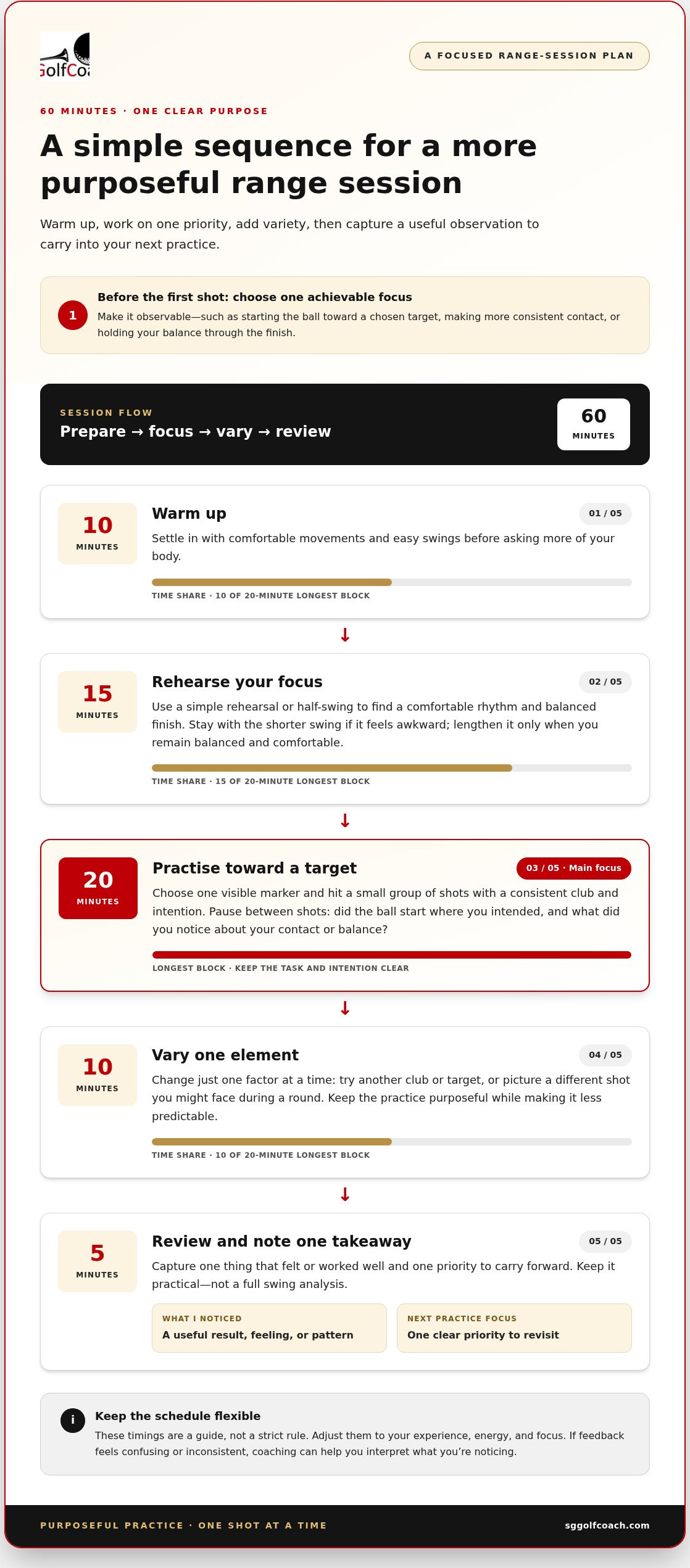
A clear sequence gives your practice a natural progression: prepare your body and swing, focus on the goal you brought with you, then add variety before reflecting on what you noticed. Use the schedule below as a guide for making the most of a 1-hour range session, not as a rule you must follow to the minute.
In short: spend 10 minutes warming up, 15 rehearsing, 20 practising a target, 10 varying your shots and five reviewing the session.
10 minutes, warm up: Start with comfortable movements and easy swings to settle in before asking more of your body.
15 minutes, rehearse: Connect your chosen focus to a simple rehearsal or half-swing, giving yourself time to find a balanced, comfortable motion.
20 minutes, practise a target: Choose one visible target and hit a small set of shots with a consistent club and intention. Pause between shots to notice the result.
10 minutes, vary: Change one element at a time, such as the club, target or imagined situation, so practice becomes less predictable without losing its purpose.
Five minutes, review: Note one thing that felt or worked well and one priority you’d like to carry into your next session.
Warm up and rehearse before building speed
Begin with relaxed movements, then make short swings using a club that feels easy to control. During the 15-minute rehearsal phase, choose a simple half-swing or practice motion that relates to your goal. Focus on a comfortable rhythm and balanced finish, rather than trying to hit the ball hard. If the motion feels awkward, stay with the shorter swing. Increase the swing length only when you can remain balanced and comfortable.
Those first 25 minutes prepare you to practise with intent instead of jumping straight into full swings. You might rehearse the same movement between shots, then check whether it feels consistent when you add the ball. Keep your attention on one cue. If you start collecting several new thoughts, return to the simplest version of the movement and give yourself room to settle.
Practise a target, vary the shot, and finish with a review
For the 20-minute target block, pick a clear marker and hit a small group of shots toward it. Let each shot answer a simple question: did it start where you intended, and what did you notice about your balance or contact? In the 10-minute variation block, change just one factor at a time. Try another club or target, or picture a different shot you might face during a round.
Use the final five minutes to capture a practical takeaway, not a full swing analysis. For example: “The shorter rehearsal helped me keep my finish balanced; next time I’ll check whether that feeling carries into a longer swing.” Timings can flex with your experience, energy and focus. If you want help shaping a personal practice plan, bespoke golf coaching can bring structure to the goals you work on between lessons.
Why Deliberate Practice Beats Simply Hitting More Golf Balls
A large bucket can keep you swinging, but repetition alone doesn’t tell you what a shot was meant to do or what its result can teach you. Deliberate practice gives each group of swings a task: choose a target, make an intentional motion, then observe the outcome. That structure can make making the most of a 1-hour range session more meaningful, though it won’t suit every golfer or guarantee a particular result.
The difference is not simply whether you hit the same club repeatedly. Focused repetitions can help you explore a specific feel, while changing clubs or targets too often can scatter your attention. The key is to know what you’re practising and what you’ll notice afterward.
Approach
Purpose
Feedback and possible limitation
Unfocused repetition
Hit balls without a specific task.
May feel enjoyable, but without a target or observation it can be hard to tell what the shots are teaching you.
Deliberate practice
Work on one defined shot or skill.
Provides a clear result to notice, but too many corrections can make the task confusing.
Neither approach guarantees progress, and a relaxed session can have its place. But if you want to learn from your practice, attach a simple question to the shots. For example: “Does this swing start the ball closer to my chosen target?” A well-struck shot is useful information, not proof that a change is permanently learned. Look for a pattern across several attempts, then see whether the feel holds up when the target or club changes.
Use feedback without overanalysing every swing
Keep your observations simple: note the ball’s start direction, whether contact felt clean and whether you finished in balance. Pick one signal that relates to your task. If you try to correct your grip, posture, path and finish all at once, you may lose track of what you’re testing. Make one manageable adjustment, then give it a few swings before deciding whether it helps.
Video or a launch monitor can be useful when it answers a specific question, such as whether your ball is starting in the direction you intended. Don’t collect numbers or replay every swing just because the tools are available. Feedback is most useful when it helps you make a clear next decision. Structured golf instruction can also help you interpret what you’re seeing and turn it into a practical task.
Add variety after focused repetitions
Once you’ve worked on a task, change one element rather than switching constantly. Keep the club and choose a new target, or keep the target and try another club. You can also picture a course situation: select a fairway target for a tee shot, then imagine an approach to a different landing area. Each shot gains a purpose, while gradual variety helps you explore whether your chosen feel carries beyond one repeated setup.
Adapt Your Range Session to Your Skill Level and Practice Goal
The same practice plan won’t suit every golfer or every day. A newer player may benefit most from building comfort with contact, while a developing golfer may want to test a particular shot or club. For making the most of a 1-hour range session, keep the structure flexible: match the task to your current ability, available space and energy rather than forcing every part of a routine.
Keep the first range sessions simple
If you’re new to golf, begin with a familiar club and short, controlled swings. Focus on a consistent setup, comfortable contact and a balanced finish. Choose a forgiving, close target area, such as a broad section of the range, rather than expecting every ball to land near a small marker.
Measure the session by the quality of your process, not perfect shots. Did you repeat your setup? Could you make a comfortable swing and stay balanced? Those are useful signs to notice as you grow more familiar with the movement. Avoid changing several things at once or trying difficult shot shapes before the basics feel manageable. A beginner golf lessons guide can help clarify foundational skills if you’re building confidence from the start.
Give experienced practice a specific challenge
As your contact becomes more reliable, make the task more demanding without making it vague. Set a target and decide what shot you’re trying to play before each small practice set. For example, choose one club and work on starting the ball toward a particular marker, or practise a shot shape you’ve already been learning. Keep the challenge specific enough to assess, and resist turning a practice session into a search for swing faults.
Rotate through a small number of clubs rather than switching after every shot. A planned change, such as moving from a longer club to a shorter one, asks you to reset your aim and make a new decision while keeping the session organised. You can also imagine a course situation and select a target that gives each shot context. Indoor screen golf offers another setting for supported practice and can complement range work.
Adapt the plan when the day doesn’t go as expected. If you have less time, keep the warm-up, one main task and a brief review, trimming the number of practice variations. If you feel tired, choose comfortable swings and shorten the session’s challenge rather than forcing speed. If the available practice space limits your targets, use one safe, visible area and focus on the shot you can practise there. The priority is a clear task you can work on well.
Personalised instruction can help you choose a suitable challenge and shape practice around your experience. Book bespoke golf coaching to build a focused plan for your next range session.
Turn Each Golf Range Session into a Clear Next Step
A range session becomes easier to build on when you capture what happened before you leave. You don’t need a detailed swing diary or a verdict on whether you played well. A few precise notes can preserve the thread between sessions, helping you choose a useful next focus instead of starting from scratch each time.
Keep a simple practice record
Write down the goal you brought to the range, the clubs you used and one observation from your practice. Keep the observation factual: “My shorter swings felt balanced,” or “I often started the ball right of my target.” Avoid turning a single shot into a conclusion about your swing. One outcome is a snapshot; notes from several sessions may reveal a pattern worth exploring.
A simple entry could look like this:
Focus: Start the ball toward a chosen target.
Clubs: A familiar iron and a wedge.
Observation: The shorter swings felt more controlled.
Next priority: See whether that comfortable rhythm carries over to another club.
Keep it brief enough that you’ll actually use it. Before your next visit, glance at the previous entry and decide whether to continue the same focus or move on. If the observation still feels relevant, give it another session. If a new question has emerged, make that the next task. This small review helps connect practice over time without treating every visit as a test you must pass.
Use coaching to make practice more personal
Sometimes your notes show a clear direction. At other times, the same question keeps returning: you’re unsure which feedback matters, or your observations seem inconsistent from session to session. That’s a sensible point to consider professional instruction. A coach can help you interpret what you’re noticing, select a focus that fits your experience and shape practice into a manageable plan. The goal is guidance and clarity, not a promise of a particular score or swing change.
Learning can take different forms. One-to-one instruction gives an adult or junior golfer individual attention, while group classes offer a shared learning setting. Tailored coaching can also connect personal priorities with a structured practice routine. If an indoor setting suits the task, screen golf offers another supported practice option alongside range work.
Ultimately, making the most of a 1-hour range session means leaving with a useful next step, even if that step is simply repeating a task with more attention. Your short log gives you a starting point; coaching can help when you’d value a more personalised perspective. Explore tailored golf coaching and screen-golf experiences to find a practice approach that fits your learning goals.
Carry Your Practice into Your Next Round
The value of range practice is in the questions and confidence you take with you. At your next round, notice whether your chosen focus helps you make a clearer decision or commit more comfortably to a shot. You don’t need every practice session to produce a dramatic change. A useful next step can be as modest as recognising what you want to keep exploring.
If you’d benefit from support connecting practice with your goals, SgGolfCoach offers tailored instruction for adults and juniors at different levels. One-to-one lessons and group classes provide different ways to learn, while indoor screen-golf experiences offer another setting for supported practice. Choose guidance that helps you approach your next session with greater clarity, rather than adding more swing thoughts.
Start with one question you’d like help answering, then let that guide your next step. Explore tailored golf coaching and screen-golf experiences and find a learning approach that suits your goals. Keep showing up with curiosity; purposeful practice can make each visit a more confident step forward.
Frequently Asked Questions
How many golf balls should I hit during a one-hour range session?
There’s no single ideal number; your pace, breaks and practice goal all affect how many shots fit into an hour. Rather than setting a ball-count target, work in focused sets and pause between them to notice contact and direction. For example, after a short set, take a moment to reset your grip and aim before continuing. If your swing starts to feel rushed or uncomfortable, slow down or take a break.
Should I hit every club during a one-hour range session?
No, you don’t need to use every club in one visit. Taking time to work through your whole bag can distract from the skill you came to practise. Choose a few clubs that fit the session’s purpose. If you’re preparing for a round, you might alternate between a tee-shot club and an approach club to rehearse changing situations, then leave other clubs for another practice day.
Can I have a productive golf range session on my own?
Yes, practising alone can be productive if you keep your task clear and manageable. Before you start, decide what you’ll observe, such as whether the ball starts near your intended line. A brief note on your phone between sets can help you remember what happened without interrupting every swing. If you repeatedly feel unsure what to adjust or how to interpret results, a coach can help shape a plan around your needs.
Is it useful to record my golf swing during a range session?
It can be useful if you’re trying to answer one specific question, such as whether your finish looks balanced. Record a small sample rather than filming every shot, then review it when you’re not in the middle of practising. One clip doesn’t show the whole story, so avoid making a major technical change from a single recording. A golf coach can help connect what you see to an appropriate practice task.
What should I do if the driving range is crowded?
Keep your routine adaptable and use the safe space and targets available in your bay. If you’re waiting, you can rehearse your setup or a controlled motion without striking a ball, provided it’s safe and permitted. Never swing near another golfer or move into someone else’s bay. If your intended target is blocked or difficult to see, choose another visible target and continue with the same practice intention.
Are golf range sessions useful for beginners?
Yes, a range can help beginners become familiar with the feel of setup, contact and basic ball direction. Start with a manageable club and a straightforward task, such as making comfortable swings and noticing where the ball travels. Give yourself time to pause rather than comparing each shot with an advanced player’s technique. If the fundamentals feel unclear, beginner-friendly instruction can make practice more approachable and suited to your experience.
Should I practise with a golf mat or from grass?
Both can be useful, though each may give you a different sense of how the club meets the ground. A mat offers a consistent surface, while grass can provide different feedback about the strike. Neither surface guarantees a better result, so focus on what you’re practising and follow the facility’s rules. If you move between surfaces, notice whether the contact feels different without assuming that one session proves a lasting change.


Comments