

How to Break 100 in Golf: A Practical Plan for Your Next Round

What if breaking 100 depended less on perfect shots and more on choosing the right next one? If you’re working out how to break 100 in golf, it’s easy to focus on the drive, then feel stuck when a penalty or difficult recovery adds strokes. A few rough holes can make the round seem lost, but steady decisions can limit the damage and keep your score moving in the right direction.
You don’t need a flawless swing to make progress. You need a practical plan for each hole and practice that reflects the shots you face on the course. This guide explains how to choose safer targets, avoid costly recovery attempts, and decide whether driving, approach shots, chipping, or putting deserves more attention. You’ll also get a manageable practice routine and a simple way to reset after a difficult hole. SgGolfCoach offers tailored adult lessons, bespoke coaching, and indoor screen-golf experiences to help you work on personal priorities. The plan starts with choices you can make in your next round.
Table of Contents
How to break 100 in golf: understand the scoring goal
Breaking 100 means completing all 18 holes in 99 strokes or fewer, counting every stroke and applicable penalty. Your score is measured against the course’s par to show how far over or under that benchmark you played. Par varies by course, so check the scorecard before setting a target. For a quick refresher on the term, see Understanding Golf Par.
Think of 100 as a scoring milestone, not a test of whether you can produce a perfect swing. Many combinations of hole scores can get you there: a par here, a double bogey there, and a few higher numbers elsewhere can still add up to 99 or less. A first sub-100 round is a breakthrough. Repeating it takes a dependable approach across different holes and conditions.
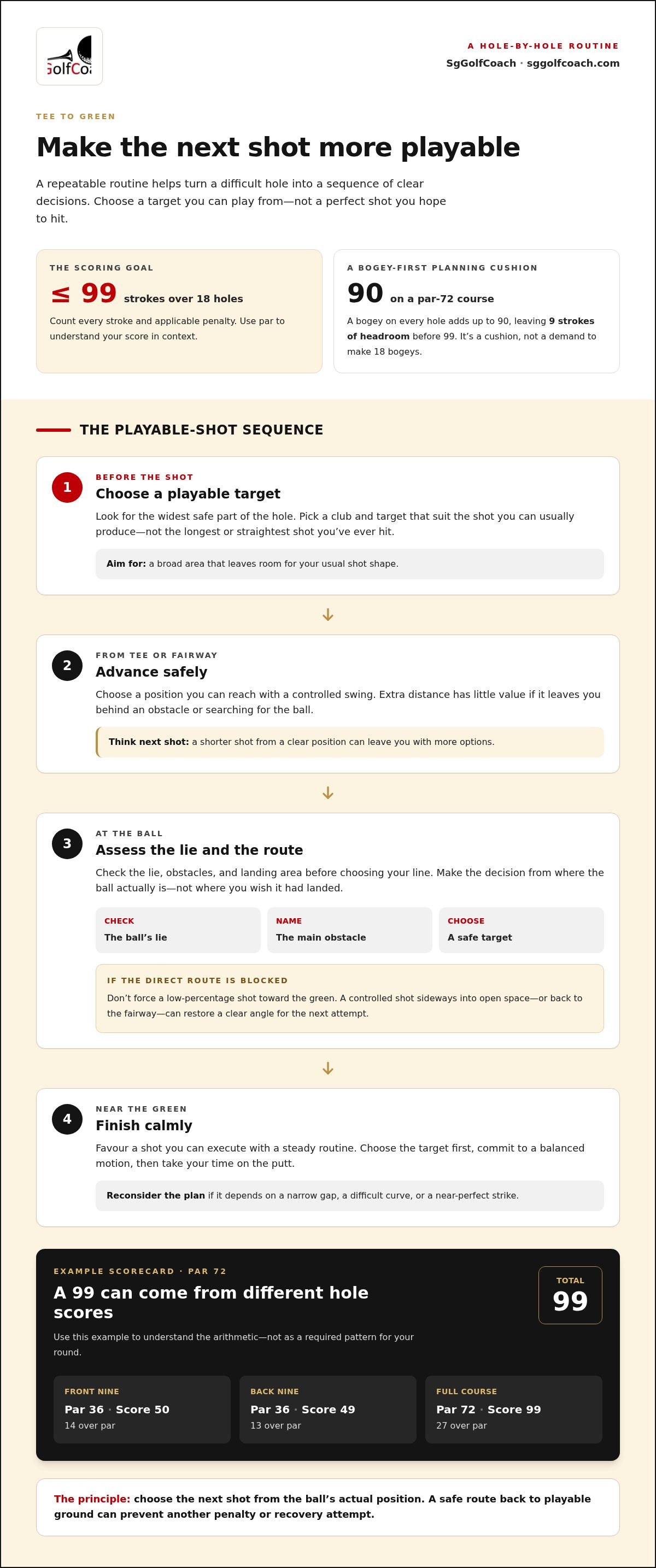
Illustrative scorecard: 18-hole course, par 72
Front nine: par 36, score 50, or 14 over par
Back nine: par 36, score 49, or 13 over par
Total: par 72, score 99, or 27 over par
This example shows how the course’s par provides context while the target stays straightforward: finish below 100. Hole scores can vary considerably and still produce the same total. Use the example to understand the arithmetic, not as a required pattern for your round.
What does a sub-100 golf score actually mean?
Par is the expected number of strokes for a hole or course, based on its design. On a par-72 course, a score of 99 is 27 over par. On a course with a different par, the same total has a different relationship to par, but it still breaks 100. Count your strokes to track the goal, then use par to understand the round in context. One successful round proves you’ve crossed the milestone once. Consistency means bringing your scores below 100 more regularly, even when a hole doesn’t go to plan.
Why fewer big numbers matter more than perfect shots
A penalty stroke can raise a hole’s score before you’ve made your next move. A difficult recovery from trees, deep rough, or another awkward position can add more strokes if the ball stays in trouble. Instead of forcing a low-percentage shot towards the green, choose a safer route back to a playable position. It may take an extra shot, but it can prevent another penalty or recovery attempt.
A bogey-first plan aims to keep each hole controlled, leaving room in the total for the occasional mistake. On a par-72 course, a bogey on every hole adds up to 90, creating nine strokes of headroom before reaching 99. That’s a planning cushion, not a demand to make 18 bogeys. When deciding how to break 100 in golf, prioritise limiting the damage after a miss rather than chasing a perfect recovery.
Build a tee-to-green routine that keeps each hole manageable
A repeatable routine gives you a useful question at every stage of a hole: what’s the most playable next shot? Follow the same sequence from tee to green, adjusting for the layout, your lie, and the shot you can make reliably. You’re not trying to force the ball as far as possible. You’re setting up a clear next decision.
Choose a playable target: Pick a broad area that leaves room for your usual shot shape.
Advance safely: From the tee or fairway, aim for a position you can reach with a controlled swing.
Assess the next shot: Check the lie, obstacles, and landing area before choosing your line.
Finish calmly: Near the green, favour a shot you can execute with a steady routine, then take your time on the putt.
Sensible decisions turn a difficult hole into a sequence of playable shots, reducing the chance of avoidable strokes. That principle is central to how to break 100 in golf: make the next decision from the ball’s actual position, not from where you wish it had landed.
Choose a tee-shot target you can play from
Look for the widest safe part of the hole rather than aiming at its narrowest ideal line. Choose a club and target that suit the shot you can usually produce, not the longest or straightest shot you’ve ever hit. Extra distance has little value if it leaves you behind an obstacle or searching for the ball. A shorter shot from a clear position gives you more options for the next one.
Recover safely and plan the next shot
If trees, rough, or another obstacle block a direct route, pause before trying to advance the ball towards the green. A gap back to the fairway or another open area may be the better target. For example, if your ball is beneath overhanging branches, a controlled shot sideways into open space can restore a clear angle for your next attempt. Choose based on the lie and the route available.
Before each shot, take a brief reset: identify the ball’s lie, name the main obstacle, choose a safe target, and picture the next shot from there. If your plan requires a narrow gap, a difficult curve, or a near-perfect strike, reconsider. Moving the ball into open ground may feel conservative, but it can simplify everything that follows. Don’t let one awkward position dictate the rest of the hole.
Keep your swing intention simple, too. Pick the target first, then commit to a balanced motion rather than changing your plan over the ball. Stanford University School of Medicine’s overview of the Biomechanics of the Golf Swing offers background on how golf swings differ. On the course, your immediate task is to choose a shot suited to your own reliable movement.
When a consistent decision routine is difficult to maintain, SgGolfCoach’s tailored adult lessons and bespoke coaching help you examine your choices and practice priorities. Explore personalised golf coaching to build a clearer process, then use the same simple sequence on every hole.
Where should you focus: driving, approach shots, short game, or putting?
The best first practice priority isn’t automatically the longest shot or the part of golf that looks most impressive. It’s the skill linked to the pattern that costs you strokes. Driving can keep the ball in play, approach shots can advance it towards a useful position, short-game shots can help you escape trouble, and putting can finish the hole. Your scorecard can reveal which part needs attention first.
Use your scorecard to find the costly pattern
After a round, look beyond the total. Note holes with penalty strokes, repeated recovery attempts, missed short putts, or several shots spent getting near the green. Add a brief observation beside the hole, such as “tee shot blocked by trees” or “chip left long putt.” A pencil and scorecard are enough. Look for a pattern across holes, then choose one recurring issue to work on before adding more technical goals.
Practise the weakest scoring area first
If tee shots repeatedly create problems, work on a comfortable setup and a target that leaves room for your usual shot. If approach play makes the next shot difficult, practise balanced contact and aim for a forgiving part of the landing area rather than a tight flag. When strokes gather around the green, give chipping and putting focused attention. A small, clear goal makes each practice session easier to evaluate.
Keep the goal tied to the problem. After a round with several blocked tee shots, for example, practise choosing a wider target and making a controlled swing rather than simply trying to hit farther. If your scorecard shows several long first putts followed by short misses, work on pace and then practise starting short putts on line. This gives each activity a purpose you can recognise the next time you play.
Some published guides, including BreakXGolf, cite example benchmarks such as 40% of fairways, 15% of greens, or 33 putts or fewer. Treat these as reference figures, not universal requirements for breaking 100. Course conditions, skill level, and the way you score each round all matter. Your own recurring patterns are a more useful guide to what to practise first.
Once you’ve identified a likely priority, keep notes over your next rounds and see whether the same issue continues to appear. SgGolfCoach’s tailored adult lessons and bespoke coaching can help you interpret those patterns and shape a practice focus around your game. The aim is not to fix everything at once, but to give your next practice session a clear purpose.
How to practise for breaking 100 between rounds
Make each practice session answer a question raised by your latest round. If several tee shots caused trouble, work on starting the ball into a safer area. If you reached the green but struggled to finish, focus on putting. A flexible session can include putting, short-game shots, and longer shots, with more attention given to the area linked to your scorecard.
Create a focused practice session
Begin with one clear objective, then choose activities that rehearse situations you actually face. You might alternate putting with chipping, then finish with longer shots if those contributed to the problem. Keep the routine adaptable: give more attention to the priority area without trying to fix every part of your game in one visit.
Putting: Practise controlling pace on longer putts, then starting shorter putts on line.
Short game: Rehearse chips from different lies so you can choose a simple landing area and leave a manageable putt.
Longer shots: Work on balanced contact and a reliable target, especially if tee or approach shots often leave you in trouble.
Decision routine: Before each practice shot, choose a target, picture the intended flight, and commit to the swing. This rehearses the same preparation you can use during a round.
Change the order to suit your needs. If your latest notes show repeated difficult chips, for instance, start there while you’re fresh, then move to putting and longer shots. SgGolfCoach’s indoor screen-golf experiences provide a setting for focused practice. If you’re new to the game, this beginner golf lessons guide offers another starting point for building sound fundamentals.
Measure progress without chasing perfect numbers
Keep a simple record after each session: what you practised, what felt reliable, and what still needs attention. Over successive rounds, note penalties, difficult recovery situations, and putts, along with a short explanation of what happened. A notebook or scorecard is enough; you don’t need specialist tracking equipment. Look for recurring patterns rather than judging progress by one unusually good or difficult result.
Useful measures should guide your practice, not dictate it. If a number draws your attention to a repeat problem, explore it. If it distracts you from the shots you actually face, adjust what you track. That feedback loop keeps practice connected to how to break 100 in golf without turning every session into a test.
SgGolfCoach’s professional instruction can help you interpret your observations and select a practice priority that fits your game. Explore tailored golf coaching to work on a more focused plan between rounds.
Turn your plan into a sub-100 round with structured coaching
Bring your practice ideas onto the course with a simple cycle: set a realistic target, choose shots that give you a playable next position, then review your scorecard after the round. Keep the focus on decisions you can repeat, not on trying to change every part of your game at once. This gives you a clear way to prepare, play, and learn from each round.
For anyone working on how to break 100 in golf, the scorecard is more than a final total. It can show whether penalties, awkward recoveries, approach shots, or putts are creating the most difficulty. Use that information to choose what to practise next, then see if the same pattern appears again.
Know when a lesson could help
If the same challenge keeps appearing despite focused practice, another pair of eyes can help you understand what’s contributing to it. An instructor can observe your movement, shot choices, or practice habits, then help you identify a useful area to work on. Repeated trouble from the tee, for example, might call for a closer look at your target and setup, while inconsistent contact could suggest a different practice focus.
SgGolfCoach’s tailored adult lessons and bespoke coaching provide professional feedback and help shape practice around your needs. A lesson isn’t a prerequisite for improving. You can also use SgGolfCoach’s indoor screen-golf experiences for focused practice, such as working on a particular shot or rehearsing a consistent routine. Treat coaching as guidance for your next steps, not a promise of a specific score or timeline.
Carry the routine into your next round
Choose one decision to practise during your next round. You might commit to a wider tee target, take a moment to assess your lie before planning a recovery, or select a safer landing area on an approach. Keep that focus simple enough to remember under pressure. A single deliberate choice gives you something specific to reflect on, even if the round includes a few difficult holes.
After playing, write down what created the most avoidable difficulty. Note the situation and your response, such as a blocked route after a tee shot or a chip that left a challenging putt. Then turn that observation into your next practice objective. If the issue persists, a lesson can help you examine it with professional feedback. If it doesn’t, keep developing the part of your game that still needs attention.
Ready to make your practice more purposeful? Explore SgGolfCoach’s tailored adult coaching and indoor screen-golf experiences to choose a focused next step for your game.
Make your next round a fresh starting point
Your next round doesn’t need to be a verdict on your golfing ability. Treat it as a chance to test one decision, notice what happens, and learn something useful for next time. A difficult hole is information, not a reason to abandon your plan. Keep your attention on the shot in front of you, and let each round help shape a more confident approach.
That steady, curious mindset is a practical part of how to break 100 in golf. Progress may not arrive in a straight line, but each thoughtful choice gives you a way to respond when the round gets challenging. If you’d value another perspective as you refine your practice, SgGolfCoach offers golf coaching and practice options.
Stay patient, keep learning from your rounds, and give your next plan a chance to work.
Frequently Asked Questions
How many strokes over par is a score of 99 in golf?
It depends on the course’s par. Subtract the course par from 99: on a par-70 course, 99 is 29 over par; on a par-71 course, it’s 28 over. The stroke total still meets the sub-100 goal in either case. Check the scorecard’s total par before working out your score relative to par, since the same number of strokes can represent a different score against par on another course.
Can you break 100 without hitting long drives?
Yes. Long drives aren’t a requirement for breaking 100; a shorter tee shot can still set up a manageable route towards the green. If your longest club feels unreliable, choose a familiar option that keeps the ball in play, then plan your next shot from its actual position. Prioritise avoiding penalties and keeping the ball moving forward over trying to reach a particular distance.
How many putts should you aim for to break 100?
There’s no required putt total, but 36 putts, averaging two per hole, can serve as a simple reference point for an 18-hole round. Treat it as a guide rather than a pass-or-fail target: a long first putt may take two, while a missed green can mean a chip and one putt. Notice three-putts and practise controlling pace so your first putt finishes closer to the hole.
What is the best golf club to use when trying to break 100?
There isn’t one best club for every golfer. Choose a club you can strike reliably and use comfortably for the shot in front of you. On a tight tee shot, a familiar shorter club may offer more control than your longest option. From the fairway, select a club that suits the distance and lie rather than forcing a difficult shot simply because it promises more length.
How often should a beginner practise to break 100?
There’s no set practice frequency that guarantees a sub-100 round. Choose a routine you can maintain, then make each session purposeful rather than measuring commitment by hours alone. You could focus on putting in one session and approach contact in another, guided by what you notice during play. If practice time is limited, a short, focused session can still give you a clear skill to work on.
Is breaking 100 in golf difficult for a beginner?
It can be challenging, particularly while you’re learning to make consistent contact and manage unfamiliar situations, but it’s a realistic milestone to work towards. The first sub-100 round may take time, and progress can vary from one golfer to another. Track your own rounds instead of comparing your score with more experienced players. A penalty-free hole or a calmer recovery is useful progress, even before the total drops below 100.


Comments