

How to Add Gentle Golf Exercises for Seniors

Golf fitness doesn’t need to mean long or demanding workouts. For adults aged 65 and older, the Centers for Disease Control and Prevention recommends at least 150 minutes of moderate-intensity aerobic activity each week, plus muscle-strengthening activities on at least two days a week. Gentle golf exercises for older adults can complement that broader routine with golf-focused mobility and strength work.
It’s reasonable to want to stay active without pushing through discomfort or wondering which movements are suitable. A steady, manageable routine can fit your energy, mobility and time on the course.
Here, you’ll learn how often to exercise, how to practise gentle mobility moves that support your swing, and how to adapt them safely as an older adult. We’ll also cover a simple warm-up and ways to adjust movements so your routine feels comfortable and purposeful.
Table of Contents
Thoracic spine rotation and warm-up mobility
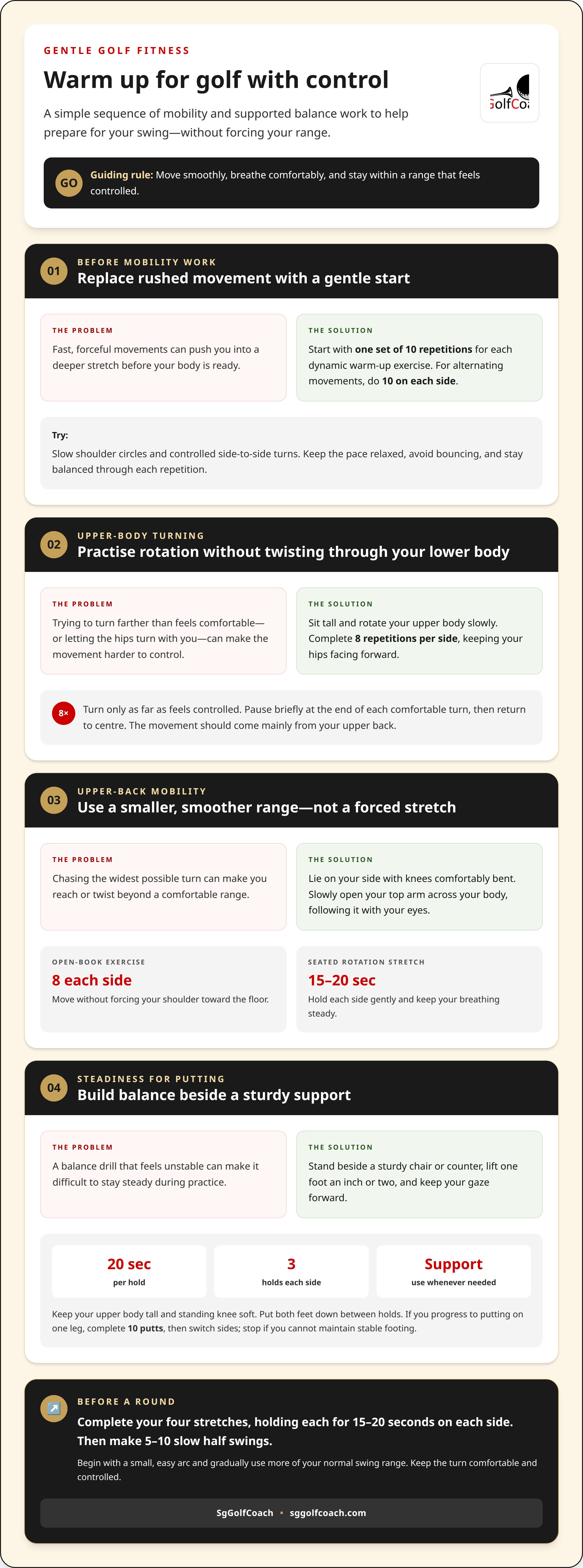
A gentle golf warm-up can combine controlled upper-body turns, easy mobility movements and gradual practice swings. Stay within a comfortable range instead of forcing your shoulders or back to rotate farther.
Start With Dynamic Warm-UpsBegin with gentle, moving exercises before practising full swings. Use one set of 10 repetitions for each dynamic warm-up exercise, completing 10 on each side when a movement alternates sides. For example, try slow shoulder circles and controlled side-to-side turns. Keep the pace relaxed and the movement smooth. Check that you can breathe comfortably and stay balanced throughout each repetition; avoid bouncing or using momentum to push into a deeper stretch.
Practice Thoracic RotationTake a seated position and practise rotating your upper body slowly to each side. Complete 8 repetitions per side, turning only as far as feels controlled. Keep your hips facing forward so the movement comes mainly from your upper back, rather than twisting through your lower body. This gives you a deliberate way to rehearse the turning action used in a golf backswing. Pause briefly at the end of each comfortable turn, then return to centre.
Improve Upper-Back MobilityAdd the open-book exercise to encourage upper-back rotation. Lie on your side with your knees comfortably bent and your arms extended in front; slowly open the top arm across your body, following it with your eyes. Complete 8 repetitions on each side, moving without forcing the shoulder toward the floor. You can also practise a seated upper-body rotation stretch, holding each side for 15-20 seconds. Keep the turn gentle and your breathing steady.
Add Golf-Specific FlexibilityUse mobility work to prepare for the positions involved in your swing, not to chase the widest possible turn. Practise a comfortable rotation in your golf posture, keeping your feet settled and your balance steady. Turn your shoulders smoothly with your trunk, then return to the starting position. If your range feels restricted, make the turn smaller and focus on control. Building strength without enough mobility can lead you to reach overhead or twist beyond your comfortable range.
Before a round, complete the four stretches in your routine, holding stretches for 15-20 seconds on each side. Then make five to 10 slow half swings before playing. Start with a small, easy arc and gradually use more of your normal swing range. This simple sequence links mobility work to golf without making the warm-up itself a series of fast or forceful swings.
Is golf good exercise for older adults?
Golf involves walking, repeated movement and balance. Targeted exercises at home can also build stability for everyday play. Try supported balance practice, single-leg putting and simple strength movements such as sit-to-stands.
Begin Balance TrainingStand beside a sturdy chair or counter, then lift one foot an inch or two. Hold your position for 20 seconds, keeping your upper body tall and your gaze forward. Complete three holds on each side, using the support whenever needed. This supported single-leg balance drill lets senior golfers practise steadiness without adding a swing. Keep your standing knee soft, and place both feet down between holds.
Practice Stability DrillsBuild from supported holds by practising single-leg balance for 10-30 seconds on each leg. Begin near a counter, and keep a hand close enough to steady yourself. Once the position feels controlled, try putting while standing on one leg. Complete 10 putts, then switch sides. Keep the putter movement small and the shoulders relaxed; stop the drill if you can’t maintain stable footing.
Bring the balance challenge into your putting setup before trying a full swing. Stand with your feet in a comfortable position, hold your posture and make a short putting stroke. Notice whether your hips stay level and your weight shifts smoothly instead of tipping forward. If putting on one leg affects your control, repeat the practice with both feet on the ground. This progression links balance training to golf while keeping the movement low impact.
Add sit-to-stands to strengthen the legs used for standing, walking and changing posture. Sit near the front of a sturdy chair, rise with control, then lower back over three seconds. Complete two sets of 8-10 repetitions, keeping your knees aligned over your feet. Use your hands for support if needed. A consistent pace matters more than rushing through repetitions or dropping heavily into the seat.
Include a glute bridge or wall push-up for whole-body strength at home. For bridges, lie on your back with knees bent, lift your hips, hold for two seconds, then lower; complete two sets of 10. For wall push-ups, place your hands on a wall and bend your elbows before pressing away; complete two sets of 8-12. Balance training can improve joint stability, with one reported estimate linking it to a 45% lower injury risk. Treat that figure as a broad finding, not a personal guarantee.
How often should senior golfers exercise?
Plan a week that balances walking, strength work and golf practice, then adjust the effort to your current routine. Adults aged 65 and older should aim for at least 150 minutes of moderate-intensity aerobic activity weekly, according to the Centers for Disease Control and Prevention.
Build walking endurance with a manageable starting routine, such as walking for 10 minutes, three days a week. Choose a flat, even surface and supportive shoes, then add a few minutes when your current walking time feels manageable. Walking works the lower body and supports cardiovascular health, strength and endurance. In Singapore, a familiar, level route can make the habit easier to repeat. Begin with a steady pace and comfortable distance.
Include muscle-strengthening activity on at least two days a week, as the Centers for Disease Control and Prevention recommends for adults aged 65 and older. Choose functional movements that reflect golf and daily tasks, such as sit-to-stands for rising from a chair or controlled trunk turns before practice. Keep each movement smooth and within a comfortable range. Strength work complements walking by training muscles involved in standing, posture and club movement.
Set a repeatable schedule for golf-specific fitness rather than placing every activity on one day. A suggested pattern is the full golf routine three days a week, with stretches on round days. If you’re beginning exercise, start with 10-15 minutes of activity every other day and build gradually. Treat gentle golf exercises for older adults as one part of the weekly plan, alongside walking, strength work and time on the course.
Tailor your plan to the movements that feel most challenging. Notice whether walking, standing from a chair, turning your upper body or maintaining balance takes the most effort. Use that observation to choose a relevant exercise: practise chair rises if standing is difficult, or shorten your walk if fatigue changes your stride. Gentle golf exercises for older adults should suit your current movement and fitness, not follow a generic routine.
Use consistency as the measure of a sustainable routine. Record walking sessions, strength days and rounds on a weekly calendar, then observe how your energy responds. If a round leaves you tired, plan recovery before adding extra training. A goal such as completing 18 holes without fatigue can help guide gradual changes. Review your schedule regularly and adjust the distance, pace or exercise selection to keep activity manageable.
Safe exercise modifications and professional guidance
If you have arthritis or limited mobility, make each movement smaller, use support and protect sensitive knees with a towel. Scale back if you experience unusual fatigue or soreness that lasts more than a day or two. Avoid forceful swings with a weighted club, which place substantial stress on the body.
Choose stable support before practising standing movements. For hip circles, stand beside a wall and keep one hand on it, especially if getting onto your hands and knees feels uncomfortable or unsafe. Slowly make a small circle, then reverse direction. Keep your weight centred over both feet and make the circle smaller if your balance shifts or the movement feels uncomfortable.
Protect your knees during a floor-based hip-flexor stretch by placing a towel or other soft item beneath them. Keep the stretch controlled instead of pushing your hips forward aggressively. If kneeling remains uncomfortable, try supported standing hip circles instead. Choose a modification that lets you practise without forcing a joint into a position it cannot manage comfortably.
Use a wall or the floor for pelvic tilts if controlling the movement feels difficult. Start with your back against a wall, make a small pelvic movement, then return to neutral. If you prefer lying down and can get to the floor comfortably, practise the same gentle tilt there. Don’t add a club or extra weight. First, make the movement smooth and repeatable.
Use a box or chair to set a consistent depth for sit-to-stands. Choose a height that lets you lower yourself with control instead of dropping into the seat. Keep your feet grounded and knees aligned as you rise. If the movement becomes difficult, use a higher seat or your hands for support, then gradually return to a comfortable range.
Modify a round according to your energy and recovery. Choose nine holes instead of 18 when energy is lower, and take a rest day after golf if you feel unusually sore or tired. Consider whether soreness lasts more than a day or two when deciding how often to play. A shorter round is a practical adjustment, not a reason to rush your next return.
Build golf fitness gradually, and avoid swinging a weighted club as hard as possible. Limited hip rotation can lead you to compensate through your lower back, potentially increasing pain and injury risk. Use a smaller, comfortable turn and stop if you cannot maintain control. Specialized sports health practices like The Orthopaedic & Sports Medicine Institute emphasize that a qualified professional can assess your movement and shape a routine around your mobility, balance and golf goals.
Golf as exercise for older adults
Golf can be one part of an active lifestyle, alongside exercises that develop strength, balance and mobility. Use these steps to make time on the course part of a broader fitness routine.
Consider the movements a round involves. Walking between shots provides repeated lower-body activity, while swings practise rotation and coordination. The amount of walking varies according to how you play, so treat golf as one activity rather than assuming every session provides the same workout. Pair course time with a separate routine that addresses movements your round doesn’t regularly practise.
Include strength training to support the movements golf requires, such as standing, maintaining posture and controlling the club through a swing. A controlled chair rise, for example, practises moving between sitting and standing. Keep your feet grounded and your stance steady as you rise. A simple movement performed with control can complement the repeated actions of playing.
Practise controlled rotation before trying to lengthen your swing. Stand in your golf stance, turn your upper body comfortably, then return to your starting position without shifting your feet. Notice whether your weight stays centred or moves sharply to one side. Repeat slowly and make the turn smaller if your balance changes. Aim for a smooth, repeatable movement, not maximum rotation or extra force.
Choose exercises for seniors that support daily activities as well as golf. A controlled chair rise practises standing; a supported balance hold trains steadiness while upright. Both movements are useful beyond the course, too. Keep a hand near stable support during balance practice, and simplify the movement if you cannot stay steady. The aim is to build control for comfortable, confident movement.
Keep golf in your routine at a pace that suits your ability. Being 75 years old does not automatically mean you are too old to play. Comfort, mobility, energy and recovery help shape how you approach the game. Muscle power declines faster than muscle strength with age, so mobility and strength work remain relevant alongside golf. Treat swings as one element of fitness, not a substitute for every type of exercise.
Set a practical goal, such as maintaining a comfortable stance through your swing or completing a round without rushing. Notice how your movement and energy feel after golf, then adapt your next session. Course activity, rotation practice and strength training each have a distinct role. Golf can help you stay active, while a balanced routine supports movement beyond the course.
SgGolfCoach: Adult Lessons
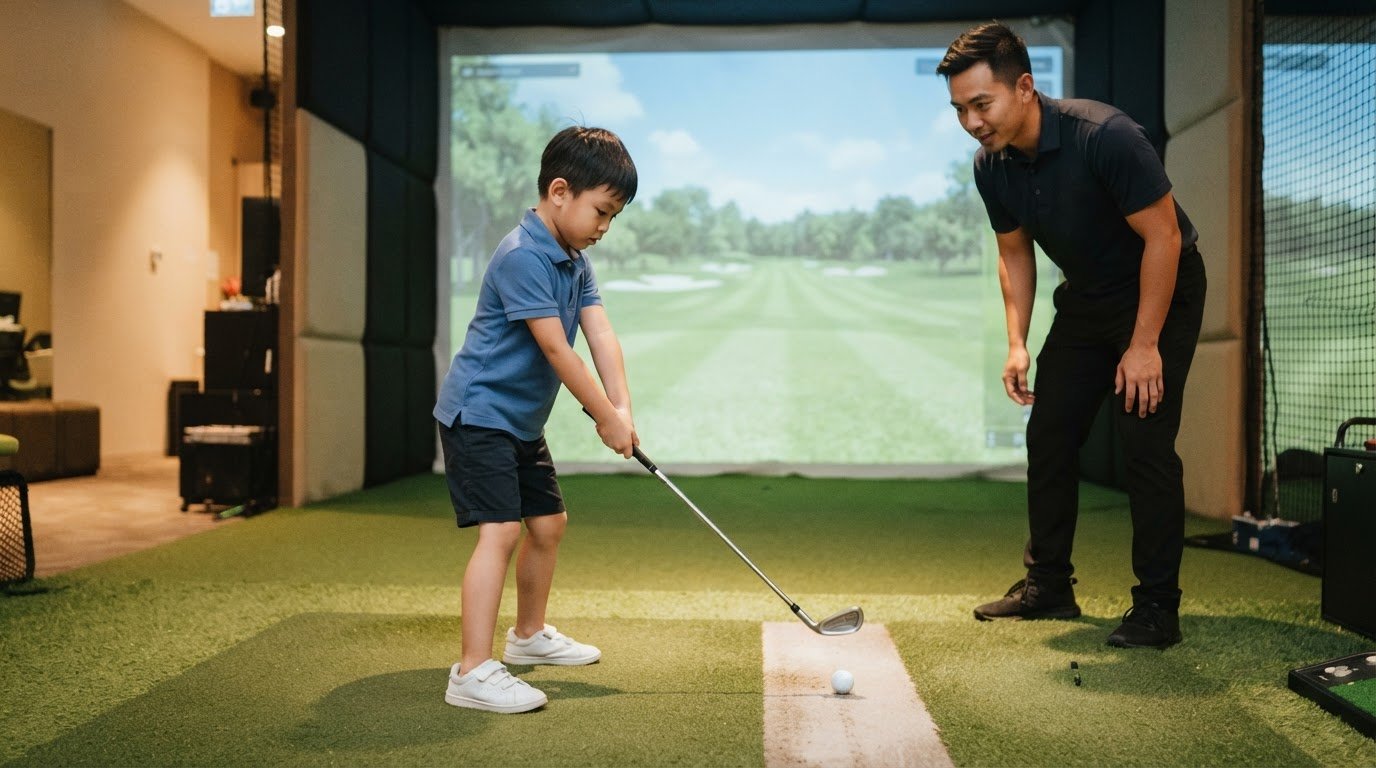
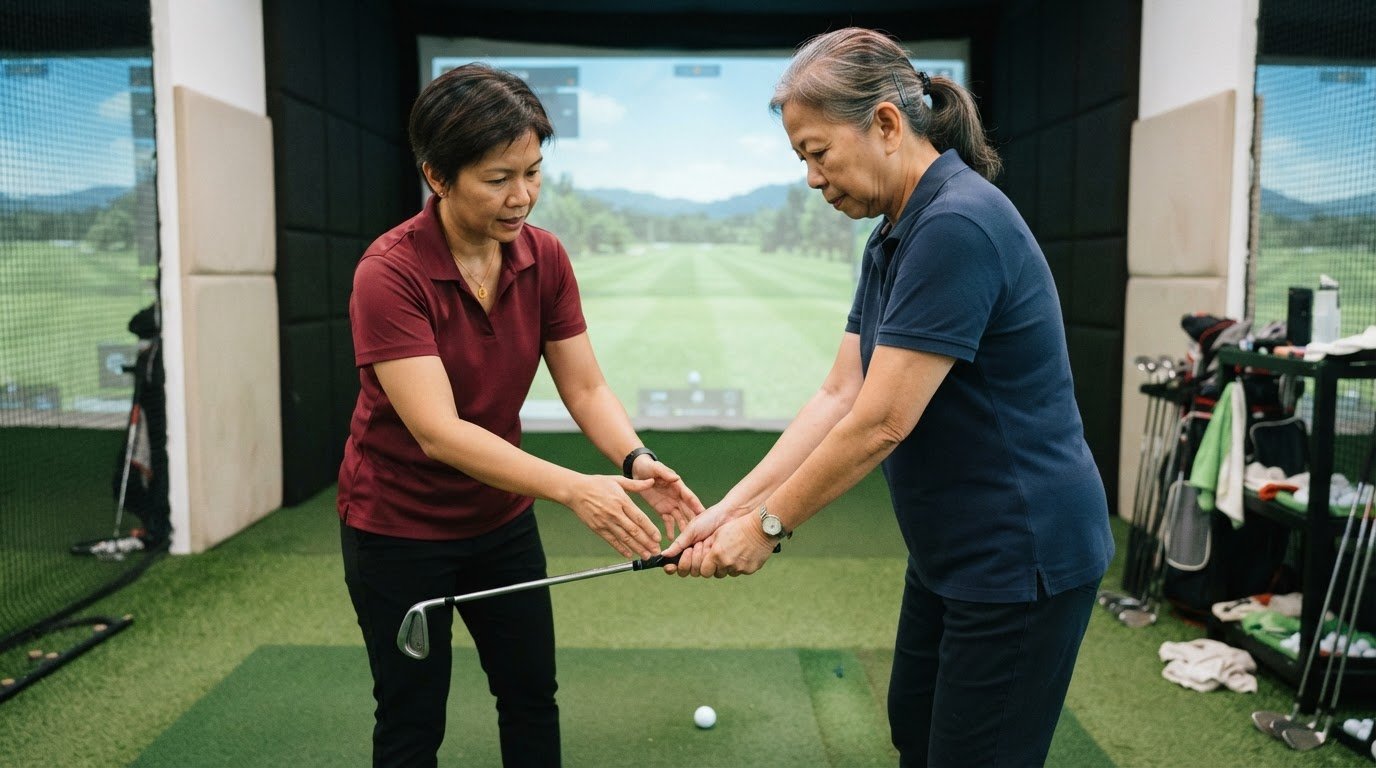
SgGolfCoach offers Adult Lessons for golfers looking for coaching in swing technique, course management and overall fitness. If you’re unsure how to adapt an exercise to your golf movement, coaching can help connect your practice to the way you play.
Adult Lessons are a natural next step when you want professional guidance on specific aspects of your game. For indoor practice, Screen Golf Booking offers another way to engage with golf. Choose the option that suits your current focus, whether you want to develop your technique or practise indoors.
To explore the next step for your golf, contact SgGolfCoach.
Make Your Next Move a Steady One
Aim for a routine you can return to, not a test of how far or fast you can move. Choose a gentle golf exercise that relates to your swing, practise with control and adjust the movement when your comfort or energy changes. Over time, this approach can make gentle golf exercises for older adults a practical part of enjoying the game.
If you’d like help connecting exercise with your golf technique, SgGolfCoach offers Adult Lessons. Coaching can make your practice more purposeful, focusing on the areas of your game you want to develop. Take the next step at a pace that feels right for you.
Contact SgGolfCoach about your golf goals, and keep building a routine that supports more confident, enjoyable play.
Frequently Asked Questions
Are these golf exercises safe with arthritis or a joint replacement?
Adapt exercises to your condition, comfort and any movement restrictions. If you have arthritis, use a smaller range and avoid forcing a joint through pain. After a joint replacement, follow the advice and limits provided by your treating clinician before adding golf-specific movements. For example, try an easy seated turn before attempting a deep standing rotation. Stop if a movement causes sharp or worsening discomfort.
Is strength training good for golfers over 60?
Yes, appropriately chosen strength training can support the muscles used for standing, walking and controlling a golf swing. Start with familiar movements, such as standing from a chair or gently pressing against a wall, and prioritise smooth technique over heavier resistance. Work both sides of your body and allow time to recover between sessions. If a movement changes your posture or causes discomfort, make it easier before continuing.
What golf stretches improve shoulder, hip, and back mobility for seniors?
Gentle shoulder rolls, a supported hip-flexor stretch and comfortable seated trunk turns can each address different areas without requiring a deep stretch. Move slowly into each position, breathe comfortably and don’t bounce or pull a joint to its end range. For a back-focused option, rotate only as far as you can while staying in control. Choose one or two movements for the area that feels tight rather than forcefully stretching every joint.
How many repetitions and how often should seniors do golf exercises?
Follow the repetitions prescribed for each movement, starting with fewer if fatigue affects your form. Spread exercise across the week instead of scheduling every session alongside a demanding round. Keep a simple record of your exercises, effort and next-day soreness. If your movement stays controlled and recovery feels manageable, continue. If not, reduce the range or session length before progressing.
Should older golfers consult a doctor or physiotherapist before starting exercises?
Seek professional guidance before starting if you have a recent injury, a joint replacement, significant pain or health-related movement restrictions. A doctor or physiotherapist can advise which positions and ranges suit your situation; clinics such as benchmarkphysio.com offer evidence-based assessments to help golfers exercise safely without aggravating existing conditions. Bring a clear example of the movement you want to practise, such as turning in a golf stance, so the guidance addresses your goal. Stop and seek advice if exercise causes new or worsening symptoms.
What exercises help older adults improve golf swing rotation without straining the back?
Practise seated upper-body turns or standing trunk rotations with your hands resting across your chest. Keep your hips steady, move through a comfortable range and return to centre before repeating on the other side. Don’t force extra rotation through your lower back if your hips or upper back feel restricted. A mirror can help you see whether your shoulders turn smoothly or your whole body shifts to create the movement.
Are chair-based golf exercises suitable for seniors with balance problems?
Yes, seated movements can help you practise controlled upper-body motion without standing throughout the exercise. Sit toward the front of a stable chair, place both feet flat and try gentle shoulder turns or arm movements that resemble a compact swing. Keep the chair on a firm, even surface and avoid leaning far beyond your base of support. For standing practice, keep a stable handhold nearby.
Comments