

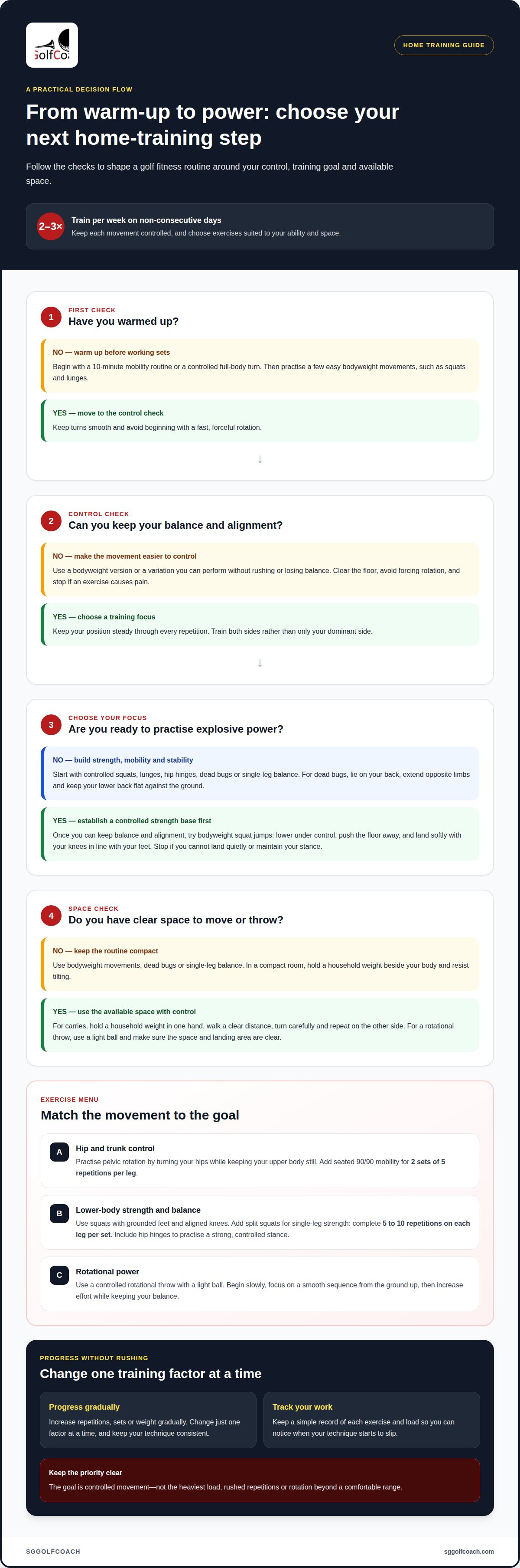
Home golf fitness exercises for swing strength

A stronger golf swing doesn’t require a home gym. Golf fitness exercises at home can build strength, mobility and rotational control with simple movements, bands or a medicine ball. Aim to train 2-3 times per week on non-consecutive days, choosing exercises that suit your current ability and the space you have.
It makes sense to ask whether golf fitness exercises at home can improve your game. Targeted practice can develop the movement and strength used in a swing, while mobility work supports a comfortable turn. Train with control and focus on how each movement relates to your swing, rather than simply doing more repetitions.
This guide explains how home training can support your golf skills, with practical exercises using resistance bands and a medicine ball to build strength and rotation. You’ll also learn how to adapt the exercises to a compact space and create a routine that feels manageable and purposeful.
Table of Contents
Want a Structured Home Program for Golf?
A practical home workout can combine mobility, balance, core strength, squats and single-sided exercises. Train on non-consecutive days, and keep every movement controlled so you can maintain a stable position.
Warm Up Before Home WorkoutsBegin with a 10-minute mobility routine or a controlled full-body turn before adding resistance. If you use a club to guide the turn, move smoothly and keep your feet planted as your torso rotates.Before your working sets, practise a few easy bodyweight movements, such as squats and lunges. Check that you can move through each position without rushing or losing balance. Don’t begin with a fast, forceful turn.
Build Swing Stability and MobilityTrain your core to help transfer force from your lower body to your upper body during the swing. Try dead bugs: lie on your back, extend opposite limbs, and keep your lower back flat against the ground. Work one side at a time, then repeat on the other.Practise pelvic rotation by turning your hips while keeping your upper body still. Add seated 90/90 mobility for 2 sets of 5 repetitions per leg. These movements develop control through the hips and trunk, while single-leg balance challenges stability without needing a large training area.
Strengthen the Lower BodyUse squats to build lower-body strength and practise generating power from a stable base. Keep your feet grounded and knees aligned as you lower, then rise with control. Start with bodyweight and add weight only when you can maintain the same movement quality throughout every repetition.Include split squats for single-leg strength and balance. Use a narrow stance to challenge stability, with most of your weight centred over the middle of your front foot. Complete 5 to 10 repetitions on each leg per set. Pair these with hip hinges to train the muscles that support a strong, controlled stance.
Add Carries and HoldsCarry a household weight in one hand, keeping your torso upright rather than leaning towards the load. Walk a clear distance, turn carefully, and repeat on the other side. In a compact room, hold the weight beside your body and resist tilting.Carries and holds challenge grip and core strength together. Choose a load you can control, keep your shoulders level, and stop the set if your posture changes. The goal is steady control, not carrying the heaviest weight available.
Avoid Workout Mistakes and Injury RisksIncrease repetitions, sets or weight gradually, changing just one factor at a time. A four-week programme gives you time to practise consistently. Keep a simple record of each exercise and load so you can spot when your technique starts to slip.Avoid training only your dominant side, rushing repetitions or forcing rotation beyond a comfortable range. Choose a variation you can control, clear the floor around you, and stop if an exercise causes pain. A balanced routine develops mobility, strength and stability, not just distance.
How Can Training Improve Your Golf Skills?
Golfers have around 0.5 to 0.7 seconds to generate force during the golf swing. Train strength, mobility and speed together so your body can practise producing and transferring force in that brief window.
Train for Swing Technique and DistancePractise a controlled full-body turn and notice how your hips and upper body move in sequence. Separating your hips from your upper body at the start of the downswing stretches the torso muscles and supports the swing sequence. A club can guide the turn, but keep the movement smooth instead of forcing extra rotation.Use strength work to develop the capacity to create force, then rehearse the movement pattern without rushing. This combination may support swing technique and distance, but gym strength alone doesn’t determine either. If you want to connect physical preparation with swing practice, consider golf coaching options.
Develop Explosive Lower-Body PowerBuild a foundation with controlled squats and lunges before adding faster movements. Once you can maintain balance and alignment, try bodyweight squat jumps: lower under control, push the floor away, then land softly with your knees in line with your feet.Keep every explosive repetition crisp. Stop the set if you can no longer land quietly or maintain your stance. Power comes from applying force quickly, not rushing through tired repetitions. Pairing lower-body strength training with quality jumps lets you practise both force production and control.
Add Explosive and Speed TrainingChoose one speed drill, such as a controlled rotational throw with a light ball, and focus on a smooth sequence from the ground up. Start slowly to learn the movement, then increase your effort while keeping your balance. Before throwing, make sure you have open space and a clear landing area.For strength, one training table recommends 1-6 repetitions, 2-6 sets and 2-5 minutes of rest. Keep power drills crisp and controlled rather than turning them into long endurance sets. These are distinct goals; don’t turn a power drill into a long endurance set.
Set Your Training Load and RecoveryFor muscle-building work, the training table gives 6-12 repetitions and 30-90 seconds of rest. For muscular endurance, it recommends at least 12 repetitions, 2-3 sets and 0-30 seconds of rest. Choose the aim first, then match the load, repetitions and recovery to that aim.Progress by adding weight, repetitions or sets, slowing the lowering phase, or moving the weight more explosively on the way up. Change one factor at a time and keep your technique consistent. Steady progression helps you practise transferring strength into faster, coordinated movement without turning every session into a maximum-effort test.
Resistance-band exercises
A home routine can use a resistance band, a stable chair and a backpack loaded with books. Start with bodyweight movements, then add resistance when you can control every repetition.
Set up a single-arm band row by sitting with your legs extended and placing the band around your feet. Hold one end in each hand, then draw one elbow back while keeping your shoulder relaxed. Complete 8 to 10 repetitions on one arm, then switch sides. Keep your torso steady rather than twisting to pull the band farther.
Pair the row with a hip hinge to train the muscles that support your posture. Stand with feet grounded, soften your knees, and push your hips back while keeping your back long. Return to standing smoothly, then perform your band row. Repeat the hip hinge and row pair 1 to 2 additional times, adjusting the band tension if your movement becomes rushed.
Use a band for a standing press to practise shoulder control. Stand on the centre of the band, hold an end in each hand and press forward without shrugging or arching your back. Return your hands slowly. Keep the tension manageable; if you can’t control the return, shorten the movement or reduce the tension.
A loaded backpack provides resistance if you don’t have a band. Secure books inside, hold the pack close to your chest and practise squats with your feet planted. You can also hold it in one hand for a stationary march, keeping your shoulders level. Start with a manageable load, then adjust it gradually.
Combine bodyweight and resistance exercises in a simple sequence: bodyweight squats, band rows and elevated push-ups using a sofa or counter. Raising your hands makes a push-up easier; choose a height that lets you keep your body aligned. Control each movement before adding resistance, and train both sides evenly for single-arm rows.
Keep the band routine consistent rather than testing maximum tension each session. Include a mixture of golf band exercises 2-3 times per week, allowing non-consecutive training days. For the row, use 8 to 10 repetitions on each arm. Track the band position or backpack load, then progress only when your shoulder stays steady and each repetition looks similar.
Rotational power exercises using a medicine ball
Use medicine-ball drills to practise controlled rotation and quick, coordinated movement. Start with a stable stance and a light ball. Speed training should never come at the expense of control.
Start with kneeling rotations to learn the movement without adding a throw. Kneel upright, hold a medicine ball close to your chest, and turn your shoulders smoothly to one side, then the other. Complete 8 to 10 rotations in each direction. Keep your hips facing forward and move through a comfortable range instead of forcing extra twist.This drill helps you notice whether your upper body can rotate while your lower body stays steady. Pause briefly on each side, then return to the centre with control. If your stance feels unstable or your back arches, reduce the range and reset before continuing.
Practise a medicine-ball rotary thrust with your feet planted. Hold the ball near your rear hip, rotate through your torso, and drive it forward in a controlled throw toward a clear, safe space. Use 3 sets of 10 repetitions, with 5 repetitions on each side per set. Reset your stance between throws rather than rushing into the next motion.A 3-5 kg medicine or slam ball is suggested for most people practising throws and slams. Choose a ball you can accelerate and control; a heavier load can slow the movement and change your technique. Give each repetition intent, then recover your balance before switching sides.
Add medicine-ball slams when you can lift and release the ball safely. Raise it overhead without leaning back, then bring it down powerfully in front of your body. The workout prescribes 3 sets of 10 repetitions. Keep the landing area clear, avoid chasing the ball, and reset your feet before every repetition.Use the slam to practise a forceful, whole-body action, not an uncontrolled drop. Keep your knees soft and your trunk braced as the ball moves down. Pairing this drill with squats can help you notice how your lower body supports a strong movement.
Progress to rotational throws only after the kneeling and standing patterns feel consistent. The weights workout recommends 3 sets of 8-10 medicine-ball rotational throws. Rotate through your hips and torso, release the ball toward an open wall or partner, and finish balanced. Match the speed of the throw to the quality of your stance.Allow enough recovery to keep each throw crisp, and stop if your balance or movement deteriorates. Medicine-ball work is one part of a golf routine, not a test of maximum speed. Controlled rotation, clear space and a ball you can handle help reduce avoidable injury risks while practising power.
Adapting golf fitness exercises for home
Build a useful routine around your available space, equipment and current ability. Golf fitness exercises at home can use a resistance band, a stable chair and bodyweight movements to develop strength, mobility and balance without a dedicated gym.
Choose a clear area where you can extend your arms and step in every direction without hitting furniture. In a small space, choose stationary lunges, squats and standing rotations instead of travelling drills. Keep your feet grounded and leave room to set down a band or backpack safely.Use a golf club for slow practice turns if you have enough clearance. Hold it across your shoulders, rotate smoothly, then return to the starting position. This lets you rehearse upper-body movement without swinging a club through a crowded room.
Adapt each exercise to your ability by changing its range or support. If a full press-up feels difficult, place your hands on a sofa, table or counter. The higher the surface, the easier the movement. Lower the surface as you gain control, keeping your body aligned from shoulders to feet.For balance work, stand beside a chair and use one hand for support during a single-leg hold. Rely less on the chair only when you can stay steady. This simple adjustment keeps the focus on stability rather than struggling to complete the exercise.
Use household items instead of specialised weights when you need extra resistance. Hold a securely loaded backpack close to your chest during squats, or carry it in one hand while standing tall. Start with a manageable load and keep your shoulders level. Remove books if your posture changes.Dumbbells can serve a similar purpose if you already have them. Use one for a controlled row or a light squat variation, and practise both sides evenly. The aim is a repeatable movement, not the heaviest load in the room.
Build a compact sequence from familiar exercises: squats, lunges, sit-ups, press-ups and burpees. Start with bodyweight versions, then add a band or backpack to movements you can perform with control. Keep the space around your hands and feet clear, especially during burpees.To train rotation without throwing, hold a light object or golf club close to your body and turn smoothly from side to side. Don’t force the range or move quickly before you can control the turn. Faster movement alone doesn’t guarantee better clubhead speed; a stable, coordinated motion matters.
Progress one feature at a time, such as lowering the press-up support, adding weight to your backpack or improving balance without a chair. Keep the rest of your routine familiar as you adjust that movement. This makes it easier to notice whether your technique stays steady through every repetition.Make golf fitness exercises at home fit your space and current ability, then progress only when your technique stays steady. For coaching that connects practice with your golf movement, book golf lessons with SgGolfCoach.
SgGolfCoach: Screen Golf Booking
SgGolfCoach offers screen golf bookings for golfers who want to practise indoors alongside a home fitness routine. It’s a practical next step when you’re ready to bring strength and mobility work back to golf practice. For swing technique support, adult lessons provide coaching for adult players, while junior programmes are available for younger golfers.
If you’re working on your playing record, SgGolfCoach also offers PC & Handicap. Choose the option that fits your current focus, whether that’s indoor practice, lessons or handicap support. These offerings complement physical training while addressing different golfing needs.
Contact SgGolfCoach to discuss your next step.
Make Your Next Practice Count
Put your training into practice with intention. Choose one movement to focus on during your next golf session, such as a balanced finish or a smooth turn, and notice how it feels. A simple point of focus can connect your work on golf fitness exercises at home with the swing you’re building on the course.
If you’d like guidance that connects physical preparation with your golf goals, Bespoke Coaching offers a focused next step. Keep your practice purposeful and refine your technique as your needs evolve.
Contact SgGolfCoach about home golf fitness and take the next step at a pace that feels right for you. Progress begins with a thoughtful practice and the confidence to keep going.
Frequently Asked Questions
What golf exercises improve swing power and clubhead speed?
Squat jumps and medicine-ball rotational throws train rapid force and coordinated turning, qualities that support a powerful swing. Start each repetition from a balanced position, then accelerate smoothly without losing control. Strength work builds the foundation, while faster movements let you practise applying force quickly. These exercises support physical preparation, but clubhead speed also depends on swing mechanics and timing.
What home exercises improve golf flexibility and hip rotation?
Try a kneeling hip-flexor stretch and a side-lying open-book rotation to work on hip and upper-back mobility. For the open book, lie on your side with your knees bent and reach both hands forward. Sweep your top arm across your body, following it with your eyes. Keep your knees stacked and move only through a comfortable range. Smooth, controlled repetitions are more useful than forcing a deeper turn.
What exercises strengthen the core for golf?
Side planks and band-resisted presses challenge your core to stabilise your trunk while your arms move. For a side plank, support yourself on one forearm and keep your body aligned; bend your knees to make the position easier. For a band press, stand sideways to the anchor and press your hands forward without letting your torso turn. These variations complement floor-based core work by training resistance to rotation.
What golf balance and stability exercises can be done at home?
Practise a tandem stance by placing one foot directly in front of the other, then hold your position without gripping a support. Progress to a single-leg reach: balance on one foot and gently reach the other foot forward, sideways and behind you. Keep a chair nearby for support as you learn the movement. Focus on steady pressure through your foot and a level pelvis, rather than reaching as far as possible.
What is a beginner golf fitness routine at home and how often should you do it?
A beginner routine can pair mobility drills with chair squats, glute bridges, deadbugs and supported balance practice. Keep the movements comfortable and prioritise clean technique before adding resistance. Aim for a session of around 15 minutes, 2-3 times per week on non-consecutive days. Leave recovery time between strength sessions, and adjust the movements to your ability so you can complete them without rushing or losing control.

Comments