

Golf Scoring for Beginners: Rules, Terms and Formats

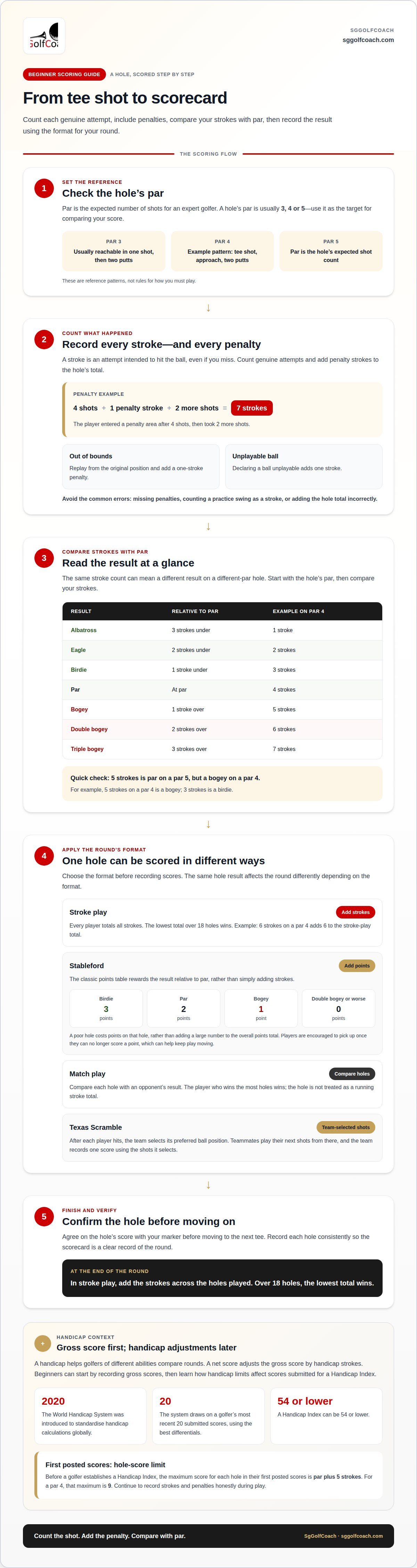
You don’t need to master every golf rule before you can keep score. This golf scoring guide for beginners starts with the basics: count each stroke, then add your scores across the holes you play. In stroke play, the lowest total over 18 holes wins.
Terms like par, bogey and handicap can seem like a lot at first. They become easier to understand when you follow a hole from tee shot to putt and see how each shot affects your score. A handicap also helps golfers of different abilities compare results.
This golf scoring guide for beginners explains key terms, common formats and how to record your score as you play. Follow a round from the tee shot to the final putt, and the scorecard becomes a useful record rather than a puzzle.
Table of Contents
Stroke play, Stableford, match play and Texas Scramble
Common scoring mistakes include missing penalty strokes, counting a practice swing as a stroke or adding the hole’s total incorrectly. Count each genuine attempt to hit the ball, include penalties and apply the rules of the format you’re playing.
Comparing Golf Scoring Formats
Stroke play totals every player’s strokes, Stableford awards points, match play compares holes, and Texas Scramble scores a team’s selected shots. Knowing the format matters because the same hole score can affect a round differently. In stroke play, the lowest total over 18 holes wins; in match play, the player who wins the most holes wins.
Stableford rewards a points total rather than simply adding strokes. In the classic table, a par earns 2 points, a birdie earns 3, a bogey earns 1, and a double bogey or worse earns 0. A poor hole therefore costs points on that hole, but doesn’t add a large number to the overall points total.
In Stableford, players are encouraged to pick up once they can no longer score a point, which can help keep play moving. Texas Scramble is a team format: after each player hits, the team selects its preferred ball position, and teammates play their next shots from there. The team records one score using the shots it selects.
Choose the format before recording scores. For example, a golfer who takes 6 strokes on a par 4 adds 6 in stroke play, while a Stableford card records the points earned for that result. In match play, that hole is compared with an opponent’s result instead of being treated as a running total.
Counting Strokes and Penalties
A stroke is an attempt intended to hit the ball, even if you miss. Count the attempt and add any penalty strokes to the hole’s total. Consistent, honest scoring makes the card meaningful and gives your playing partner a clear record to check.
For example, a player who takes 4 shots before entering a penalty area and then takes 2 more shots finishes with 7 strokes after the one-stroke penalty. A ball out of bounds must be replayed from its original position with a one-stroke penalty. Declaring a ball unplayable also adds one stroke.
Common errors include omitting a penalty or forgetting the replay stroke after an out-of-bounds shot. Before moving to the next tee, agree on the hole’s score with your marker. If a casual round uses a maximum such as double par, apply that limit consistently rather than changing it after a difficult hole.
What do par, birdie and bogey mean?
Par is the reference score for a hole; birdies and bogeys describe results below or above par. Once you know these terms, you can understand a score in relation to the hole, not just count the strokes.
Understanding Par and Birdie
A hole’s par is the expected number of shots for an expert golfer, usually 3, 4 or 5. It gives you a clear point of comparison while playing, whether you finish at par or use more or fewer strokes. On a par 4, for example, a skilled golfer’s expected score is 4.
A birdie means completing a hole one stroke under par. That means 2 strokes on a par 3, 3 on a par 4, or 4 on a par 5. The hole’s par sets the target, so the same number of strokes can mean different things on different holes.
Par also hints at the typical shape of a hole. A par 3 is usually reachable in one shot, followed by two putts. On a par 4, a golfer might take a tee shot, an approach shot and two putts. These are reference patterns, not extra rules for how you must play.
Compare your result with par after each hole. If you take 5 strokes on a par 4, you’ve made a bogey; if you take 3, you’ve made a birdie. Across 18 holes, these terms show where your score sits relative to each hole’s target and help you spot scoring habits.
Scores Above and Below Par
Eagles and albatrosses describe stronger scores below par. An eagle is 2 strokes under par, while an albatross is 3 under. On a par 5, 3 strokes is an eagle and 2 is an albatross; on a par 4, 2 strokes is an eagle and 1 is an albatross.
Bogey describes a score 1 stroke over par, and double bogey means 2 over. A triple bogey is 3 over. So, on a par 3, scores of 4, 5 and 6 are respectively a bogey, double bogey and triple bogey. On a par 5, those terms correspond to 6, 7 and 8 strokes.
Think of the terms as a quick comparison: birdie, eagle and albatross are under par; bogey, double bogey and triple bogey are over. For example, 5 strokes on a par 5 is par, but 5 on a par 4 is a bogey. This shared language helps golfers discuss results clearly, whether they’re reviewing one hole or an 18-hole round.
Start by checking the hole’s par, then compare it with your strokes. Remember that two under par is an eagle and two over is a double bogey. These basics help you interpret a result quickly without confusing the target score with the strokes you played.
How do you keep score in golf?
A handicap helps golfers of different abilities compare rounds, while a net score adjusts the gross score by handicap strokes. Beginners can start by recording gross scores, then learn how handicap limits affect scores submitted for a Handicap Index. This golf scoring guide for beginners treats the scorecard as both a record of the round and a way to track progress.
The World Handicap System was introduced in 2020 and standardises handicap calculations globally. It uses the best differentials from a golfer’s recent rounds, drawing on their most recent 20 submitted scores. A Handicap Index can be 54 or lower. The calculation therefore considers selected recent results, rather than simply averaging every score a golfer has recorded.
Before a golfer establishes a Handicap Index, the maximum score for each hole in their first posted scores is par plus 5 strokes. This limit helps prevent one unusually difficult hole from dominating a submitted round. For example, if a hole’s par is 4, the maximum score counted for that first posted score is 9. The player still records strokes and penalties honestly during play.
Once a golfer has a Handicap Index, the maximum hole score used for handicap purposes is net double bogey. This adjusted limit is different from the gross score recorded during play. Gross score includes the actual strokes and penalties; the handicap limit applies when adjusting a hole score for handicap purposes.
Net score is the gross score adjusted for the handicap strokes received during the round. These strokes are allocated across holes according to the applicable stroke index. A player might receive a stroke on one hole but not another, so calculating net score involves more than subtracting the entire handicap from the gross total.
Keep gross and net scores separate when reviewing results. A birdie or a difficult hole appears in the actual gross record, while the handicap adjustment follows its own limits. Comparing both figures across submitted rounds can help you understand your performance and how your Handicap Index responds to recent scores.
Handicaps support fair competition and help track personal progress. An index can change as newer scores enter the recent set used in its calculation. It is not a fixed label or a prediction of your next round. This golf scoring guide for beginners makes the distinction clear: your handicap helps compare ability, while the scorecard records what happened on the course.
For guidance with scoring and handicap progress, Adult Lessons can support your skill development, while PC & Handicap helps you track handicap information.
Paper scorecards versus scoring apps
A paper scorecard and a digital app can both track scores over an 18-hole round. Choose the method that lets you record each hole clearly and review your results afterward.
A paper scorecard keeps the course layout and scoring spaces together. Find the row for each hole and write your strokes in the box after you finish it. If the course par is listed, compare your score with par as you play. A pencil also makes it easy to correct an entry neatly.
A scoring app records results digitally and often calculates a running total from the scores you enter. This can make it easier to review a round without adding each hole manually. The essential task is the same: enter the correct score for every hole, including penalties, and check that the total covers all holes played.
Read the scorecard before teeing off. Look for the hole numbers, par values and any stroke index information used for handicap scoring. In stroke play, record the number of strokes taken on each hole, not just whether the ball reached the fairway. For example, a golfer who takes 6 strokes on a par 4 records 6, even if the approach shot was strong.
Scores give useful context, but they vary by golfer and course. Recreational golfers typically score around 90-100 strokes for an 18-hole round, while the research range for beginners is 95-120 strokes. Many 18-hole courses have a total par of 70 to 72 strokes, so compare a round with that course’s par rather than treating one total as universal.
Set a goal that focuses on steady progress. A beginner can first aim to finish each hole, even if it takes 8 or 9 shots, then work toward breaking 120 consistently. Record the full score honestly before reviewing whether a particular hole, such as one with a bunker, affected the round. A realistic target helps turn scores into useful feedback.
Use the notes area, if available, to record one detail that might explain a score. For example, note “tee shot missed fairway” or “stance felt unsettled” beside the hole. After several rounds, these notes can reveal patterns that a total alone won’t show. Whether you use paper or an app, consistent records make round-to-round comparisons more useful.
How a golf round and hole are played
A round links a sequence of holes, each with its own teeing area, route and green. Most courses have 18 holes, though beginners can start with 9 before playing a full round.
Be considerate, keep up a prompt pace, follow safety practices and avoid distracting other players. On each hole, the player whose ball is farthest from the hole generally plays next. In stroke play, players may play out of turn when it is safe and responsible.
Play starts in the teeing area. Hit toward the fairway or green, then play from where the ball comes to rest until it reaches the hole. Count each attempted stroke and add any penalty strokes to the hole’s total.
A par 3 is typically reachable in one shot, followed by two putts. On a par 4, a common pattern is a tee shot, an approach shot and two putts. On a par 5, many golfers take three shots to reach the green before putting. These are examples, not required shot sequences; a golfer counts the strokes actually taken.
Once the ball reaches the green, putting begins. Players generally take turns with the ball farthest from the hole playing first, unless they agree to play out of turn safely in stroke play. The hole ends when the ball is holed. Record the score before moving to the next tee.
A hole-in-one means getting the ball into the hole in one swing. More commonly, a player uses several shots across the tee, fairway, approach and green. Across 18 holes, stroke play rewards the lowest total number of strokes. In match play, players compare results hole by hole, so winning a hole matters more than the overall stroke total.
Some rounds take place over 9 holes instead of 18, giving a beginner a shorter introduction to playing a course. A group of four typically takes between 3.5 and 4.5 hours for a full 18-hole round. The time depends on the group’s pace and how quickly players move between shots and holes.
One useful takeaway: follow the ball from tee to hole, count each stroke and penalty, then record that hole’s score. Repeat the sequence for each hole. The Rules of Golf also allow a player to make a stroke within 40 seconds once able to play, supporting prompt movement through the round.
To put the sequence into practice, explore golf scoring practice in a guided setting.
SgGolfCoach: Screen Golf Booking
SgGolfCoach offers Screen Golf Booking for experiencing golf scoring indoors. Once you understand how strokes, hole scores and formats fit together, use a screen-golf session to practise following the sequence of play and recording your results.
For structured guidance alongside practice, Adult Lessons and Junior Programs support golfers as they develop their skills. PC & Handicap helps you understand handicap tracking and how it relates to your scores. Choose the option that suits your next step, whether you’re getting familiar with play or working toward more consistent scoring.
Contact SgGolfCoach to discuss your golf-learning goals.
Make your next round a learning opportunity
Make your next round about more than the final number. Choose one aspect of your game to pay attention to, such as your pre-shot routine or how you respond to an unexpected result. A small focus gives each round a purpose and makes progress easier to notice over time.
Use this golf scoring guide for beginners whenever a term or format feels unfamiliar. You don’t need to remember everything at once. Build confidence through regular play, honest scorekeeping and curiosity about what each round can teach you.
If you’d value guidance as you put your understanding into practice, contact SgGolfCoach for golf scoring help. The right support can help turn new knowledge into a more considered approach to playing. Keep learning, enjoy the process and let each round be a fresh opportunity to grow.
Frequently Asked Questions
What Is a Handicap, and Why Does It Matter?
A handicap is a measure of a golfer’s playing ability that helps make competition between players fairer. It provides a shared reference when comparing performances, rather than relying only on raw scores. Under the World Handicap System, a Handicap Index can be 54 or lower. For a beginner, the value is practical: it helps track progress and compare results across rounds without treating one unusually good or difficult day as the full picture.
How is a handicap calculated?
The World Handicap System calculates a Handicap Index using the best differentials from a golfer’s most recent 20 submitted scores. A differential relates a score to the difficulty of the course and the conditions of play. The index therefore reflects selected recent results, not simply the golfer’s average score. As newer scores are submitted, the set of recent rounds used in the calculation can change.
What golf terms should beginners know?
Start with the terms that explain a result or scoring method. Par is the reference score for a hole; a birdie is one stroke under par, and an eagle is two under. A bogey is one over. Stroke play totals strokes, while match play compares holes won. Stableford awards points according to a hole score relative to par.
How does golf scoring work for beginners?
In a typical stroke-play round, record the strokes taken on each hole, then add the hole scores for the round total. Include penalty strokes in the relevant hole’s score. For example, a scorecard with hole results of 5, 6 and 4 shows 15 strokes across those three holes. Keep the score for each hole separate, so you can see where the total came from.
What do par, birdie, bogey, and double bogey mean?
These terms compare a golfer’s strokes with a hole’s par. On a par 3, a score of 2 is a birdie, 3 is par, 4 is a bogey, and 5 is a double bogey. The labels shift with the hole’s par: on a par 5, a score of 6 is a bogey. Identify par first, then compare your strokes.
How do you count strokes on each golf hole?
Count each attempt intended to strike the ball, including an attempt that misses, and add applicable penalty strokes. For example, if a player takes a tee shot, a second shot, misses on the next attempt, then holes the ball with another shot, the hole’s score is 4 strokes before any penalties. Record the result for that hole before adding it to the round total.
What is stroke play versus match play in golf?
Stroke play compares each player’s total strokes across the round, and the lowest total wins. Match play compares results hole by hole: the player with the better score wins the hole, and whoever wins the most holes wins the game. A high score on one hole affects the formats differently, so find out which format is being played before assessing the result.
What are the basic rules for penalties and lost balls?
Taking relief from a ball in a penalty area carries a one-stroke penalty. A ball out of bounds must be replayed from its original position with a one-stroke penalty. If a ball is not found after three minutes of searching, it is considered lost; add one penalty stroke and replay from the original spot. Include all penalty strokes in the hole’s score.



Comments