

Golf Rules and Etiquette for Beginners: The 2026 Essential Checklist

What if the most intimidating part of your first round at a premier Singapore course isn't the daunting water hazard on the fifth hole, but the silent judgment of the seasoned group playing behind you? Most new players feel a wave of anxiety when stepping onto the tee, worried that a lack of knowledge regarding golf rules and etiquette for beginners will mark them as an amateur. It's a common hurdle that can make this beautiful sport feel like an exclusive club with a secret language you haven't quite mastered yet.
We understand that uncertainty, and we believe that true confidence comes from a blend of technical skill and social fluency. This 2026 checklist is designed to help you master the unwritten social codes and fundamental rules required to step onto any national course with absolute poise. Our goal is to provide the tools you need to feel like a "real" golfer from the moment you arrive at the clubhouse, ensuring you belong in any playing group.
We'll provide a clear roadmap for handling common ball-drop scenarios and maintaining a brisk pace of play without the stress. You'll discover how to navigate the course like a professional, ensuring your focus remains on your swing and the social enjoyment of the game. Let's prepare you to transition from the simulator to the fairway with complete peace of mind and the respect of your peers.
Table of Contents
The Beginner’s Mindset: Why Rules and Etiquette Matter
Stepping onto a lush fairway for the first time is an exhilarating experience. However, many new players find their excitement overshadowed by a nagging fear of doing something "wrong" in front of others. You should view golf rules and etiquette for beginners not as a rigid set of restrictions, but as the essential social oil that keeps the game moving smoothly for everyone. When you understand these conventions, you transform from an anxious outsider into a respected member of the golfing community who understands the rhythm of the course.
It's a common misconception that the rulebook exists solely to hand out penalties. In reality, the 2026 R&A and USGA updates are designed to assist the player as much as they regulate the game. Knowing your options for relief or how to properly identify a ball can actually save you strokes and prevent unnecessary frustration. As your premium mentor, we encourage you to see these guidelines as a source of empowerment. Mastering the "Spirit of the Game" means acting with integrity and showing consideration for others, which is the hallmark of a true golfer regardless of their handicap.
The Difference Between Rules and Etiquette
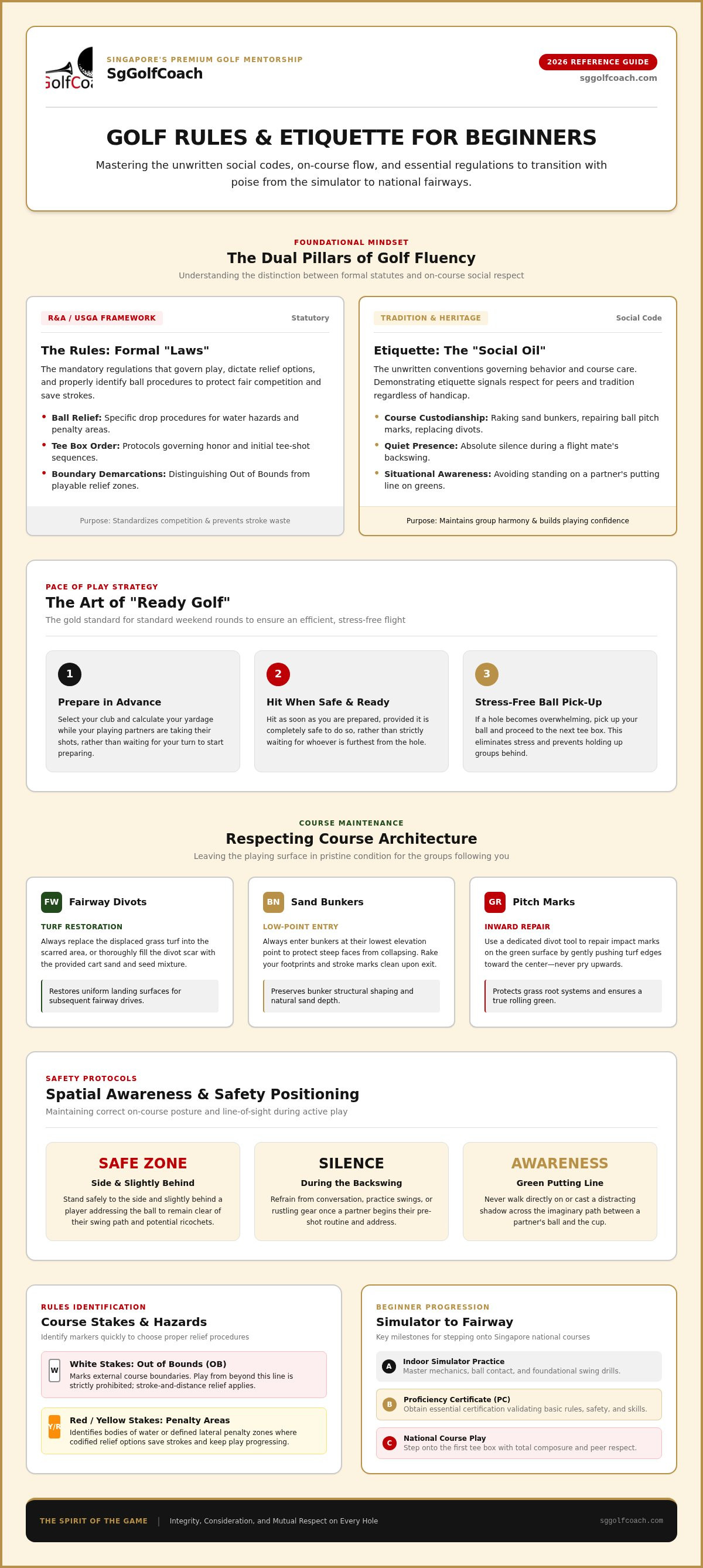
While they often overlap, rules and etiquette serve distinct purposes. Rules are the formal "laws" that dictate how the game is played, such as the specific procedure for dropping a ball back into play after a hazard. Etiquette refers to the established golf etiquette conventions that govern social behavior and course care. This includes simple acts like remaining silent during a partner's backswing or raking a bunker after your shot. For a novice, demonstrating excellent manners is often more vital than knowing every technical rule, as it shows a fundamental respect for the traditions of the sport.
Building Confidence Through Knowledge
Anxiety often stems from the unknown. Knowing exactly where to stand when a flight mate is driving or understanding how to move across the green without stepping on a "line" significantly reduces first-tee jitters. This situational awareness projects an image of competence and presence that belies your experience level. When you are a pleasure to play with, you'll find that more experienced players are eager to invite you back for future rounds. Golf etiquette is a commitment to the game’s heritage and a disciplined pace that respects every player's time on the course.
Essential On-Course Etiquette: Mastering the Social Flow
Mastering the flow of a round is what separates a novice from a golfer who feels at home on any national course. While technical skills are vital, your ability to integrate into the social rhythm of the flight determines your overall experience. Integrating golf rules and etiquette for beginners into your routine ensures you aren't just playing the game, but participating in its long-standing traditions with grace. This social fluency is just as important as your swing mechanics when it's time to step onto the first tee.
The Art of Ready Golf
In a standard weekend round, "Ready Golf" is the gold standard for maintaining a pleasant pace. It simply means hitting your shot as soon as you are ready, provided it's safe, rather than strictly adhering to the traditional rule where the person furthest from the hole hits first. You can prepare for your next move by selecting your club and calculating your yardage while your partners are playing their shots. If a hole becomes overwhelming, don't be afraid to pick up your ball and move to the next tee. This keeps the game moving and reduces the stress of holding up faster groups behind you.
Respecting the Course Architecture
Leaving the course in pristine condition is a hallmark of a player who values the sport's environment. When your ball impacts the green, use a divot tool to repair the pitch mark by gently pushing the turf toward the center. On the fairway, always replace your divot or use the provided sand and seed mix to fill the scar. When navigating bunkers, enter from the lowest point to avoid damaging the steep faces, and always rake your path as you exit. This PGA beginner etiquette and rules guide provides a detailed look at these essential maintenance habits.
Safety and silence are the final pillars of on-course presence. Always stand to the side and slightly behind the player hitting, ensuring you're out of their peripheral vision and the potential flight path. Avoid any movement or club rattling during a partner's backswing. These small acts of consideration build a reputation as a sophisticated playing partner. If you want to master these nuances before your first national round, our bespoke coaching programs offer personalized guidance on the finer points of golf rules and etiquette for beginners.
Navigating Key Scenarios: From Tee to Green
Your journey on each hole begins at the tee box, a space where precision and poise are paramount. While the traditional "honor" system dictates that the lowest scorer on the previous hole hits first, modern play often encourages a more fluid, ready-golf approach. Always stay behind the tee markers and maintain absolute silence while others are addressing the ball. This discipline is a core component of golf rules and etiquette for beginners, signaling that you respect the focus required for a successful start.
If your ball finds the rough, remember the strict three-minute search limit. This rule, detailed in the official USGA Rules of Golf, is a firm boundary designed to prevent course bottlenecks. If your search is taking time and the group behind is waiting, inviting them to play through is a sophisticated move that earns you immediate respect. It demonstrates that you value the collective pace of play as much as your own score.
Bunker Basics and Sand Etiquette
Sand traps require a meticulous level of care to remain fair for all players. One of the most critical rules is that you cannot "ground" your club. This means your clubhead must not touch the sand during a practice swing or your actual backswing; touching the sand before the strike results in a penalty. To maintain the course's pristine condition, always enter and exit the bunker from the lowest point. This simple act prevents the steep faces from collapsing. Once you've finished your shot, rake your footprints and any disturbances thoroughly so the next player finds a smooth, professional surface.
Putting Green Protocols
The green is the most delicate part of the course and requires your full attention to social decorum. You should never walk on another player’s "line," which is the direct path their ball will take to the hole. Walking on this line can create small depressions that alter the putt's trajectory. Additionally, be mindful of your shadow. On sunny afternoons, ensure your shadow doesn't stretch across a partner's line or the hole itself. Since recent rule updates, you can choose to leave the flagstick in while putting, which often helps maintain a steady pace. These small details are what define your mastery of golf rules and etiquette for beginners.
Fundamental Rules Every Beginner Should Know
While etiquette ensures you're a welcome addition to any flight, a firm grasp of technical rules ensures your scorecard reflects your true progress. Understanding the golf rules and etiquette for beginners involves more than just social graces; it requires knowing how to navigate the physical boundaries of a national course. One of the most visible indicators of these boundaries is the stake system. White stakes signify Out of Bounds (OB), which typically requires you to play from your previous spot with a one-stroke penalty. In contrast, red or yellow stakes indicate penalty areas where you have more flexible relief options to keep your round moving smoothly.
The fundamental directive in golf is to play the ball as it lies. However, the rulebook provides essential relief for man-made obstructions or specific course maintenance issues. When you must take a drop, the 2026 standard dictates that you hold the ball at knee height and let it fall straight down into the relief area. This procedure ensures a fair restart without gaining an unfair advantage from a hand-placed lie. Mastering these mechanics early on builds the confidence needed to handle complex scenarios without hesitation, allowing you to focus on the joy of the game.
Identifying Penalties and Relief
Yellow penalty areas offer two relief options, while red areas provide an additional lateral option. If your ball is in a thick bush but not in a penalty area, you can declare an unplayable lie and take a one-stroke penalty to find a better position. Abnormal Course Conditions refer to temporary situations such as casual water, ground under repair, or interference from man-made structures like cart paths and sprinkler heads. These conditions allow for free relief to ensure the game remains fair and your equipment stays protected.
The Provisional Ball Strategy
Efficiency is a hallmark of a sophisticated player who respects the time of others. If you suspect your ball is lost outside a penalty area or is out of bounds, hit a provisional ball immediately. This act saves you a ten-minute walk back to the original spot if the first ball isn't found. You must clearly state, "I'm playing a provisional ball," before hitting the second shot. If you find your original ball in bounds within three minutes, you continue with it and abandon the provisional ball without penalty.
To refine your understanding of these rules in a low-pressure environment, we recommend exploring our Bespoke Coaching programs designed to bridge the gap between theory and practice.
From Theory to Practice: Your First Round with SgGolfCoach
Moving from the controlled environment of an indoor golf Singapore facility to the vast, open fairways of a national course is a significant milestone for any student. Simulators are excellent tools for honing your swing mechanics without the pressure of weather or complex terrain. However, the transition to grass presents unique variables that require a deeper understanding of golf rules and etiquette for beginners. Our coaching philosophy ensures this transition is seamless, pairing technical mastery with the practical wisdom needed to navigate real-world scenarios with absolute poise.
We believe that true confidence on the course comes from knowing you belong there. By integrating rule education directly into our bespoke coaching sessions, we remove the anxiety often associated with the first round. You aren't just learning how to hit the ball; you're learning how to manage the course, respect your peers, and uphold the traditions that make the game so rewarding. This holistic approach prepares you for a lifetime of enjoyment on the greens.
The Path to Your PC and Handicap
In Singapore, the Proficiency Certificate (PC) is the essential gateway to accessing national courses. We guide you through the PC handicap golf Singapore process, ensuring you aren't just memorizing a list of penalties but truly understanding the logic behind the game's governance. Enrolling in beginner golf lessons Singapore provides the structured environment necessary to pass your rules test with confidence. A professional mentor acts as a shortcut, clarifying nuances that might otherwise take years to learn through trial and error, while ensuring you develop a handicap that accurately reflects your potential.
Booking Your First On-Course Lesson
A "playing lesson" is where theory meets reality. Under the watchful eye of a professional, you'll apply etiquette in real-time, learning exactly when to rake a bunker or how to manage your shadow on the green without disrupting a partner's focus. This hands-on experience removes the guesswork and allows you to focus on the lifestyle benefits of the sport. You'll leave the lesson feeling like a seasoned golfer, ready to join any flight with the respect of your peers.
Before you head to the first tee, ensure your bag is equipped for compliance. A final checklist for every beginner includes a pitch mark repair tool for green maintenance, a ball marker to accurately identify your position, and extra balls for provisional shots. Carrying a digital copy of the 2026 rule updates ensures you're never caught off guard. Mastery of golf rules and etiquette for beginners is your ticket to a stress-free round. Elevate your game with bespoke coaching at SgGolfCoach to ensure your first round is as rewarding as it is disciplined.
Step Onto the First Tee with Absolute Confidence
Mastering golf rules and etiquette for beginners is the final bridge between practice and performance. By internalizing the social rhythm of "Ready Golf" and the technical nuances of penalty relief, you ensure every round is seamless for both yourself and your playing partners. This knowledge builds a sophisticated on-course presence that commands respect from the moment you arrive at the clubhouse. You've learned that the rulebook isn't just a list of restrictions; it's a guide to enjoying the game's rich heritage with poise.
At SgGolfCoach, we specialize in making this transition effortless through bespoke adult and junior coaching programs. Our expert mentors provide the dedicated guidance needed for PC and Handicap certification, utilizing both premium indoor simulators and national outdoor training facilities. We're here to ensure your journey into the sport is defined by growth, precision, and personal enjoyment. Your transformation into a confident, skilled golfer begins with the right partnership and a commitment to excellence.
Start Your Journey with Professional Beginner Lessons and discover how refined technique meets social fluency. We look forward to seeing you on the fairway.
Frequently Asked Questions
What is the most important rule for a beginner to remember?
The most critical rule for any novice is to maintain the pace of play through "Ready Golf." This means hitting your shot when you are ready and it is safe, regardless of who is furthest from the hole. It ensures the game remains enjoyable for everyone. Prioritizing this aspect of golf rules and etiquette for beginners helps you integrate into any flight and reduces on-course pressure.
How long do I have to search for a lost golf ball?
Under the 2026 R&A and USGA standards, you have exactly three minutes to search for a lost ball. This time limit begins from the moment you or your partners start looking for it. If you cannot locate the ball within this window, it is officially considered lost. Adhering to this timeframe is essential for keeping the game moving and showing respect for the groups playing behind you.
Can I move my ball if it is stuck behind a tree?
You generally cannot move your ball without a penalty if it is obstructed by a natural object like a tree. You must either play it as it lies or declare it unplayable. Declaring an unplayable lie incurs a one-stroke penalty but allows you to drop the ball within two club-lengths or go back on a line. This strategic decision is a key part of golf rules and etiquette for beginners.
What should I do if I think my ball went out of bounds?
If you suspect your ball traveled out of bounds, you should immediately play a provisional ball from the same spot. You must clearly declare your intention to your partners before hitting. This proactive step saves time by preventing a long walk back if your original ball is indeed lost. If you find the original ball in play, simply pick up the provisional and continue without penalty.
Is it okay to use my mobile phone on the golf course?
While modern golf allows mobile phones for GPS yardage apps, you should keep your device on silent at all times. Avoid taking voice calls or playing loud media, as this disrupts the focus other players expect. If you must take an urgent call, step away from the flight and keep the conversation brief. Maintaining a quiet environment is a hallmark of sophisticated etiquette on any premier national course.
What does "playing through" mean and when should I offer it?
"Playing through" refers to the act of inviting a faster group behind you to pass and play the hole ahead. You should offer this if your group is searching for a ball or if there is an open hole ahead and the group behind is waiting on every shot. It is a gracious gesture that prevents course congestion and demonstrates your commitment to the collective social enjoyment of the sport.
Do I need a handicap to play on a public golf course?
In Singapore, you typically don't need a full handicap for public courses, but you must possess a valid Proficiency Certificate (PC). This certificate confirms you understand basic safety and golf rules and etiquette for beginners. SgGolfCoach offers specialized programs to help you achieve your PC and transition toward a full handicap. This ensures you have the necessary skills and knowledge to navigate national courses with absolute confidence.
What is the correct way to drop a golf ball for relief?
To take a proper drop for relief, you must hold the ball at knee height and let it fall straight down into the relief area. The ball must stay within this area to be in play. If it rolls outside the boundary, you should drop it a second time. If it still won't stay, you place it where it first touched the ground. This specific 2026 procedure ensures fairness for all players.


Comments