

Effective Golf Practice: Skills for the Course

What if hitting fewer balls could make your next practice session more useful? Learning how to practice golf effectively starts with a clear target, not a packed bucket. When you swing without a plan, it’s hard to know what to work on or whether a change is helping. Putting and short-game skills can easily get overlooked, too.
Improvement comes from a focused cycle: choose one priority, practise it with useful feedback, then test it in varied situations. You don’t need to make every session complicated. Aim to finish knowing what you worked on and what to try next.
In this guide, you’ll learn how to set a practical session goal, balance full swings with putting and short-game practice, and track progress without chasing every imperfect shot. You’ll also find ways to bring range skills into more realistic challenges, so practice can support calmer decisions on the course. A simple plan and regular review can build confidence as well as technique.
Table of Contents
How to Practise Golf Effectively Starts with a Clear Goal
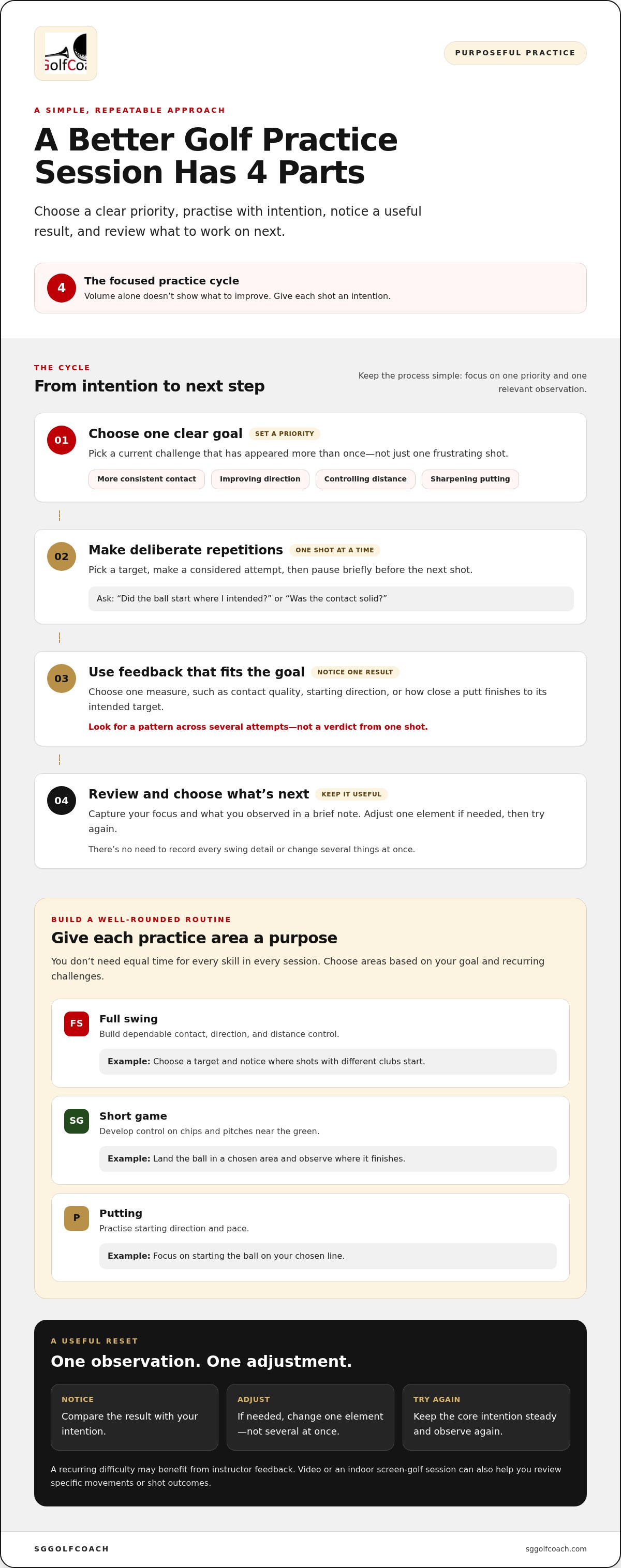
Effective golf practice has four parts: a clear goal, deliberate repetitions, feedback, and review. Hitting more balls can build familiarity, but volume alone doesn’t show you what to improve or whether a change is working. Give each shot an intention and take time to notice the result.
Start by choosing one current priority, such as making more consistent contact, improving direction, controlling distance, or sharpening your putting. Look for a challenge that has come up repeatedly during practice or play. If you’re unsure where to begin, consider how it affects your decisions on the course. The aim of the game of golf is to complete each hole in as few strokes as possible, but progress isn’t measured by scores alone. More reliable contact or more confident decisions can be meaningful steps forward.
How do you choose one useful golf practice goal?
Turn a broad ambition into an action you can observe during the session. “Improve my iron play” is difficult to assess. “Notice whether my next set of shots starts towards my intended line” gives you something specific to watch. For putting, you could focus on starting the ball on your chosen line. Keep the goal narrow enough to review without trying to track every detail of your swing.
Choose a challenge that has appeared more than once instead of reacting to a single frustrating shot. If distance control is your focus, select a target area and notice where your shots finish in relation to it. Don’t expect one session to guarantee a lower score. Set an intention, gather useful observations, and use them to decide what to practise next.
What makes a golf practice session deliberate?
Deliberate practice means each repetition has a purpose. Pick a target, make a considered attempt, then pause briefly to notice what happened. Did the ball start where you intended? Was the contact solid? That short reset helps you prepare for the next attempt rather than repeating the last swing on autopilot.
Keep the process simple: choose an intention, hit a shot, observe one relevant result, and reset. If the result differs from your aim, avoid changing several things at once. One useful observation is easier to apply and review. Unstructured ball-hitting can still be enjoyable, especially as a relaxed introduction to practice. Focused repetitions offer a clearer way to work towards a particular skill. For a basic overview of the game of golf, including its objective and terminology, see Wikipedia.
Build Better Golf Skills with Feedback and a Simple Review
A useful review helps you distinguish a passing result from a pattern. Use a straightforward loop: attempt the shot, observe one result, adjust one element if needed, then try again. If your goal is direction, for example, note where the ball starts in relation to your target. Avoid changing your grip, aim, and swing thought all at once. One adjustment makes it easier to understand what may have influenced the next shot.
How can golfers assess practice without overanalysing every swing?
Choose one measure that matches your goal, such as contact quality, starting direction, or how close a putt finishes to your intended target. Look for patterns across several attempts instead of letting one excellent or poor shot define the session. A brief note on your phone or in a practice journal can capture your focus and what you observed. There’s no need to record every swing detail.
An occasional miss is information, not proof that practice has failed. If several shots show a similar pattern, consider whether your setup or intention needs attention. If the results vary, note that too. Video can help you review a specific movement, while an indoor screen-golf session offers another setting for observing shot outcomes. Use these tools to guide reflection, not to diagnose every technical detail on your own. The PGA’s guide to simple golf drills can also help you choose a structured task to review.
When should you adjust a drill or seek coaching feedback?
Change part of a drill when it no longer serves your goal or when it’s too easy or difficult to keep your attention on the skill you’re practising. Keep the core intention steady as you adjust the target, club, or challenge. That makes it easier to judge whether the new version is more useful.
If the same difficulty keeps returning, an instructor can help identify a priority and interpret what your practice observations may mean. Professional feedback can bring clarity to a recurring pattern, so you can focus on a relevant adjustment instead of guessing at several changes. Explore one-to-one golf instruction for a personalised review of your practice. A steady cycle of observation and adjustment is central to how to practice golf effectively, though progress takes consistent attention over time rather than a guaranteed quick fix. For tailored support as you refine that process, consider personalised golf coaching.
Balance Full-Swing, Short-Game, and Putting Practice
A well-rounded routine gives attention to more than full swings. You don’t need to give every skill equal time in every session. Choose practice areas based on your current goal and the challenges that keep appearing in your game. Varying your tasks also lets you rehearse how you select a target, prepare, and respond, rather than repeating one technique in isolation.
What should golfers practise at the driving range?
Give each shot a purpose. Instead of hitting the same club towards open space, pick a clear target and switch clubs in a way that supports your session goal. For contact, notice how consistently you strike the ball. For direction, pay attention to its starting line. You don’t need to judge every detail at once.
Once you’ve worked on your priority, make the final shots less predictable. Change the target or club between attempts, and reset your routine before each swing. This adds variety and encourages you to choose and commit to each shot instead of relying on a long sequence of identical repetitions.
How should you practise putting and the short game?
For putting, combine distance control with starting direction and the routine you want to use on the course. Roll balls towards a selected target from different starting points, then notice whether they finish near your intended area. For chips or pitches, choose a landing zone and assess both where the ball lands and where it finishes. These clear outcomes make practice more purposeful than simply hitting balls towards a hole.
You can also vary the practice setting. Indoor golf practice and play offer a structured environment to work on skills and experience simulated golf, complementing rather than replacing other forms of practice. Choose the areas that matter most to you, and make how to practice golf effectively a matter of thoughtful balance rather than a fixed formula.
Follow a Repeatable Golf Practice Plan from Warm-Up to Review
A repeatable structure helps you make good use of a range, putting area, or indoor screen-golf setting, even when the time you have changes. Keep the sequence consistent, then adapt the focus and tasks to your skill level. Aim to leave with one useful observation and an intention to carry into your next round.
What should a golfer do before hitting practice shots?
Begin with comfortable movement and easy swings, allowing yourself to settle in before working on a technical focus. Set one session goal and decide what a useful result would look like. If you’re focusing on direction, for instance, choose a target and notice where the ball starts in relation to it. Keep a brief note on your phone or in a notebook so you can review the session without trying to remember every shot.
Use this flexible sequence as a guide, not a fixed prescription. Adjust each step to your time, practice setting, and needs:
Step 1: Warm up. Move comfortably and begin with easy swings before adding a specific focus.
Step 2: Choose a priority. Select one skill and identify what you’ll observe to assess it.
Step 3: Practise deliberately. Use a target or task that supports the goal, pausing to reset between attempts.
Step 4: Vary the challenge. Change the target, club, or shot intention so you practise responding to different situations.
Step 5: Review. Record one thing that worked and one priority to revisit next time.
How can golfers make practice more like playing a round?
Repeated shots from the same position can help you focus on a skill, but course play asks you to make fresh choices. After working on your priority, vary the target, club, and intended shot. Before each attempt, use a consistent pre-shot routine: choose a target, settle on your intention, and prepare to swing. This gives you a familiar process to use beyond the practice area.
For example, a session focused on iron direction might begin with repeated shots towards one target, then move to different targets and clubs. The sequence doesn’t need to mimic a specific hole. It simply asks you to pause, make a choice, and commit before each shot.
Finish by noting one success and one next-step priority. Carry a single intention into your next round, such as using your routine before each approach or choosing a clear target before you swing. Focus on applying it rather than forcing a score outcome. For personalised support in shaping a practice plan, explore bespoke golf coaching.
Turn Effective Golf Practice into Lasting Progress with Expert Guidance
Practice becomes more useful when it connects to what happens on the course. Set a priority, work on it with intention, observe what your shots reveal, then review what to carry forward. The aim isn’t to make every shot perfect or judge progress by a single score. Look for clearer choices, more dependable routines, and patterns you can understand over time.
How can coaching make golf practice more purposeful?
If the same challenge keeps returning, an instructor can help you decide what deserves attention and shape a practice focus around it. For example, a recurring miss may call for a closer look at your setup, swing technique, or target choice. Personalised feedback helps put observations into context, so you can focus on a useful next step instead of making several changes at once.
Instruction can support golfers at different stages, whether they’re learning the fundamentals or refining established skills. SgGolfCoach offers adult and junior instruction through one-to-one coaching and group classes, with bespoke coaching for a more tailored focus. Indoor screen-golf experiences provide another setting for structured practice and play. These options can complement independent practice, and you can use a simple goal-and-review process between lessons.
What is a realistic next step for a golfer who wants to improve?
Try one focused session using the plan in this guide. Choose a single priority, warm up comfortably, practise with a clear intention, then review what you noticed. After your next round, consider whether that focus helped you make a decision or follow a routine with more confidence. Keep what felt clearer in mind, and let the next recurring challenge guide your next session.
Improvement is a process of learning and adjustment, not a promise of instant results. If you’re ready for guidance, explore beginner golf lessons to learn about building a sound foundation. For a personalised approach to your goals, Explore golf coaching with SgGolfCoach.
Make Your Next Practice Session Count
Knowing how to practice golf effectively starts with a clear priority, purposeful repetitions, and a brief review of what you noticed. A balanced approach also makes room for full swings, short-game skills, putting, and course decisions, so your preparation reflects more of the game than the range alone.
Progress isn’t only a lower score. More consistent contact, a clearer target choice, or a routine you can rely on are meaningful signs that your practice is taking shape. If a recurring challenge is difficult to interpret, professional feedback can help you choose a useful focus and plan your next step.
SgGolfCoach offers instruction for adults and juniors at different levels, including one-to-one lessons, group classes, bespoke coaching, and indoor screen-golf experiences. Explore the approach that suits your goals through golf coaching with SgGolfCoach. Start with one intention, stay curious about what each session teaches you, and carry that confidence onto the course.
Frequently Asked Questions
How often should I practise golf to improve?
Practise as regularly as your schedule allows, prioritising focused sessions over simply adding more range time. A routine you can maintain gives you opportunities to revisit a skill, notice patterns, and adjust your next session. Choose one priority for each visit, then review whether it still needs attention before deciding what to work on next. Include putting and short-game practice alongside full swings over time.
How long should a golf practice session be?
There’s no single session length that suits every golfer. Plan around the time you have, your goal, and your ability to stay attentive. A shorter session with a clear focus can be more useful than continuing after you’ve lost concentration. Set a priority, allow time to practise it deliberately, and leave a moment to review what you noticed. Adapt the plan rather than feeling you must hit a certain number of balls.
What should I practise first as a beginner golfer?
Start with foundations that help you make a balanced, repeatable swing, such as grip, posture, alignment, and basic contact. Work on one element at a time and use a nearby target to give each attempt direction. Include putting and simple chips as you become comfortable, since golf involves more than full swings. A beginner lesson can help clarify what to focus on first and give you a manageable structure for practice.
Is it better to practise golf at the driving range or on the course?
Both settings develop different parts of your game. A driving range gives you space to focus on contact, direction, and selected clubs, while course play asks you to choose targets, manage different situations, and follow your routine under changing conditions. Use range practice to work on a specific skill, then notice how it holds up during play. If you can’t get on the course, vary targets and shot intentions during practice to rehearse decision-making.
Can a golf simulator help me practise effectively?
Yes, a simulator can provide a structured setting to practise shots and experience simulated play. It can help you focus on a particular skill or work through different golf situations, depending on the activities available. Treat it as one part of your practice, not a complete replacement for every type of golf experience. Pair screen-golf sessions with work on your routine, short game, and putting to keep attention on the full game.
How do I know if my golf practice is working?
Look for patterns related to your session goal instead of expecting every shot to be perfect. If your focus is direction, notice whether shots tend to start closer to your intended line across several attempts. Record one useful observation and compare it with what you notice in later sessions or on the course. Learning how to practice golf effectively means reviewing meaningful signs of progress, including more consistent contact and clearer decisions, not just lower scores.
Should I take golf lessons if I already practise regularly?
Lessons can be useful if the same challenge keeps returning or you’re unsure which adjustment to make. An instructor can help you interpret recurring patterns and set a practice focus that fits your needs. SgGolfCoach offers instruction for adults and juniors at different levels, including one-to-one lessons, group classes, and bespoke coaching. Regular practice can still be valuable on its own. Professional feedback is another way to make your efforts more purposeful.


Comments