

Driving Range Drills: Build a Better Practice Session

What if your next bucket of balls made you more prepared for the course, not just more tired? If practice feels repetitive, it’s easy to hit shot after shot without knowing whether your contact or direction is improving. The best drills to do at the driving range give each swing a clear purpose and help you practise a skill you can use on the course.
In this guide, you’ll find repeatable drills for contact, accuracy, distance control and decision-making. You’ll also learn how to build a manageable session, record what you notice and choose what to practise next. Start with simple targets and clear checkpoints, then adjust the challenge as your consistency grows. For a practice plan tailored to your goals, coaching can help you select and refine drills. Indoor screen golf gives you another setting to work on your game.
Table of Contents
Driving Range Drills: Start With a Clear Practice Goal
A useful range drill is a repeatable task focused on one skill, with a result you can observe. Instead of hitting ball after ball, choose a target and notice whether each shot starts in the intended direction. The driving range gives you space to practise, but a specific goal is what makes the session purposeful.
Before you begin, choose a target, settle on a simple routine and decide what you’ll pay attention to. You might assess contact, where the ball starts or how consistently it reaches a chosen distance. This gives you a fair way to review the drills to do at the driving range, rather than relying on feel alone. Range practice can help you work on a skill, but it can’t reproduce every course condition, where lies and pressure vary.
Choose one skill to work on today
Pick one main focus: contact, start direction or distance control. Link it to a recent challenge, such as shots often starting right of your intended line, without assuming you already know the cause. If it helps, choose one secondary focus, but avoid trying to change several things at once. Otherwise, it becomes harder to tell what each shot is teaching you.
Set up a useful practice station
Choose a clear target and decide on your intended start line before each set. If alignment sticks are permitted, position one safely outside your swing path as a visual guide, not something to hit. Step away between shots and reset your posture, aim and intention. This keeps the routine deliberate instead of turning the set into a rapid sequence of swings.
Make the result easy to review. For a contact session, note whether the strike felt centred and the ball flight looked controlled. For direction, watch where the ball started relative to your chosen line. You don’t need elaborate tracking. A brief note after a set can show whether the task is useful or needs to be simplified.
Stay curious, not critical. One poor shot doesn’t define the session, and a good range result doesn’t promise the same outcome on the course. If you’re unsure which skill to prioritise, a coach can help shape practice around your goals. The drills below give you a few clear tasks to start with.
Three Driving-Range Drills for Better Contact and Alignment
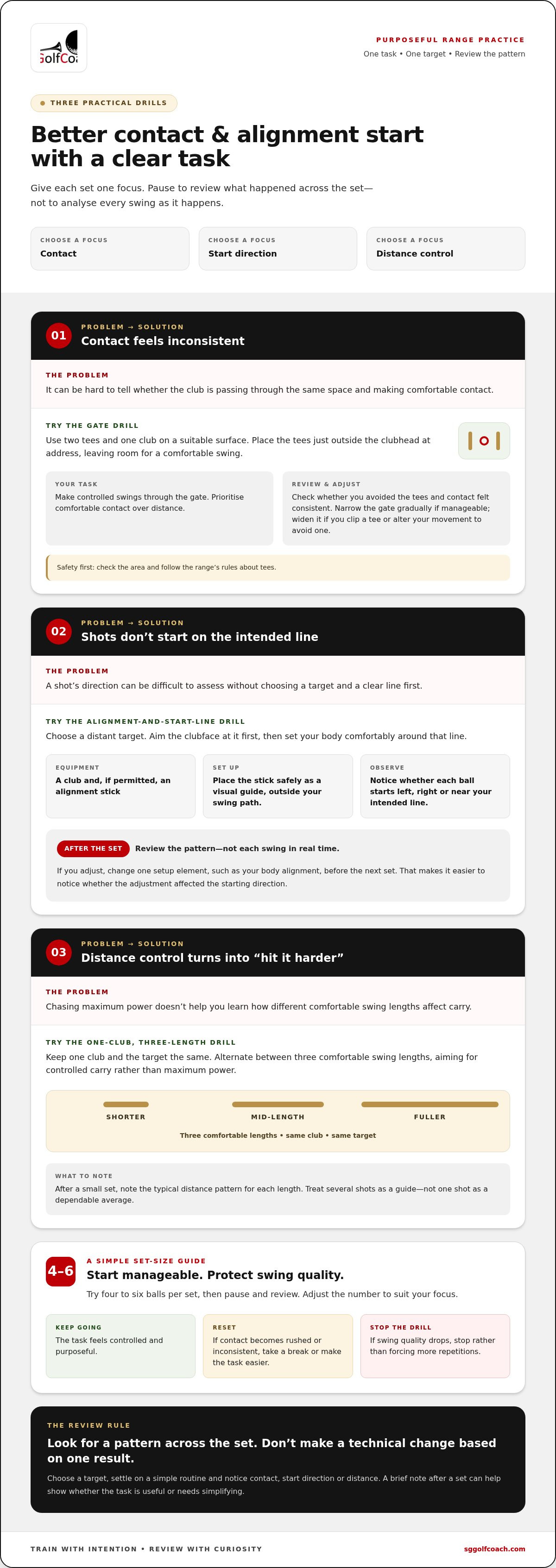
Give each set one task, then pause to review the pattern instead of analysing every swing as it happens. Start with a manageable number of balls, such as four to six per set, and adjust to suit your focus. If contact becomes rushed or inconsistent, take a break, make the task easier or stop the drill. The PGA.com driving range practice tips also highlight the value of practising with a target and a specific focus.
Gate drill for consistent ball contact
Equipment: Two tees and one club. Setup: On a suitable surface, place the tees just outside the clubhead at address, leaving enough room for a comfortable swing. Check that the area is safe and follow the range’s rules about tees.
Task: Make controlled swings through the gate, prioritising comfortable contact over distance. Hit a small set, then check whether the club passed through without striking either tee and whether contact felt consistent. If the setup feels manageable, narrow the gate gradually. Widen it again if you start clipping the tees or changing your movement to avoid them.
Alignment-and-start-line drill
Equipment: A club and, if permitted, an alignment stick. Setup: Choose a distant target. Aim the clubface at it first, then set your body comfortably around that line. Place the stick safely as a visual guide, outside your swing path.
Task: Hit a short set and observe whether the ball starts left, right or near your intended line. Review the pattern after the set, not during each swing. If you make an adjustment, change one setup element, such as your body alignment, before the next set. That makes it easier to notice whether the adjustment affected the starting direction.
One-club, three-length drill
Equipment: One club and a chosen target. Setup: Keep the target the same and choose three comfortable swing lengths, from shorter to fuller. Task: Alternate between those lengths, aiming for controlled carry rather than maximum power. After a small set, note the typical distance pattern for each length. Treat several shots as a guide, not one shot as a dependable average.
These drills to do at the driving range work best when you keep the task simple and assess the pattern across a set. Avoid making technical swing changes based on a single result. A coach can help you tailor practice to your priorities. Explore personalised golf coaching for guidance on shaping drills around your game.
Make Range Practice More Like Golf With Target and Pressure Drills
On the course, you choose a target, select a club and commit to a shot. Practise those decisions on the range by changing targets and clubs instead of repeating the same swing from the same position. This makes practice more engaging and gives you a chance to rehearse your routine. Treat each challenge as a way to focus, not a test you have to pass perfectly.
Range markers are useful references, but they can’t reproduce course conditions such as uneven lies, obstacles or changing wind. Pay attention to more than ball flight: notice whether you made a clear decision, aimed with intention and followed your routine. A Stanford University School of Medicine overview of golf swing biomechanics provides context on the swing’s complexity. It’s another reason not to diagnose a technical fault from one result.
Random-target challenge
Choose a new target before each shot, then decide on a club and intended shot shape or trajectory. Change clubs between attempts so you practise resetting instead of falling into a repeated rhythm. After a short run of shots, review whether each decision and pre-shot routine felt clear. A shot can be useful practice even if it misses the target, as long as you chose and committed to it deliberately.
Nine-shot target game
Select three range targets and give each a simple personal scoring zone, such as a nearby area you’d count as a successful result. Hit three shots toward each target, changing your club or intended shot between attempts. Keep a simple tally of how often shots finish in your chosen zones. Use the results as feedback on focus and consistency, not as a formal handicap measure or a verdict on your ability.
Course-simulation sequence
Picture a familiar hole and choose range targets for successive shots, such as a tee shot followed by an approach. Select a club for each imagined shot and repeat your pre-shot routine before hitting. Change clubs and targets as the imagined hole unfolds. This rehearses focus and club selection, but the range can’t duplicate the lies or decisions you’ll face on the course.
Keep the pressure personal. You might aim to complete a sequence while sticking to your routine, or make each target decision before stepping in. The drills to do at the driving range are most valuable when they sharpen your choices and habits, not when every shot has to be perfect. If the game feels too difficult, widen your scoring zones or simplify the sequence. Build the challenge again as your confidence grows.
Build a Driving-Range Session You Can Repeat and Measure
A repeatable session format makes it easier to notice progress without turning practice into a test. Keep the time flexible: spend longer on your priority while your focus and contact remain steady, and shorten the session if your quality starts to fade. You don’t need a fixed ball count. A clear sequence and brief review are more useful than hitting balls just to use them up.
A simple practice-session sequence
Move through four stages, adjusting the time you give each one to suit your session:
Warm up: Begin with easy swings and familiar clubs, building into your normal rhythm without chasing distance.
Focus drill: Use the main part of your session to work on the single skill you chose, such as contact or start direction.
Target game: Finish by aiming at different targets or playing a short course-simulation sequence that uses the same skill.
Reflect: Record what you noticed and what you’d like to repeat or adjust next time.
Keep the final game connected to your focus. If you practised distance control, for example, choose targets that let you assess whether you can reproduce a comfortable carry. This brings the session’s work into a decision-making task without adding another swing goal.
Track progress without overanalysing
After practice, write down the drill, target, club and one useful observation. That might be how often you reached your chosen target zone or whether contact felt comfortable through most of a set. Keep the note brief. You’re looking for a trend, not a detailed report on every swing.
Compare notes across sessions instead of deciding whether you improved based on one visit. Repeating a familiar format gives you a clearer basis for comparison. If a drill becomes consistently manageable, make one adjustment, such as choosing a smaller target or adding a different club. Avoid changing several drills and goals at once, because you’ll have less clarity about what helped.
These drills to do at the driving range are easier to assess when you use a consistent session structure and keep a simple record. If you’d like help building a practice plan around your priorities, explore tailored golf coaching.
Turn Driving-Range Drills Into Progress on the Course
Range practice becomes more useful when you carry one habit into play. That doesn’t mean every shot on the course will match a range result. Instead, take a simple cue with you, such as choosing a specific target before each shot or following the same deliberate pre-shot routine. A consistent process gives you something to return to, even when the outcome varies.
Carry one practice cue into your next round
Keep the cue simple enough to remember under pressure. If you worked on start direction, commit to picking a clear target line. If your focus was routine, follow the same steps before each shot. After the round, note which practice task felt relevant and where you’d like more support. Look for patterns over several rounds rather than drawing conclusions from one difficult hole or an unusually good shot.
Return to a drill when the same challenge keeps appearing. For example, if you repeatedly lose confidence choosing a target, use a target-based exercise at your next session and notice how clearly you make the decision. The goal isn’t to recreate every course condition on the range. It’s to practise habits that help you respond with more intention during play.
When tailored coaching can help
Self-guided practice can feel unclear when you’re unsure what to focus on or how to interpret a recurring pattern. A coach can help shape drills around your priorities and playing level. SgGolfCoach tailors instruction for adults, juniors and golfers at different stages of development. If you’re building fundamentals, the beginner golf lessons guide can also be a useful next step. Indoor screen golf offers another setting for focused practice when you want to work on your game away from the range.
Choose one drill from this article for your next range session. Keep the task manageable, note what you observe, then decide whether to repeat or adjust it next time. For support turning practice into a plan that fits your game, explore tailored golf coaching.
Make Your Next Range Session Count
Better practice starts with a clear focus. Choose one skill, use a drill with an observable result, then finish with a target challenge that brings your routine into play. A brief note after each session helps you spot patterns over time without judging progress by a single shot.
The most effective drills to do at the driving range are the ones you can repeat with purpose and carry into your next round. SgGolfCoach offers tailored coaching for players of all levels, including individual and group golf instruction and indoor screen-golf experiences. Explore tailored golf coaching with SgGolfCoach to get support shaping practice around your game.
Frequently Asked Questions
What are the best drills to do at the driving range?
The best drills to do at the driving range target one skill and give you a result you can observe. Try a tee gate to practise comfortable contact, an alignment drill to check where shots start, or one-club distance practice to develop control. Choose a drill based on a recent challenge, keep the task manageable and review the pattern after a small set rather than judging each shot in isolation.
How should a beginner practise at the driving range?
A beginner can keep range practice simple: warm up with comfortable swings, choose one skill and aim at a clear target. Use a familiar club and a drill that makes the result easy to notice, such as whether contact feels comfortable or shots start near the intended line. Pause between swings to reset. If you’re unsure what to focus on, a coach can tailor practice to your experience and goals.
How many golf balls should I hit during a practice session?
There isn’t one ideal number of balls for every golfer or session. Stop when your focus or swing quality starts to fade, even if balls remain. Work in small sets with a clear task, then take a moment to assess what happened. A shorter, attentive session can be more useful than hitting continuously without a goal. Adapt the amount of practice to your energy, available time and comfort.
How can I make driving-range practice more like playing golf?
Change targets and clubs between shots, and follow a pre-shot routine before each attempt. You could imagine a familiar hole, choose a target for the next shot and select a club based on that intention. Review both your decisions and the ball flight. Range targets are useful references, but they don’t reproduce course conditions. Treat the exercise as routine and focus practice, not as a guarantee of on-course results.
Can driving-range drills improve my golf swing?
Structured drills can help you practise contact, alignment and distance control, especially when you repeat a task and track results over time. They can’t guarantee improvement or identify every swing issue on their own. Focus on observable outcomes instead of making several technical changes without guidance. If a recurring pattern leaves you uncertain, a coach can help interpret it and tailor practice to your playing level.
How often should I practise at the driving range?
Choose a practice rhythm that fits your schedule, energy and goals, then pay attention to the quality of each session. Regular, focused practice lets you revisit a skill and compare patterns over time, but there’s no single frequency that suits everyone. Leave room to rest if you feel tired or your attention slips. A coach can help shape a manageable plan around your experience and priorities.
Should I use the same golf club for every range drill?
Use the club that suits the drill’s purpose. Keeping one club can make it easier to focus on contact or compare different swing lengths, while changing clubs between shots helps you practise resetting your aim and routine. You don’t need to use every club in one session. Start with the skill you want to develop, then decide whether one club or a varied selection will make the task more useful.


Comments