

Understanding Golf Terminology: A Reference for Beginners

A scorecard makes far more sense once you know the language behind each shot. Understanding golf terminology starts with a few essentials: par and bogey explain scores, the tee box, fairway and green describe course features, and terms such as putt and grip help you follow how a shot is played. These basics give beginners a clear starting point.
Golf terminology can seem like a lot at first, especially as players move between talking about the course, their clubs and their score. That’s normal. Learning common terms one group at a time makes it easier to follow the game and feel more at ease on the course.
This guide explains the basic golf terms beginners are most likely to encounter. You’ll learn about course features and etiquette, scoring and shots, putting and green terminology, and the names of common grips and clubs, with straightforward definitions to help each term stick.
Table of Contents
What Are Essential Golf Terms and Phrases for Course Features and Etiquette?
A golf course is made up of distinct areas, and each term describes a player’s position or next move. Knowing the layout, scoring formats and rating terms also makes a scorecard easier to follow.
Fairways, Greens, Rough, and Bunkers
The fairway, green, rough and bunker are course areas that shape how a player approaches each shot. The fairway is the shorter-grass route towards the green, while the rough has longer grass that can make clean contact harder. The green is the closely cut area around the hole, where players putt.
A bunker is a sand-filled hazard that can make the next shot more demanding. A ball in the fairway generally offers a clearer route than one in rough or sand. These terms describe both location and playing conditions, helping golfers understand why the same club may not suit every lie.
Etiquette terms also guide group movement. “Ready golf” means playing when ready to help maintain the pace, provided it is safe and considerate. Avoid distracting someone preparing to hit, and leave the course area in good condition after play.
Front Nine and Back Nine
The front nine is the first nine holes of an 18-hole round, and the back nine is its second nine. Together, these two sections make up a standard full round, with the turn marking the halfway point between them.
Scorecards number holes in playing order, so hole 1 begins the round and hole 18 ends it on a standard 18-hole layout. The term “turn” refers to the transition after the front nine, not a separate hole. Knowing whether a group is on the front or back nine helps players follow progress and understand scorecard references.
Handicaps and Course Ratings
A handicap is a measure used to account for differences in golfers’ playing ability, while course and slope ratings describe challenge. Course rating estimates how difficult a course should play for a scratch golfer with a 0 handicap. Slope rating indicates how much harder the course may play for a bogey golfer compared with a scratch golfer.
Slope ratings can range from 55 to 155. A higher slope indicates a greater relative challenge for a less-skilled player, while the course rating focuses on scratch-golfer difficulty. These measures offer context, not a prediction of an individual score. PC & Handicap services can help golfers understand handicap-related information as their play develops.
Course Layouts and Hole Numbering
A golf course layout is its arrangement of holes, with each hole beginning at a tee area and ending at a green. Courses can have 9-hole or 18-hole layouts, and some are designed with 36 holes across multiple sections.
On a 9-hole course, the sequence runs from hole 1 through hole 9; an 18-hole course continues through hole 18. Each hole has its own route and features, such as a dogleg, which is a bend in the fairway. Looking at the hole number and the course map together helps players identify where they are and what lies ahead.
What Are the Most Important Basic Golf Terms for Beginners?
Golf scoring compares the strokes a player takes with the expected score for each hole. Learning these terms helps golfers read scorecards and follow both individual holes and a full round.
Scores Relative to Par
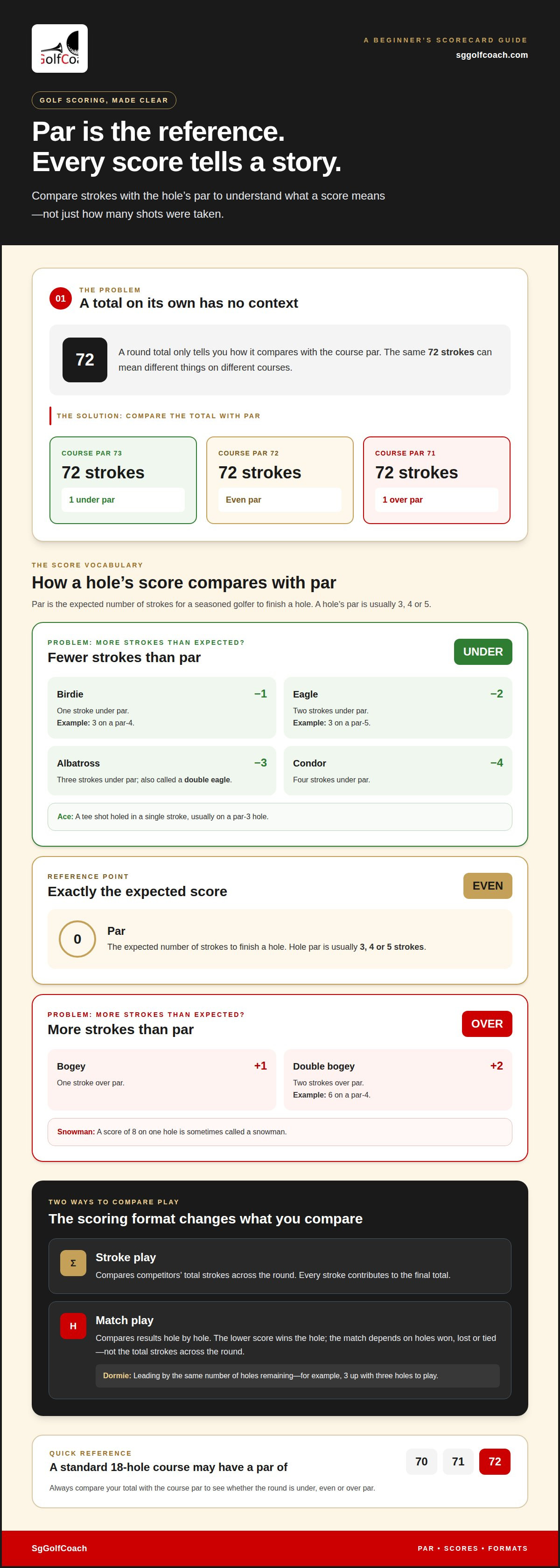
Scoring relative to par describes whether a golfer uses more, fewer or the expected number of strokes. Par is the expected number of strokes for a seasoned golfer to finish a hole. A hole’s par is usually 3, 4 or 5 strokes, and a standard 18-hole course may have a par of 70, 71 or 72.
A score of 72 on a par-72 course is even par for the round. The same score would be one under par on a course with a par of 73, or one over par on a par-71 course. Compare the score with par, not just with another player’s total, to understand what the number means.
Ace, Birdie, Eagle, and Other Scores
An ace is a tee shot holed in a single stroke, usually on a par-3 hole. A birdie is one stroke under par, such as 3 on a par-4. An eagle is two strokes under par, such as 3 on a par-5. These names show how a score relates to that hole’s par.
An albatross, also called a double eagle, is three strokes under par on one hole. A condor is four strokes under par. A bogey means one stroke over par, while a double bogey means two over. For example, 6 on a par-4 is a double bogey. A score of 8 on one hole is sometimes called a snowman.
Stroke Play and Match Play
Stroke play compares competitors’ total strokes across the round, while match play compares results hole by hole. In stroke play, every stroke contributes to the final total, so a high score on one hole remains part of the round’s score.
In match play, the player or team with the lower score wins that hole. The overall match depends on holes won, lost or tied, rather than simply adding every stroke across the round. “Dormie” describes a player or team leading by the same number of holes remaining, such as being 3 up with three holes to play.
Penalties, Out of Bounds, and Lost Balls
A golf penalty is a consequence applied under the rules when a specified situation occurs. Out-of-bounds and lost-ball situations affect how play continues and how the score is recorded. The applicable relief procedure determines the next step.
If a ball moves after a player has addressed it, a one-stroke penalty generally applies unless the player did not cause the movement on purpose. A drop puts a ball back into play after it has been lost or entered a penalty area, and relief for an unplayable lie also involves a drop. For help understanding handicap-related scoring, PC & Handicap support can provide a useful next step.
Approach shots and reaching the green in regulation
Approach shots move the ball towards the green, while shot names describe distance, height and contact. Knowing these terms helps you follow each stage between a tee shot and a putt.
Approach Shots and Green in Regulation
An approach shot is a shot intended to land on or near the green. A golfer reaches the green in regulation by getting there two strokes under the hole’s par: one shot on a par-3, two on a par-4, or three on a par-5.
For example, a player who reaches a par-4 green with the second stroke has reached it in regulation. The next stroke can be a putt, though the golfer may need more than one to finish the hole. This measure focuses on reaching the green, not the final number of strokes.
Club choice and the ball’s lie influence an approach. A ball sitting cleanly on short grass offers a different contact point from one in longer grass. The target matters too: a player may aim for an open section of green rather than directly at the pin.
Chip, Pitch, and Putt
A chip is a short shot that travels low and rolls after landing. A pitch is a higher, shorter shot that spends more time in the air. A putt is a stroke, usually played with a putter, that rolls the ball along the ground towards the hole.
Imagine a ball just off the green with open ground between it and the cup. A chip may let it roll towards the target; a pitch can help carry it over an obstacle. Once the ball is on the green, a controlled putter stroke sends it towards the hole.
Common Shots and Lies
A lie describes how the ball rests before the next stroke. A clean lie on the fairway differs from a ball nestled in rough, where grass can affect the clubface at impact.
A slice curves sharply from left to right for a right-handed golfer. A hook curves from right to left. The directions reverse for a left-handed player. A draw is a controlled curve from right to left for a right-handed golfer, while a fade moves from left to right.
Expressions for Good and Bad Shots
Golfers use informal expressions to describe shots, not official scoring categories. A “great strike” usually praises solid contact, while “on the green” means the ball has reached the putting surface.
“Chunked” describes a shot where the club hits the ground before the ball, often sending it a shorter distance. “Topped” means contact catches the ball high, so it travels low. If a shot finishes far from its intended target, a golfer may simply call it a miss. These phrases describe what happened; the score still depends on the strokes taken.
Putting and green terminology
Putting terms describe how golfers read the green, position the ball and finish a hole. Tee times and green fees relate to starting play, while handicap and green-in-regulation figures describe different aspects of performance.
Putting Terms and Green Features
A putt is a stroke that rolls the ball across the green towards the hole, usually with a putter. “Reading the green” means studying its slopes and undulations to judge how they may influence the ball’s path. A golfer considers both line and pace, since a putt can miss even when aimed correctly.
The cup is the hole in the green, with a diameter of 4.25 inches. A “three-putt” means taking three putts on one hole, while a “gimme” is a short putt that playing partners concede and count as made. A conceded gimme is a casual agreement, not a putt physically holed.
A Texas Wedge is a shot played with a putter from off the green. It may suit a clear, even route where the ball can roll, rather than fly over longer grass. A hole-out from off the green records zero putts for that hole because the ball went in without a putt on the putting surface.
Flag colours may be used to indicate pin position, but conventions can vary. Knowing the position helps golfers judge the distance from the green’s edge to the cup.
Handicap and Green in Regulation
A handicap reflects a golfer’s playing ability, while green in regulation records whether the player reaches the green within the expected stroke target. These measures describe different things: one helps contextualise ability, while the other tracks an aspect of a hole’s play.
For example, reaching a par-4 green in two strokes counts as regulation, whether the golfer later takes one putt or several. A golfer can therefore reach the green in regulation but still record a high score after putting. PC & Handicap support can help make handicap-related information easier to interpret.
Green Fees and Tee Times
A green fee is the charge for playing a round at a golf course. It covers access to play, rather than a golfer’s handicap or score. The amount can depend on the course and booking conditions.
A tee time is the scheduled time a player or group begins a round from the first tee. It helps organise the course’s starting sequence. An assigned tee time tells golfers when to be ready to begin, while the green fee covers the course’s playing charge.
Golf grips and club terminology
Grip and club terms describe how a golfer holds the club and selects a tool for each shot. Knowing how club families differ helps connect a target with the intended distance and direction.
Golf Grips
A golf grip is the way a player holds the handle of a golf club. The baseball grip places all 10 fingers on the club, without overlapping or interlocking them.
Two familiar styles are the overlapping grip and the interlocking grip. With an overlapping grip, one little finger rests over the gap between the other hand’s fingers. With an interlocking grip, the little finger and index finger link together. The best choice is one a golfer can hold comfortably while controlling the clubface through the swing.
Grip pressure matters too: a relaxed, secure hold supports a smooth motion, while excessive tension can restrict the hands and arms. During a slow practice swing, check that both hands stay together on the handle. This simple check can reveal whether the grip shifts before the club reaches the ball.
Drivers, Woods, Irons, and Wedges
A driver is the longest club in the bag and is used for long tee shots. It is also called a 1-wood; fairway woods commonly include the 3-wood and 5-wood.
Woods are designed for longer shots, while irons and wedges serve different situations across the course. The iron club family is generally numbered from 1 to 9, with higher numbers indicating increasing loft. Loft is the angle of the clubface, which affects how the ball launches. A sand wedge typically has 56 degrees of loft, while a lob wedge is designed for short, high shots.
A putter is a club used to roll the ball on the green. Rather than choosing by club name alone, consider the lie, distance to the target and shot required. For instance, a driver suits a long tee shot, while a putter suits a short roll towards the cup.
Choosing a Club for the Shot
Club selection means matching a club to the shot’s target, lie and intended distance. A golfer might choose a fairway wood for a longer shot from the fairway, an iron for a controlled approach, or a wedge for a shorter shot near the green.
Each club produces a different launch and feel, so the same swing can send the ball on a different trajectory. A simple practice routine is to note which club feels controlled for each type of shot, then observe the resulting direction and distance. To develop a more consistent grip and swing, explore tailored golf coaching.
SgGolfCoach: Screen Golf Booking
SgGolfCoach offers Screen Golf Booking for golfers who want to practise interpreting shots and golf terms in an indoor screen-golf setting. It can help connect words such as “clubface,” “target” and “approach” with the decisions involved in playing.
For guidance with swing technique, course management or the fundamentals behind each shot, Adult Lessons provide a coached learning path. Junior Programs support younger players as they build their skills, while PC & Handicap helps golfers make sense of handicap-related information. Choose the option that fits your learning goal, whether you want to understand a screen-golf session or develop your play with coaching.
Contact SgGolfCoach to discuss the next step that suits your golf journey.
Take Your Next Step on the Course
Understanding golf terminology becomes more useful when you connect a word to a decision during play. Choose an unfamiliar expression and notice how it applies to your next shot, practice session or conversation with playing partners. That small habit can turn golf language into a practical part of learning, rather than a list to memorise.
Shape your next step around what you want to develop. You might focus on a more confident swing, clearer course decisions or a better understanding of how practice translates into play. Build those skills with purpose, at a pace that suits your goals.
SgGolfCoach can help you explore a suitable way to continue learning. Start a conversation with SgGolfCoach about your golf goals, and take your next step with confidence.
Frequently Asked Questions
What Golf Terminology Explains Scoring and Handicaps?
Scoring terms describe a player’s strokes, while a handicap helps compare golfers with different playing abilities. “Gross score” is the actual number of strokes taken; “net score” subtracts the handicap from that total. For example, a golfer with a 10 handicap who scores 84 has a net score of 74. These figures help explain scorecards and handicap-related results.
What Is Par In Golf?
Par is the expected stroke count assigned to a hole, providing a benchmark for judging a score. A hole’s par is commonly 3, 4 or 5, based on its design and expected play. Check the scorecard before starting: comparing your strokes on each hole with its par shows whether you finished above, below or level with that benchmark.
What Are Common Golf Shot Terms and Their Meanings?
Shot terms describe the intended action or the ball’s flight. An approach aims towards the green, while a chip travels low before rolling and a pitch flies higher. A slice curves sharply from left to right for a right-handed player. “Up and down” describes reaching the green with one shot, then holing the next putt, often after missing the green in regulation.
What Do Key Golf Swing Terms Mean?
Swing terms describe stages or positions in the motion used to strike the ball. “Stance” is the player’s position before swinging, and “backswing” is the movement that takes the club away from the ball. The “downswing” brings the club towards impact; “follow-through” describes the continued movement after contact. These words help a coach give precise feedback about one part of a swing.
What Golf Slang and Lingo for Beginners Should You Know?
Begin with informal expressions you may hear during a friendly round. A “mulligan” is a casual do-over for a poor shot, but it isn’t allowed in official play. A “snowman” is an 8 on a hole. “Dormie” describes a match-play lead equal to the holes remaining, such as being 3 up with three holes left. Context tells you whether a phrase is casual or competitive.
Why Do Golfers Need to Master Golf Terminology?
Understanding golf terminology helps players read scorecards, follow instructions and communicate clearly during a round. For instance, “ready golf” signals that a player may play when ready to help keep the pace, while “front pin” describes a hole position near the front of the green. Understanding golf terminology isn’t about memorising every phrase; it’s about recognising the words that guide a decision.
What are the basic golf terms and their meanings?
Basic golf terms name course areas, shots, scores and equipment. “Rough” identifies longer grass beside the fairway, while “dogleg” describes a bend in a fairway. “Driver” names a club used for long tee shots, and “putter” is used to roll the ball on the green. Learn each term in context, such as matching a club name to the shot being discussed.
What do birdie, eagle, bogey, and par mean in golf?
These scoring terms compare a player’s strokes with par on one hole. A birdie is one stroke under par, an eagle is two under, and a bogey is one over; par is the expected score. For example, 2 on a par-3 is a birdie, while 6 on a par-5 is a bogey. The same score can have a different name on another par-rated hole.



Comments