

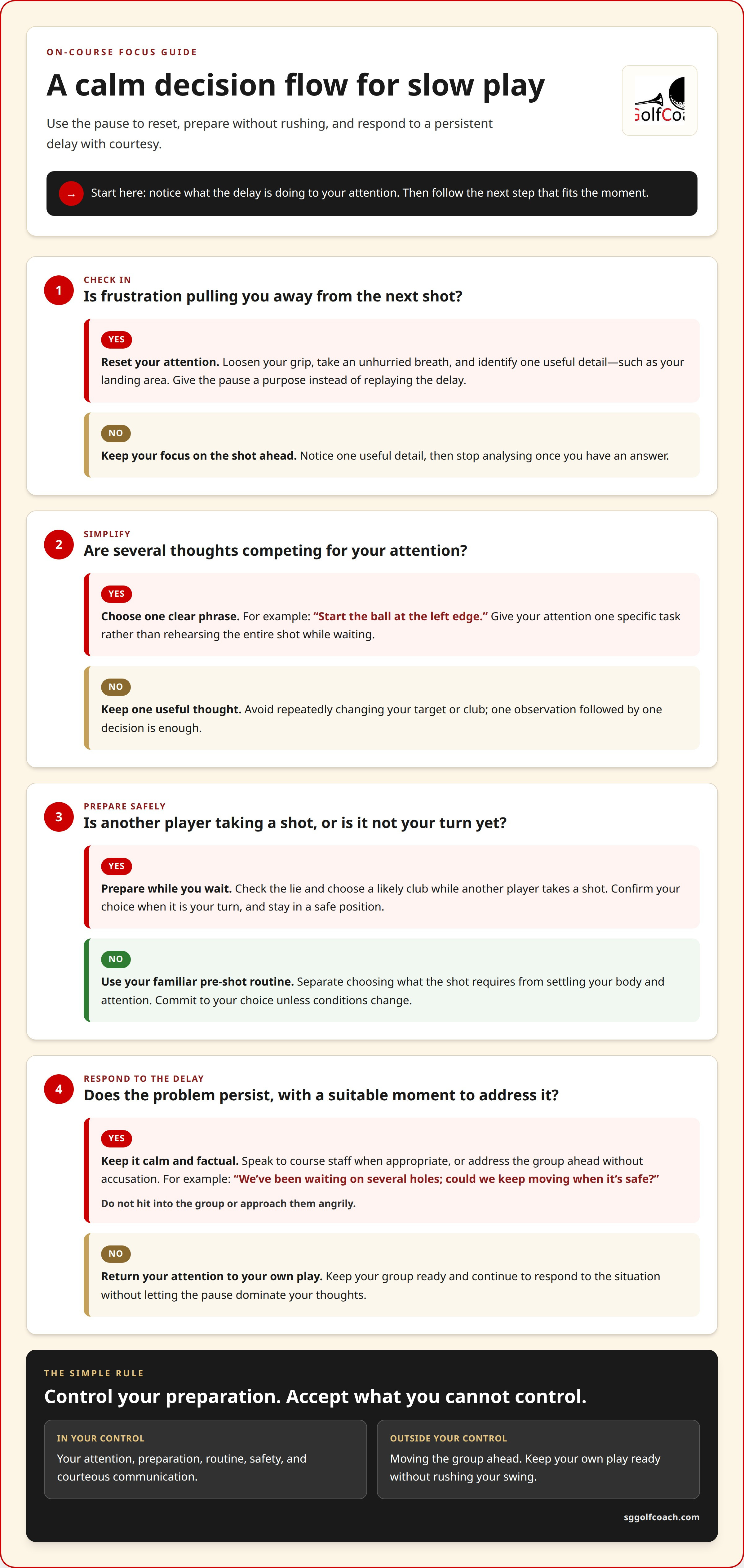
How to Deal with Slow Play in Golf Without Losing Focus

Slow play can test your focus, but rushing your swing usually makes the next shot harder. Learning how to deal with slow play in golf starts with accepting the pause, keeping your usual pre-shot routine, and speaking calmly and courteously with playing partners when needed.
It’s frustrating when a round loses momentum, especially when you’re ready to play but the group ahead isn’t moving. The goal isn’t to ignore the delay or let it dominate your thoughts. Stay composed and do your part to keep play moving.
This guide covers practical ways to reset between shots, avoid rushed decisions, and encourage a quicker pace politely. It also explains how courses may monitor pace, helping you distinguish a slow stretch from a group falling behind. A steady routine and clear communication can protect your focus and help you enjoy the round, even when the wait is outside your control.
Table of Contents
Managing thoughts, attitude and behaviour
Slow play can pull your attention away from the next shot and toward the delay. A deliberate mental reset helps you respond to the pace without letting irritation dictate your decisions.
Managing Frustration While Waiting
Managing frustration starts with noticing irritation and choosing where to direct your attention. Carrying annoyance into your setup can distract you from the shot ahead. Try a simple reset: loosen your grip, take an unhurried breath, and identify one useful detail, such as your landing area. Give the pause a purpose instead of replaying the delay.
Some golfers find their thoughts multiply during a wait. Type-A golfers tend to think rapidly, with two or three ideas running at once. If that sounds familiar, reduce the next decision to one clear phrase, such as “start the ball at the left edge.” That gives your attention a specific task without requiring you to rehearse the entire shot while waiting.
Separate what you control from what you don’t. You can’t move the group ahead, but you can prepare without slowing your own group. For example, check the lie and choose a likely club while another player takes a shot, then confirm your choice when it’s your turn. Keep comments about the pace factual, not personal.
A neutral observation can also redirect your attention. Notice the wind, the shape of the hole, or the safest part of the landing area, then stop analysing once you have a useful answer. Repeatedly changing your target or club can make the wait feel longer and leave you uncertain over the ball. One observation followed by one decision is enough to keep your focus engaged.
Set a clear boundary for frustration. If you catch yourself complaining after each pause, replace the next complaint with a practical action, such as moving to a safe position or preparing your glove. That small change won’t control the delay, but it can keep irritation from shaping your decisions and interactions throughout the round.
Responding to a Slow Group Ahead
Respond to a slow group calmly and respect both the players and the course. Pressure or confrontation can create conflict without improving the pace. Notice whether the delay continues and whether there’s room to move forward. Don’t hit into the group or approach them angrily. Wait for a suitable moment to address a persistent problem.
Keep your own group ready while you wait. If the delay continues, speak to course staff when appropriate, or address the group ahead without accusation. A calm phrase such as “We’ve been waiting on several holes; could we keep moving when it’s safe?” focuses on the situation and suggests a practical change. Then return your attention to your own play.
Slow play on tour and during weekend rounds
An 18-hole round is often described as taking about four hours, while a weekend round can stretch to 5 1/2 hours. If your group falls behind or an open hole appears ahead, stay alert, use ready golf when safe, and respond to the course’s pace expectations rather than rushing every shot.
Planning for Round Duration
Allow enough time for course conditions and the pace of play. A tight schedule can turn ordinary waits into pressure, making each pause feel like lost time. Plan to spend more than four hours on the course, and allow extra time if you’re playing during a busy weekend.
Round length depends on more than how quickly you walk between shots. Waiting for groups, searching for a ball, choosing a club, and moving between holes all affect the pace. On a crowded day, even a ready group can be delayed by players ahead. Treat the expected duration as a planning guide, not a promise that every round will finish on schedule.
Tour golf also shows how a single decision can take time. Bryson DeChambeau’s analysis of a tricky 70-yard shot brought slow play into focus. That example doesn’t mean every careful decision is unreasonable; the challenge is keeping preparation proportionate to the shot. On a weekend round, decide what information you need, make the choice, then commit instead of reopening the decision.
Responding to Pace Changes in Your Group
Notice when your group is losing ground or leaving an open hole ahead. Small delays can compound across a round, especially when players wait for one another unnecessarily. If you’re ready and it’s safe, play rather than automatically waiting for the player furthest from the hole.
Stay aware of the group ahead and the players behind. If your group has fallen behind, simplify decisions and move promptly between shots without sacrificing safety or rushing your swing. If there’s an open hole ahead, consider whether repeated delays are within your group’s control. Keep the conversation practical: agree to be ready, then follow through.
Ready golf is a shared approach, not a race. For example, a player who has selected a club can prepare while another golfer finishes, provided everyone remains clear and safe. If the gap persists despite your group moving efficiently, ask course staff for direction. Course policies and local conditions shape the appropriate response, so don’t assume every open hole calls for the same action.
Avoiding rushed swings during delays
A delay can disrupt your rhythm between choosing a club and making a swing. To avoid rushing, separate preparation from execution: decide what the shot requires, then use a familiar routine to settle your body and attention. Keeping that routine intact when the pace changes is a reliable way to deal with slow play in golf.
Start by considering three useful yardages: the minimum, the maximum, and the number for your target zone. This simple framework gives you a clear range without inviting endless calculations. For example, if your target zone is beyond your comfortable minimum but within your maximum, choose the club and shot that best fit the landing area. Once you decide, don’t reopen the choice unless conditions change.
Next, keep your pre-shot routine consistent, even when the group ahead has delayed play. Instructor Ken Venturi described a three-step process: aim the club, set the lead foot, then set the back foot. Treat those steps as a sequence, not a race. A familiar order helps you reach the ball with a clear intention instead of trying to recover lost time with a hurried takeaway.
Use the wait before your turn to observe, not to rehearse repeatedly. Note the lie, wind direction, and intended target, then step away until it’s your turn. Rehearsing the entire swing several times can make the shot feel more complicated. One purposeful practice motion, followed by Venturi’s setup sequence, gives your attention a defined task without making the delay part of your swing.
Preparation around the ball takes patience, too. Instructor Jim McLean said he had worked with Bo Hoag for more than two years on this part of the game, and taught Keegan Bradley for five years. These examples show that preparation is a skill developed over time, not something to improvise under pressure. Focus on one cue you’ve practised, such as a balanced finish, rather than adding a new thought at address.
If the wait has disrupted your timing, reset before approaching the ball. Step back, exhale, and restate your target in a few words. Then begin your routine from the start. Learning how to deal with slow play in golf also means resisting the urge to skip essential setup steps or swing harder to make up time. Move efficiently between shots, but let the club accelerate through a balanced motion.
After contact, assess the result without blaming the delay. If the shot misses, identify one useful detail, such as contact or direction, and carry that observation forward. If you’re waiting again, return to the same yardage framework and routine. Repeating those decisions keeps the pause from dictating your next swing.
Dealing with slow playing partners
Speak to a slow-playing partner calmly, clearly, and without making it personal. Golf instructor Matthew Dunigan recommends speaking up politely but firmly when it’s time to pick up the pace. With ready golf, the player who is prepared and safe to play goes next, rather than always following the traditional order of whoever is furthest from the hole.
Use ready golf when your group agrees and it’s safe for everyone. For example, if one partner is choosing a club while another is ready, the prepared player can take their shot, provided nobody is in range or in the line of play. Make eye contact, confirm the others are ready, and never let a faster pace override safety or a player’s concentration.
Choose a neutral moment to speak, such as while walking between holes rather than when a partner is addressing the ball. Keep the request specific: “Could we get ready while the others putt?” is more useful than “You’re always too slow.” The first suggests an action the group can take; the second assigns blame and can make a friendly round uncomfortable.
If a partner takes a long time over each shot, suggest one shared adjustment. You might agree that everyone selects a club while another player hits, or that the next player prepares once the landing area is clear. Matthew Dunigan’s advice supports direct communication, but delivery matters: a steady tone and practical suggestion make it easier for someone to respond without feeling embarrassed.
Distinguish between a slow habit and a genuine delay. A partner searching for a ball or dealing with an awkward lie may need time, while repeated indecision can often be shortened. In the latter case, offer a simple prompt such as, “We’re clear when you’re ready,” then let them complete their routine. Avoid commenting after every shot.
Raise the issue privately: Speak between shots or holes, not during a partner’s swing.
Describe the effect: Say the group is waiting, rather than labelling someone inconsiderate.
Suggest one change: Prepare clubs earlier or use ready golf when safe.
Keep your own play efficient: Be ready without pressuring another player to rush a swing.
If your group still falls behind, focus the discussion on what everyone can change. For example, agree to move promptly after each shot and prepare while others play. If the delay continues despite a respectful conversation, ask course staff for guidance instead of escalating the disagreement. This keeps the round civil and leaves pace decisions to the people responsible for the course.
Monitoring and penalizing slow play
Judge slow play against the pace target set for a particular course or event, not a single universal time. One golfer reported a four-hour pace-of-play policy at their home course, but that example doesn’t establish a standard for every course in Singapore.
Pace monitoring may consider whether a group is keeping up with the group ahead, how much time passes between holes, and whether delays recur. These measures help distinguish one difficult hole from a continuing gap. For example, a group slowed by a ball search may regain pace on the next hole, while repeated waits can point to a broader problem.
Course staff may assess a concern by looking at the group’s progress and what is causing the delay. Relevant details include the course’s posted target, congestion ahead, and whether the group is ready to play when it’s safe. A gap alone doesn’t explain why play has slowed, so context matters before anyone concludes that a group is responsible.
Think of a pace target as a shared expectation, not a demand to swing quickly. If a course gives a four-hour target, the group’s movement and decisions contribute to meeting it. Players can prepare while others play, move directly between shots, and avoid unnecessary delays. These actions support the pace without sacrificing a considered shot or safe play.
Penalties depend on the rules for the round. A competition may have procedures for monitoring and addressing slow play, while a casual round may follow the course’s own pace policy. Don’t assume that a warning, penalty, or other consequence applies everywhere. The event or course rules determine the appropriate response.
If someone raises a pace concern, calmly ask which target or procedure applies. Then focus on the practical issue: whether your group is behind, what is slowing play, and what can safely change. For example, if players are taking too long to prepare, agree to choose clubs earlier. If congestion ahead is causing the wait, rushing your swings won’t solve it.
For a tournament, read its pace instructions before play and follow any directions given during the round. For a casual game, use the course’s posted guidance and speak with staff if your group can’t resolve a persistent delay. This keeps the discussion grounded in the applicable policy, rather than assumptions about a universal limit.
Clear expectations make monitoring more useful and less personal. To develop a consistent routine for focused play, practise a measured golf routine.
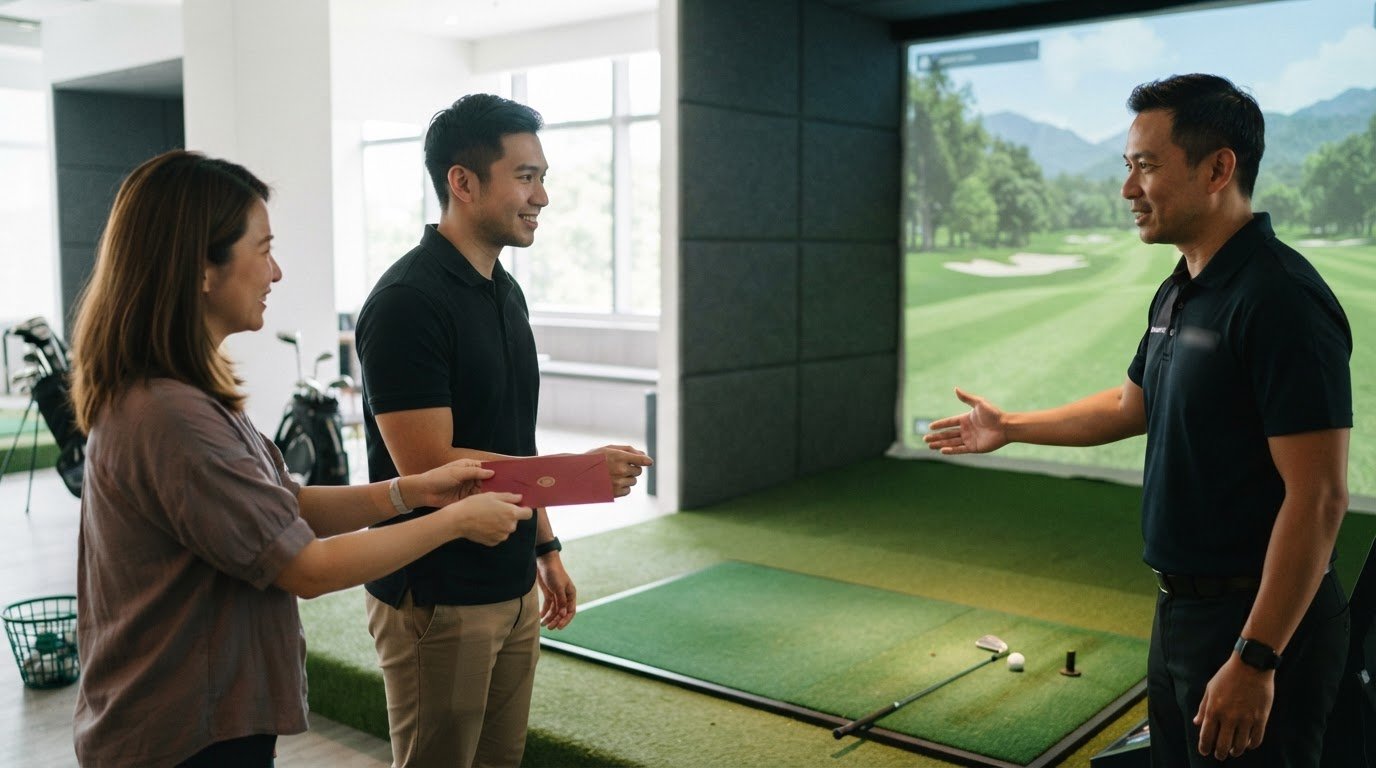
SgGolfCoach: Screen Golf Booking
SgGolfCoach offers Screen Golf Booking for golfers who want an indoor golf experience without waiting on course play. It can be a useful option when you want to focus on your game in a screen-golf setting, or when delays have made an outdoor round difficult to plan.
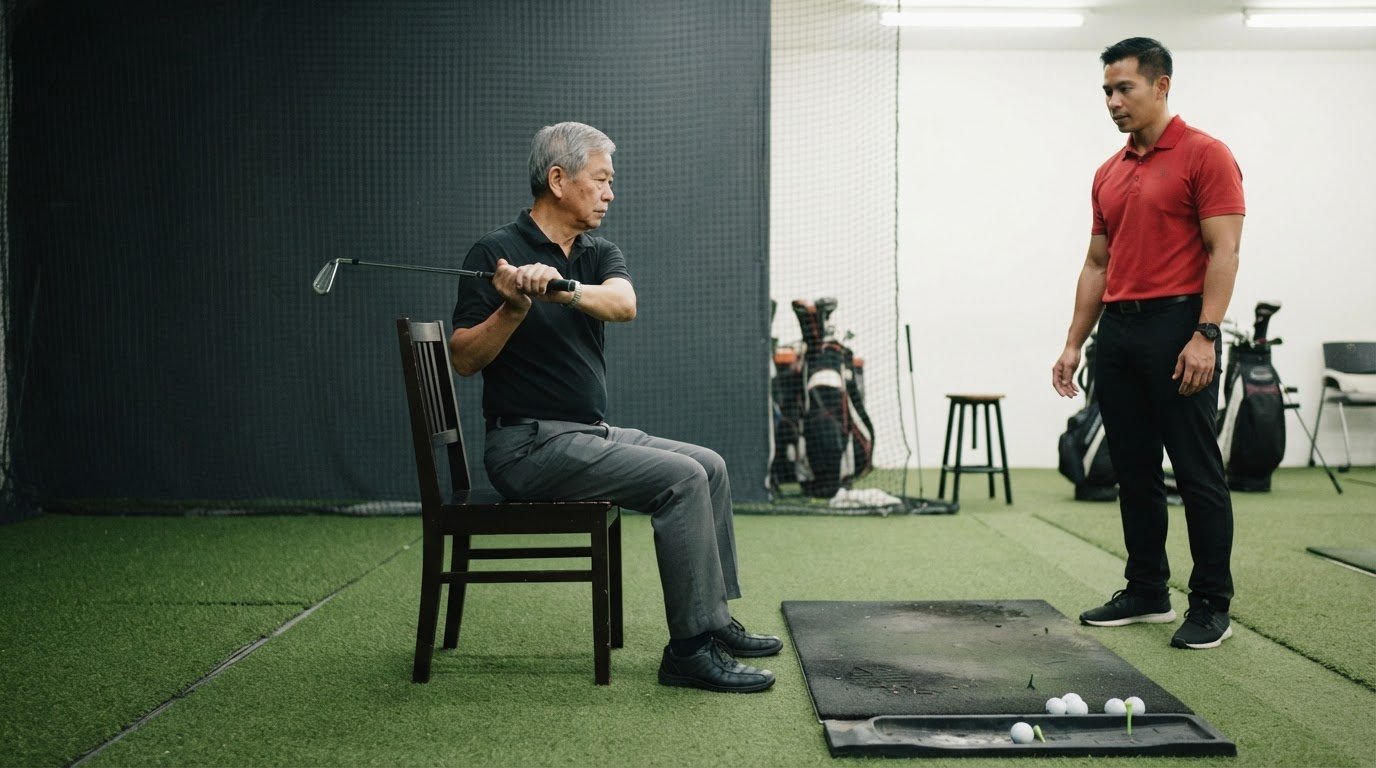
For more structured development, SgGolfCoach’s Adult Lessons and Junior Programs connect practice with professional coaching. Choose what fits your needs: screen golf for an indoor practice session, or lessons for guidance on technique and course management. Each offers a different way to keep building your game.
If you’d like to explore a suitable next step, contact SgGolfCoach.
Make your next round a fresh start
Before your next tee time, choose one response to carry into the round: stay patient, keep your decisions clear, or communicate calmly when pace becomes an issue. A simple intention gives you something constructive to return to when the wait feels frustrating. Learning how to deal with slow play in golf isn’t about controlling every delay. It’s about building a response that keeps the game enjoyable and your attention on the shot ahead.
That steadiness can develop with practice. Coaching can help you refine your technique and course management, while an indoor screen-golf session offers another setting to work on your game. Choose the option that best fits what you want to develop next.
Contact SgGolfCoach about golf coaching and take your next step with a clear focus. Approach the next round with patience, play with intention, and leave room to enjoy the game.
Frequently Asked Questions
What do the Rules of Golf say about prompt pace of play and unreasonable delay?
The basic expectation is to play promptly and avoid unreasonable delay, while taking the time needed to play safely and make a considered shot. A brief wait for the group ahead to clear is different from repeatedly delaying play through avoidable indecision. For example, prepare your club and plan while another player takes a shot, then play when it’s safe.
What pace-of-play policies, warnings, and penalties do golf courses use?
Policies differ by course and competition, so the applicable local rules determine how pace is measured and what happens next. A course may communicate a target and ask a group to regain position; competition procedures may also include warnings or penalties. A delay on one hole alone doesn’t show whether a group has breached a policy. The cause, overall progress, and stated procedure all matter.
How do course difficulty, group size, and tee-time intervals affect round duration?
Round duration reflects how smoothly players move through the course. Longer walks between greens and tees, challenging holes, and time spent searching for balls can slow progress. Larger groups also have more players preparing and taking turns, while tighter tee-time intervals can leave less space between groups. For example, a difficult hole combined with a ball search may create a queue behind several groups.
What are Singapore golf clubs’ typical pace-of-play rules and procedures for slow groups?
Singapore clubs set their own pace expectations and procedures; there isn’t one rule for every club. A club may communicate its target before play and direct groups that fall behind to take specific steps. Before teeing off, read the club’s notices or instructions, and follow directions from course staff during the round. This helps you respond to the policy that applies there.

Comments