

Tracking golf stats to improve: Find the numbers that matter

You don’t need a launch monitor to find numbers that can help your golf. Tracking golf stats to improve your game can start with five or six useful measures, such as fairways hit, greens in regulation, putts and up-and-downs, recorded consistently from round to round.
It’s easy to focus on your final score, but it doesn’t always show where you’re losing strokes. A simple record of what happened on each hole can reveal patterns in your tee shots, approaches and putting, giving your practice a clearer purpose.
Learn which statistics to track, how to review hole-by-hole shot history and greens in regulation, and how to assess progress without sensors or a launch monitor. You’ll also see how to compare several rounds, so one unusually good or difficult day doesn’t define your progress. Start with a few reliable numbers, then use them to choose your next area of focus.
Table of Contents
1. What golf stats should you track?
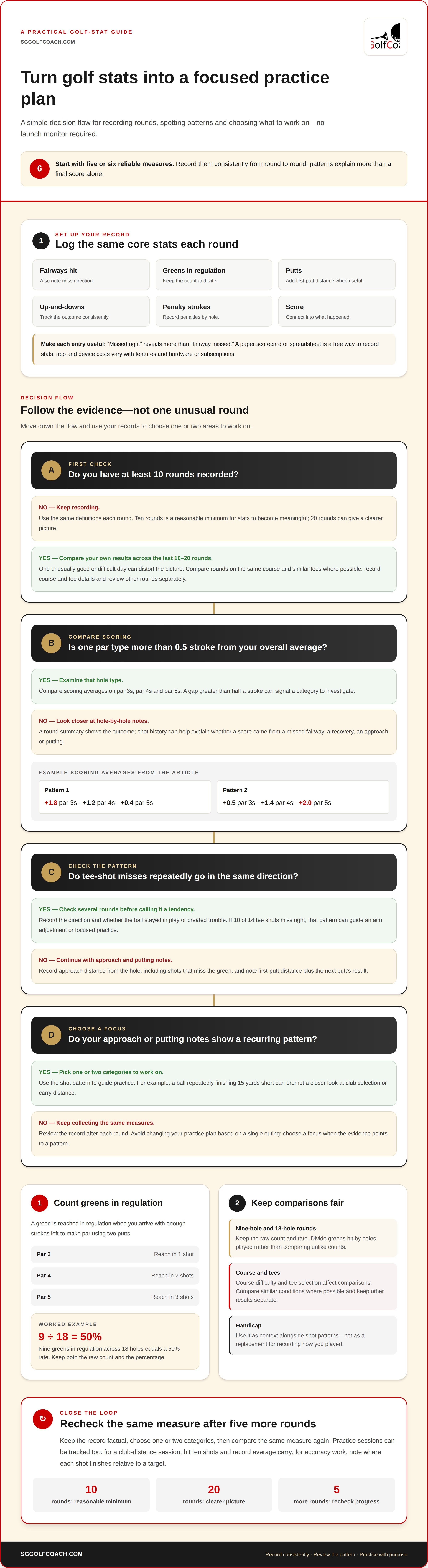
Tracking golf stats to improve your game starts with measures that help explain your score. Choose five or six core statistics and use the same definitions every round: fairways hit, greens in regulation, putts, up-and-downs, penalty strokes and score. Note the direction of tee-shot misses, too. “Missed right” gives you more to work with than simply marking a fairway miss.
Compare your own averages before judging them against another player. Use results from your last 10 to 20 rounds, because one unusually good or difficult day can distort the picture. Then compare scoring averages on par 3s, par 4s and par 5s. A gap greater than half a stroke from your overall average can signal a hole type to examine. For example, averaging +1.8 on par 3s, +1.2 on par 4s and +0.4 on par 5s suggests a different pattern from +0.5, +1.4 and +2.0.
Course difficulty and tee selection affect comparisons. Whenever possible, compare rounds on the same course and from similar tees. For other rounds, record the course and tee details with your scores, and review those results separately. This helps distinguish a genuine performance change from a difference in the challenge.
For nine-hole and 18-hole rounds, retain both the raw count and the rate. Divide greens hit by holes played, for example, rather than comparing a nine-hole count directly with an 18-hole count. Label each entry clearly, so your averages remain meaningful across round lengths.
Golf stat-tracking apps and devices vary in cost in Singapore, depending on their features and whether they use hardware or subscriptions. A paper scorecard or spreadsheet is a free way to record your chosen statistics, without relying on an app’s availability or features. Choose the method that makes consistent recording easiest.
Practice sessions need their own measures. During a club-distance session, hit ten shots and record the average carry. For accuracy work, note where each shot finishes relative to a target, then compare the pattern in later sessions. Tracking golf stats to improve your practice means recording the outcome you’re working on, not just counting swings.
Ten rounds is a reasonable minimum for statistics to become meaningful, while 20 rounds can give a clearer picture. Choose one or two categories to work on, then check the same measure after five more rounds. Handicap, course difficulty and tee selection should remain context for that comparison. Use handicap alongside shot patterns, not as a replacement for recording how you played.
2. Round summaries and hole-by-hole shot history
A round summary shows the outcome; hole-by-hole notes help explain it. For every shot, record the club, intended target, result and any penalty. Note whether the ball finished in the fairway, rough, bunker or another position. After the round, connect those details to the hole’s score. A bogey after a missed fairway and recovery shot has a different cause from a bogey after a three-putt.
Track tee-shot misses by direction, not just fairway hit or missed. If 10 of 14 tee shots miss right, that pattern can guide an aim adjustment or focused practice. Note whether each miss leaves a clear next shot or creates trouble. A miss that stays in play may cost less than one that brings a penalty or forces a difficult recovery. Use several rounds of records before treating one direction as a consistent tendency.
Distance and dispersion show more than a longest drive. Consider two players: one carries the ball 240 yards with a 40-yard spread, while another carries it 220 yards with a 15-yard spread. The shorter but tighter pattern may leave more approach shots from the fairway. Record where shots finish relative to the target, including left, right, short or long. Compare the patterns for each club, rather than blending driver and iron results.
Approach-shot proximity adds useful context to greens in regulation. Note the distance from the hole after each approach, including shots that miss the green. A simple note takes about five seconds and can build a proximity record across 20 rounds. Separate approach distances, such as shots from 100–150 yards, so you can see where accuracy changes. If a 7-iron’s dispersion narrows from 30 yards to 18 yards over weeks, that gives you a measurable sign of improved consistency.
Putting notes should include first-putt distance and the next putt’s result. For a long first putt, record whether the ball finishes beyond the hole but within 3 feet, or leaves a longer second putt. This distinguishes poor distance control from a missed short putt. Three-putts from outside 30 feet can point toward lag-distance control; repeated three-putts from 15–25 feet may suggest the first putt is finishing in difficult positions.
Review the shot history after each round and select one pattern to address. For example, a ball that repeatedly finishes 15 yards short can prompt a closer look at club selection or carry distance. Keep the record factual, then choose a practical adjustment for the next session. This turns shot history into a focused plan for lower scores, rather than a collection of numbers without a purpose.
3. Greens in regulation
A green is reached in regulation when you arrive with enough strokes left to make par using two putts. That means reaching a par 3 green in one shot, a par 4 green in two, or a par 5 green in three. Mark each hole as a green hit or missed, then count your greens across the round. This simple measure links approach play with scoring opportunities.
Calculate the rate by dividing greens hit by holes played. Across 18 holes, record a maximum of 18 marks, then divide your successful marks by 18. For example, nine greens in regulation across 18 holes equals a 50% rate. Keep the raw count too: it shows how many chances you created, while the percentage makes rounds of different lengths easier to compare.
Use handicap as context, not as a fixed target. Approximate benchmarks are 50% for a 5-handicap golfer, 20% for a 15-handicap golfer, and under 10% for a 25-handicap golfer. These figures help frame your own results, but they don’t reveal why a green was missed. Record the miss direction and approach distance as well, then look for a pattern across rounds.
Separate results by hole type and approach distance to locate the source of missed greens. For example, weak par-4 results may involve long approaches; shots from 150+ yards are one possible trouble point. Note whether each miss finishes short, long, left or right. A 15-handicap golfer misses short on 54% of approach shots from beyond 50 yards, making distance control worth examining when short misses recur.
Greens in regulation create a scoring chance, but the next putt still matters. Reaching the green and taking two putts is a solid result. If you hit the green but take three putts, the approach succeeded, yet putting cost a stroke. Pair your green count with putts per hole to distinguish progress on approaches from losses on the green. That makes your next practice priority clearer.
After each round, compare the same measures: total greens, rate, hole type, approach distance and miss direction. Avoid changing your conclusion after one difficult round. If par-4 misses repeatedly follow approaches from beyond 150 yards, focus your review there; if greens are hit but scores remain high, examine putting instead. The useful signal is a repeated pattern, not a single missed green.
Use your record to set a specific next step. If short approaches are a recurring issue, work on distance control; if misses cluster left, assess your alignment and start direction. Record the next round using the same definitions. Consistent notes show whether your approaches are producing more greens and better scoring chances, rather than relying on the impression that your swing felt better.
4. Can You Get Real Strokes Gained Without Sensors?
You can assess where you lose strokes without sensors, but meaningful strokes-gained analysis needs a comparison baseline. Record each shot’s starting position, result and penalty, then compare the strokes needed with your own average from similar situations. Without a reliable baseline for those positions, treat the result as an estimate, not a precise strokes-gained figure.
Begin with a hole-by-hole record. For each shot, note its distance or lie, club, outcome and next position. Include putts and penalty strokes, since both affect the total. A drive that finishes in the fairway followed by an approach that misses short tells you more than the final score alone. Over several rounds, compare similar situations to see which parts of your game are costing strokes.
Include penalties in your analysis, not just the distance you hit the ball. A lost ball or out-of-bounds shot adds one penalty stroke, and you replay from the previous spot. A shot into a penalty area can affect your score, so record it in your notes. Log the penalty and the shot that caused it. If tee-shot misses repeatedly lead to trouble, reducing them may matter more than adding distance.
For a manual strokes-gained estimate, divide the round into tee shots, approach play, short game and putting. Compare each area with your own typical results from similar lies and distances. If an approach from a familiar position usually takes fewer strokes to finish than it did today, record the difference as a loss in approach play. Keep comparisons consistent: courses, tees and conditions can change what a shot demands.
Apps, GPS watches and manual scorecards suit different needs. An app can make detailed shot history easier to enter; a GPS watch can provide on-course distance information; a scorecard offers a simple manual record. Choose according to whether you need shot-by-shot notes, distances or a straightforward total. You can also pair a scorecard with written notes and review them after the round.
A handicap provides context, but it doesn’t explain every lost stroke. Compare similar situations from your rounds, then note which category most often adds shots before you finish a hole. You might find recurring penalties or extra putts, while another golfer may see approach play as the bigger issue. Use your record to choose one category to practise, then apply the same method in later rounds.
Manual tracking takes attention, so keep the method practical. Record key details just after each hole, while the sequence of shots is fresh. When you review the notes, identify one recurring cause, such as a penalty after a right miss or a difficult first putt after an approach. A basic log can help you understand your scoring and plan focused practice, without a monitor.
5. Tracking golf progress without a launch monitor
A paper scorecard, notebook or spreadsheet can reveal trends without capturing every shot automatically. Start with four entries for each hole: score, putts, fairway result and penalties. Keep those categories consistent, then add a short note when a shot causes an unusual result. Manual tracking takes about ten seconds per hole, and entering the round afterward can take 5–10 minutes. Tracking golf stats to improve your game can begin with this simple record.
Make your notes specific enough to guide your next practice session. Instead of writing “bad approach,” record “short of green” or “missed left.” For a tee shot, note whether it finished in the fairway or missed right or left. After five rounds, the entries may reveal patterns worth exploring. A repeated miss in one direction gives you a clearer focus than a vague impression of inconsistency.
Practice records need a clear target. For a club-distance session, record average carry over 8–10 swings, then repeat the process in later sessions. Comparing those averages can reveal a 25-yard gap between clubs that may affect club selection. Keep the club, target and result together; otherwise, different hitting conditions may look like a change in your swing. This is another practical way of tracking golf stats to improve performance without a launch monitor.
For wedge work, choose one distance and measure how close each shot finishes to the target. A useful example is reducing average proximity from 35 feet to 20 feet from 50 yards. Record each attempt, not only the best shot. Recording each attempt can help you notice whether your practice is becoming more consistent, rather than focusing on one unusually good shot.
Separate practice outcomes from course scores. A range session can help assess carry or direction, while a round shows how those shots perform during play. A higher percentage of successful target shots in practice doesn’t automatically mean lower scores; course decisions, penalties and putting also affect results. Review both records together to see which practice gains carry onto the course.
Set a review rhythm that gives patterns time to emerge. Revisit your notes every four to six weeks, then choose one measurable goal, such as adding five yards of carry. If you track strokes gained, review results weekly and use the three weakest categories as a practice list. Focus each session on one priority, then record the outcome. Tracking golf stats to improve over time means looking for a sustained trend, not reacting to each round.
A launch monitor can provide measured shot information, but a consistent notebook still records your scores, distances and practice outcomes. Compare like with like: the same club, target and shot type. For a focused next step, explore golf progress support as you turn your notes into purposeful practice.
SgGolfCoach: Screen Golf Booking
SgGolfCoach offers Screen Golf Booking for players who want to practise indoors and build consistency. Bring notes on recurring misses or club distances to give your practice a clear focus. A screen-golf session complements, but doesn’t replace, a written record of your course rounds.
If your records point to an issue with technique or decision-making, SgGolfCoach’s Adult Lessons and Junior Programs provide coaching for different learners. PC & Handicap is relevant if you’re seeking support with your playing record and handicap. Choose the option that fits the question your numbers raise, rather than trying to change every part of your game at once.
Contact SgGolfCoach to discuss the next step in your golf progress.
Turn your next round into a fresh starting point
Use your notes to set one clear intention for your next practice, then see what the results tell you. Tracking golf stats to improve your game works best as a decision-making habit, not a verdict on your ability. A useful measure helps you choose where to focus without taking away from the pleasure of playing.
Keep your next goal specific and manageable. If a pattern persists, coaching can help you explore its cause and decide what to work on next. Contact SgGolfCoach for golf coaching and take a thoughtful next step towards progress, with confidence in the process as well as the score.
Frequently Asked Questions
What golf stats should you track?
Track fairways hit, greens in regulation, putts, up-and-downs and penalty strokes, alongside your score. These measures help separate tee-shot, approach, short-game and putting performance. For example, a steady score with fewer penalties but more putts suggests a different practice priority from a round with repeated missed fairways. Use the same definitions each time, so differences reflect your play, not changes in how you record results.
Can You Get Real Strokes Gained Without Sensors?
You can keep a manual shot record without sensors and use it to estimate where strokes are gained or lost. Note each shot’s starting position, outcome and next lie, then compare similar situations against a consistent baseline. The estimate is only as useful as the comparison: different course conditions or unlike lies can distort the result. Manual tracking can still show whether tee shots, approach play or putting deserves closer attention.
How do I know if I am actually improving at golf?
Look for a repeated change in a measure that matters to your goal, not just one lower score. Compare similar rounds and track whether the same problem occurs less often, such as penalties after tee shots or missed greens from a particular approach distance. Ten rounds can provide a reasonable minimum for meaningful statistics, while 20 rounds usually give a clearer view. Keep course and tee details beside each result.
How do you analyze your golf game after a round?
Start by finding holes where your score differed from your usual pattern, then trace each extra stroke to its cause. A penalty, a recovery shot and a long first putt point to different issues. Review one category at a time, such as tee shots or putting, and look for a recurring situation instead of judging your whole game from one hole. Choose one focus for your next practice session.
How many putts per round is good for an amateur?
Fewer than 36 putts per round is a sensible first target for most amateur golfers, equivalent to an average of two putts per hole. Treat that figure as a guide, not a complete measure of putting quality. A golfer may take fewer putts after missing greens but still lose strokes through poor approaches. Record first-putt distance and three-putts too, so the total has useful context.
How often should I review my stats?
Review your trends every four to six weeks, allowing enough rounds for patterns to emerge. Revisit a specific practice goal after five more rounds rather than judging it after each outing. If a result changes, consider whether you used the same course, tee selection and recording method. End each short review with one decision: keep your focus, adjust it or choose a different category.
What is the best sign that my practice is working?
The clearest sign of progress is a measurable change in the skill you practised that also shows up during play. If a session targets distance control, record how far shots finish from the intended target, then check whether similar approaches leave more manageable next shots on the course. Better practice results alone don’t tell the whole story. Pair them with course notes to see whether the change is improving decisions or scoring.
Which golf statistics should beginners track to improve their scores?
Beginners can start by recording score, putts, fairway result and penalties on each hole. These are practical to track without interpreting every shot, and can reveal costly patterns such as repeated penalties or extra putts. Add greens in regulation once the basic record feels manageable. Keep notes simple, such as “missed right” or “three putts,” so later reviews point to a clear area for practice.



Comments