

How to Fix a Golf Hook: Professional Swing Adjustments for Singapore Golfers
- sggolfcoach

- 4 days ago
- 12 min read
What if that frustrating snap hook is actually a sign of your growing potential as a golfer? While it’s demoralizing to watch your ball dive violently left into the rough, this miss often indicates you’ve developed the hand speed and inside-out path that many beginners desperately crave. You’ve moved past the amateur slice, but you haven't yet mastered the precision required for a repeatable ball flight.
We understand the frustration of losing distance and accuracy on the tee, especially when the pressure of a tight fairway makes that "snap hook" reappear. You deserve to know the difference between a high-performance draw and a destructive hook. This guide will show you exactly how to fix golf hook Singapore issues through professional swing adjustments and refined mechanics. We’ll help you transform that unpredictable curve into a powerful, controlled draw that finds the fairway.
By the end of this article, you’ll have a clear understanding of clubface control and a repeatable drill for your next session at the driving range. We’re moving beyond quick fixes to build a neutral, reliable ball flight that restores your confidence on every hole.
Table of Contents
The Golf Hook Explained: Why This Ball Flight Plagues Intermediate Players in Singapore
Core Causes: How Grip Orientation and Swing Path Create the Hook
Hook vs. Slice vs. Draw: Identifying Your Specific Ball Flight Pattern
Actionable Drills to Neutralize Your Clubface and Improve Accuracy
Bespoke Coaching Solutions: Mastering Your Swing with SgGolfCoach
The Golf Hook Explained: Why This Ball Flight Plagues Intermediate Players in Singapore
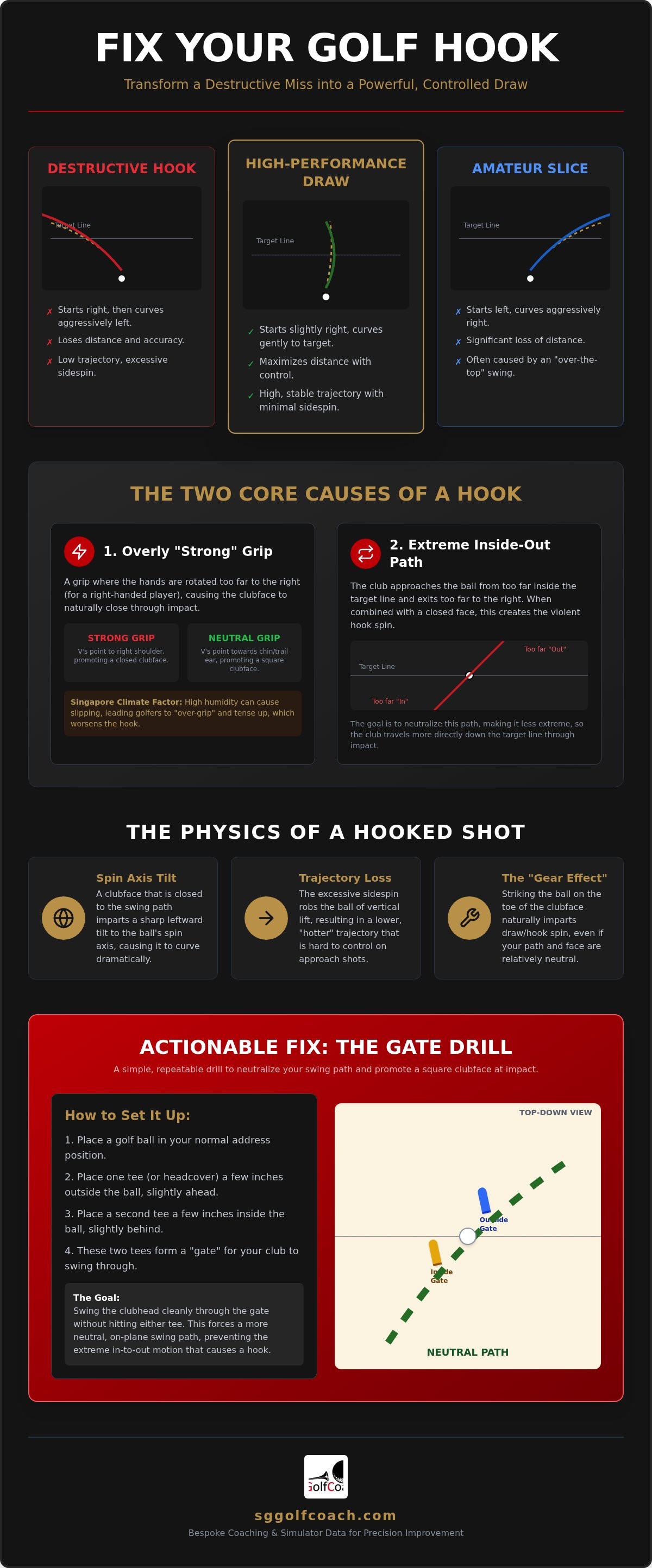
A hook occurs when a golf ball starts its journey straight or slightly to the right of the target before curving aggressively to the left for a right-handed player. It's often the bane of intermediate golfers who have finally conquered their beginner slice. In the Glossary of golf, this flight is defined by its significant lateral movement. While a slice is often the result of a weak, "over-the-top" move, a hook suggests you've developed the hand speed and inside-out path necessary for a high-level game. This is why many professional instructors call it the "better player's miss." It shows you're releasing the club; you're just doing it too much.
The psychological toll of this miss is heavy. When you're standing on a tee box with water or thick jungle on the left, the fear of the "big miss" can lead to defensive, restricted swings that only make the problem worse. You might try to "steer" the ball, which often results in an even more closed clubface. If you want to learn how to fix golf hook Singapore golfers often struggle with, you must first understand the physics. The golf hook is fundamentally a clubface-to-path relationship where the face is significantly closed relative to the swing path at impact.
Hook vs. Draw: Knowing the Difference
A draw is a functional, high-performance shot that starts slightly right of the target and gently falls back to the center with minimal side spin. It's the gold standard for distance and control. Conversely, a destructive hook features excessive curvature that results in "dead" balls that tumble into the rough. The dreaded "snap hook" is particularly dangerous on Singapore's lush, narrow courses. This shot leaves the clubface so closed that the ball dives low and left almost immediately, making recovery nearly impossible from the dense foliage found at many local clubs.
The Anatomy of a Hooked Shot
The physics of a hook involve a tilted spin axis. When the clubface is closed to the path, it creates excessive right-to-left spin that robs the ball of its vertical lift. This results in a lower, hotter trajectory that lacks the "soft landing" required for precise approach shots. Several factors contribute to this destructive flight:
Spin Axis Tilt: The ball curves because its axis of rotation is tilted significantly to the left.
Trajectory Loss: Hooked shots fly lower, making it difficult to clear hazards or hold firm greens.
The Gear Effect: Strikes on the toe of the club naturally induce draw spin, even if your path is relatively neutral.
Mastering how to fix golf hook Singapore issues requires diagnosing whether your miss is a result of this impact location or a deeper path flaw. Professional analysis can help you identify these subtle differences and restore your confidence on the course.
Core Causes: How Grip Orientation and Swing Path Create the Hook
Understanding the root of a hook requires looking closely at the relationship between your hands and the club's trajectory. A closed clubface at impact is the primary culprit of the hook, as it forces the ball's spin axis to tilt sharply to the left. While many players focus solely on their swing, the issue often starts before the club even moves. Many golfers in the region fall into the "Strong Grip" trap, where the V-shape formed by the thumb and index finger points too far toward the right shoulder. This orientation makes it incredibly easy for the clubface to rotate shut during the downswing.
Singapore’s unique climate adds another layer of difficulty to maintaining a neutral grip. High humidity levels lead to persistent moisture on the hands, which often causes the club to slip mid-swing. To combat this, golfers frequently "over-grip" the club. This excessive tension prevents a natural release and often results in the hands turning over too aggressively. If you're searching for how to fix golf hook Singapore issues, addressing how you manage moisture and grip pressure is a critical first step. When paired with an extreme "in-to-out" swing path, these grip errors produce the violent right-to-left spin that ruins an otherwise solid drive.
The Role of the Hands and Wrists
Precision in the wrists is what separates a professional draw from a frustrating hook. Active hands often lead to "flipping," a move where the wrists snap shut through the hitting zone to compensate for a lagging clubhead. Additionally, a bowed lead wrist during the transition or at the top of the swing closes the face prematurely. Maintaining a flatter wrist position is essential for keeping the face square. For golfers struggling with these technical plateaus, bespoke coaching provides the expert oversight needed to transition from "flippy" hands to a stable, professional release.
Swing Path and Body Alignment
Your body's movement often dictates whether the club has room to swing freely. When your arms drop too far behind your torso, you'll experience a "stuck" feeling that forces an exaggerated inside-out path. Alignment also plays a deceptive role. Many golfers aim further right to compensate for a hook, but this actually encourages the body to swing even more to the right of the target line, which only increases the hook spin. If your hip rotation stalls before impact, your hands will instinctively take over to finish the swing, slamming the face shut in the process. Consistent hip clearance is vital for giving the arms enough space to swing through on a neutral plane.
Hook vs. Slice vs. Draw: Identifying Your Specific Ball Flight Pattern
To master how to fix golf hook Singapore golfers must first become detectives on the driving range. Your ball flight is the most honest feedback you'll ever receive. By analyzing the "Start Direction" versus the "Curve Direction," you can reverse-engineer your swing flaws with surgical precision. Your clubface angle at impact primarily dictates the initial start direction, while the curve is created by the relationship between that face and your swing path. If the ball starts right and stays right, your face is open; if it starts right and curves back, you're on the path to a draw.
The Pull-Hook is the most devastating variation for any scorecard. It starts left of your target and curves even further left, often ending in the dense tropical foliage that lines many local fairways. This happens when your clubface is closed to the target line and even more closed to an outside-in swing path. Conversely, the Push-Hook starts right of the target and curves back aggressively past the center line. This indicates an inside-out path with a clubface that's closed to that path. Distinguishing between these two is vital for applying the correct technical fix.
Flight Characteristics Comparison
Hooks and draws might look similar to the untrained eye, but their data profiles are worlds apart. A controlled draw typically features a higher launch angle and lower side-spin rates, which allows the ball to land softly on the green. A hook is characterized by a lower launch and high lateral spin. This combination causes the ball to stay low and "run out" uncontrollably once it hits the turf. Mapping your typical miss pattern during a range session helps you identify whether you're dealing with a minor path issue or a total face-to-path mismatch.
The Role of Equipment in Ball Flight
Sometimes the fault isn't entirely in your swing mechanics. If your club's shaft flex is too soft for your swing speed, the clubhead may "kick" too early, closing the face before you reach impact. This is a common issue for golfers who have recently increased their power through dedicated practice but haven't updated their gear. Additionally, many modern drivers are designed with a "draw-bias" to help beginners stop slicing. For an intermediate player already fighting a hook, these clubs only amplify the problem. If you're just starting to evaluate your kit, Mastering the Basics provides essential insights into how equipment fundamentals impact your journey toward a consistent swing. Professional club fitting or a bespoke coaching session can quickly determine if your equipment is working against your progress.
Actionable Drills to Neutralize Your Clubface and Improve Accuracy
Mastering how to fix golf hook Singapore issues requires moving beyond theory into physical sensation. You need to feel the difference between a closed face and a square one. Start with the "Neutral Grip" Reset. Look at your lead hand and ensure the "Vs" formed by your thumb and index finger point toward your trailing ear rather than your trailing shoulder. This subtle shift prevents the club from turning over too aggressively during impact, which is the most common cause of the ball diving left.
In our tropical climate, maintaining this grip is a constant battle. Sweaty palms often lead to the club slipping, which prompts golfers to over-strengthen their grip as a defensive reflex. Keep a dry towel and a fresh glove handy. Regularly cleaning your grips to keep them tacky is a simple but overlooked part of maintaining a neutral clubface. If you find yourself flipping your wrists to compensate for a poor path, try the "Split-Hand Drill." By separating your hands on the grip, you'll immediately feel if your trail hand is taking over and slamming the face shut through the hitting zone.
Drills for the Driving Range
Practical sessions at the range should be structured and intentional. Use the "Gate Drill" by placing a headcover or an empty ball bucket just outside the ball. This forces you to swing on a more neutral plane, as an extreme inside-out path would result in hitting the object. Pair this with the "Toe-Up to Toe-Up" drill. Swing the club to hip height on both sides, ensuring the toe of the club points directly at the sky at both points. This teaches you to control the rotation of the face through the hitting zone. Finally, always use alignment sticks. Without them, your body will instinctively aim further right to avoid the left side, which only deepens the hook mechanics you're trying to erase.
Leveraging Indoor Simulators for Fixes
While outdoor practice is valuable, precision often requires the data-driven environment of a simulator. Facilities like Royce Luxury offer a controlled setting where weather variables like wind and humidity are removed. This allows you to focus entirely on "Face-to-Path" data. If your path is 4 degrees right but your face is 2 degrees left, you’ll see exactly why that hook is happening. For a deeper dive into these high-tech training environments, check out our guide on Indoor Golf in Singapore.
Professional guidance is the fastest way to interpret this data and apply these drills correctly. If you're ready to stop guessing and start improving, book a bespoke coaching session today to receive a personalized swing analysis and a tailored plan for your progress.
Bespoke Coaching Solutions: Mastering Your Swing with SgGolfCoach
Self-diagnosis is notoriously difficult in golf because what you feel in your swing is rarely what is actually happening. While understanding the physics of a closed clubface is the first step, applying that knowledge under pressure requires an expert eye. Our bespoke coaching at SgGolfCoach provides the sophisticated, personalized instruction necessary to identify the subtle differences between a path issue and a face-angle error. By utilizing the premium indoor simulators at Royce Luxury, we can analyze your precise "Face-to-Path" data to determine exactly why your ball is diving left. This data-driven approach is the most efficient way to learn how to fix golf hook Singapore challenges and build a swing that lasts.
We believe that every golfer has a unique signature. Our instructors don't force a "textbook" swing upon you; instead, we offer tailored adjustments that respect your natural biomechanics while neutralizing your destructive misses. If you're ready to invest in your progress, Finding the Right Golf Coach in Singapore is essential for moving past frustrating plateaus and achieving aspirational excellence on the course.
The Benefits of Personalized Mentoring
Generic "YouTube fixes" often lead to a cycle of temporary improvements followed by technical regression. They offer a one-size-fits-all solution for a problem that is deeply individual. Through our bespoke coaching, we move beyond these surface-level tips to create a structured development plan. We help you manage your "miss" during a live round, teaching you how to navigate the course even when your swing feels slightly off. A major part of this journey involves building a repeatable pre-shot routine. This mental and physical anchor helps neutralize the hook under pressure, giving you the confidence to swing freely whether you're at the driving range or on the first tee.
Next Steps for Your Game
The journey to a more controlled ball flight begins with a single diagnostic session. By analyzing your current swing data, we can provide immediate, actionable feedback that transforms your game. Our Junior Programs and Adult Lessons are designed to build long-term consistency, fostering a deep understanding of the sport that goes beyond simple mechanics. Transitioning these adjustments from the practice bay to the fairways of Mandai Executive Golf Driving Range is where true mastery happens. We invite you to partner with us in your progress. Let’s work together to transform that frustrating hook into a powerful, reliable draw, ensuring you enjoy every moment of your time on the green.
Elevate Your Game with a Controlled Ball Flight
Mastering a consistent swing is a journey of precision and patience. You've learned that neutralizing a strong grip and refining your swing path are the foundational steps in understanding how to fix golf hook Singapore challenges. By distinguishing between a destructive pull-hook and a high-performance draw, you can begin to practice with the intentionality required for mastery. Whether you're utilizing the premium indoor simulators at Royce Luxury for data-driven insights or refining your technique at Mandai Executive Golf Driving Range, professional guidance ensures your progress is both rapid and sustainable.
We provide tailored coaching for adults and juniors, offering a bespoke experience that respects your natural swing while eliminating technical plateaus. Don't let a frustrating hook hold you back from enjoying the sport you love. It's time to transform that unpredictable curve into a powerful, repeatable asset on the tee. Book a bespoke golf coaching session with SgGolfCoach to fix your hook today and start your journey toward aspirational excellence. We look forward to being your partner in progress on the fairways.
Frequently Asked Questions
What is the fastest way to fix a golf hook?
The most efficient method for how to fix golf hook Singapore issues is a professional swing analysis. A bespoke coach can quickly distinguish between a closed clubface at impact and an exaggerated inside-out swing path. While drills help, personalized feedback at facilities like Mandai Executive ensures you aren't just masking the problem with another swing flaw. This diagnostic approach saves you months of trial and error on the driving range.
Is a strong grip always the cause of a hook?
While a strong grip is a frequent culprit, it isn't the only cause of a hook. You might have a perfectly neutral grip but still hook the ball due to an extreme "in-to-out" swing path or stalled hip rotation. When your lower body stops moving, your hands naturally take over and slam the clubface shut. Identifying the specific interaction between your path and face is essential for a permanent fix.
How does Singapore’s humidity affect my golf grip and ball flight?
High humidity levels in Singapore often cause hands to sweat, which reduces the friction between your glove and the club. This often leads to "over-gripping" as a subconscious way to maintain control. This extra tension in your forearms prevents a smooth release and can cause the clubhead to turn over too early. Keeping your grips dry and using a fresh glove is a simple but effective strategy for stability.
What is the difference between a snap hook and a regular hook?
A regular hook typically starts straight or slightly right before curving back toward the target with a standard trajectory. A snap hook is far more destructive; it starts left of the target line and dives even further left with a very low, hot flight. This "duck hook" is usually caused by a combination of a shut clubface and an outside-in path, making it one of the most difficult misses to recover from.
Can my golf clubs cause me to hook the ball?
Your equipment can definitely influence your ball flight. If your driver has a "draw-bias" or if the shaft is too flexible for your swing speed, the clubhead may close too quickly at impact. This is why professional club fitting or bespoke coaching is valuable. An expert can determine if your gear is fighting against your natural swing mechanics and suggest adjustments that help you find a more neutral flight.
Should I aim further right if I am hooking the ball?
Aiming further right is a common mistake that often makes a hook even worse. When you align your body to the right, you subconsciously encourage an even more inside-out swing path to "push" the ball back toward the target. This increased path angle, combined with a closed face, generates more side spin and a wider curve. Instead, you should focus on neutralizing your alignment and squaring your clubface at impact.
How can an indoor simulator help me fix a hook?
Indoor simulators provide precise data that is impossible to see with the naked eye. At premium facilities like Royce Luxury, you can analyze your "Face-to-Path" ratio on every single shot. This feedback tells you exactly how many degrees your face is closed relative to your swing direction. Having this concrete data allows you to make micro-adjustments to your grip or path, leading to much faster technical progress.
Is a hook better than a slice for a beginner?
Many instructors consider a hook to be a "better player's miss" because it usually indicates you've developed the hand speed and release that beginners lack. While a slice is often weak and powerless, a hook at least has distance and compression. However, both are destructive to your scorecard. Transitioning from a hook to a controlled draw is the final step in achieving a high-performance, professional ball flight.


Comments