

Strategic Golf Course Management Tips: Lower Your Scores in Singapore (2026)
- sggolfcoach

- 1 day ago
- 13 min read
You might believe that a lower handicap requires a faster swing or a more technical release, but the fastest way to shave five strokes off your scorecard has nothing to do with your mechanics. By mastering specific golf course management tips Singapore players can outplay their own swing flaws through disciplined, high-level decision-making. It's the intellectual edge, not just the physical one, that separates the elite from the average on our local fairways.
It's incredibly frustrating to watch a promising round at one of Singapore's many courses evaporate because of a single blow-up hole or a miscalculated approach into a humid headwind. You've likely felt that spike of anxiety when facing a narrow fairway flanked by water, wondering if your club selection truly accounts for the heavy, tropical air. We understand that these moments of hesitation can ruin an otherwise beautiful day of sport. This guide from SgGolfCoach promises to help you navigate our unique layouts with the confidence of a seasoned professional. You'll discover how to master your mental framework and make smarter tactical decisions that yield immediate, measurable results without a total swing overhaul. We will explore how to handle Singapore's specific environmental factors, manage high-pressure hazards, and leverage bespoke strategy to refine your game before you even step onto the first tee.
Table of Contents
What is Golf Course Management and Why It Matters in Singapore
Many golfers believe that lower scores are found at the bottom of a bucket of range balls. While a refined swing is a valuable asset, true mastery comes from how you navigate the field. Understanding What is a Golf Course and its various hazards is just the beginning. Course management is the art of navigating the field of play with deliberate intent. It's about making choices that maximize your strengths while minimizing the impact of your unavoidable misses. Utilizing professional golf course management tips Singapore golfers swear by is the first step toward a more rewarding experience.
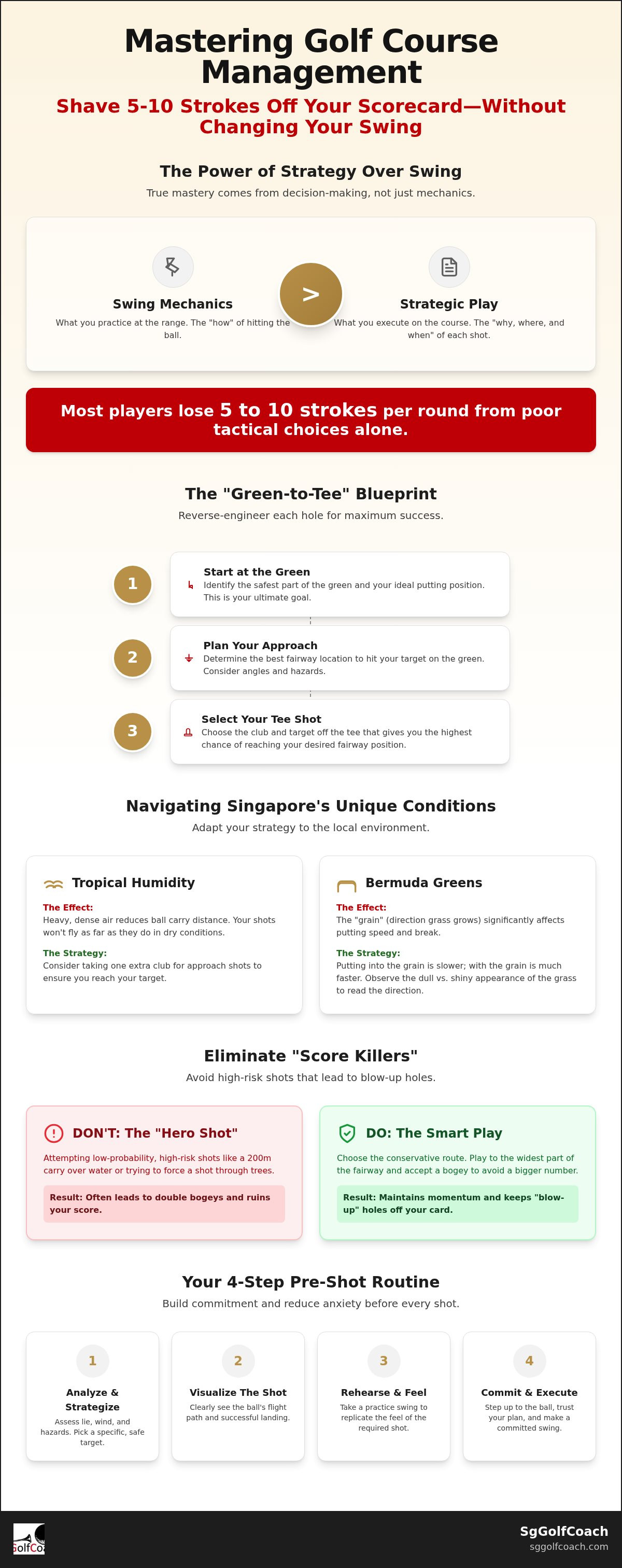
As a premium mentor, I view strategy as the essential bridge between a good swing and a great score. You don't need a professional-level swing to achieve professional-level results if your decision-making is precise. Most recreational players lose between 5 to 10 strokes per round simply by making poor tactical choices. They chase pins they can't reach or attempt low-probability "hero shots" that almost always result in a double bogey. Success comes when you stop trying to play like a tour pro and start playing your own game.
The Difference Between Swing Mechanics and Strategic Play
A "perfect" swing is a beautiful tool, but it often fails on the course without a clear tactical plan. Mechanics are what you practice at the range; strategy is what you execute under pressure. When you apply effective golf course management tips Singapore conditions demand, you significantly reduce mental fatigue. Instead of obsessing over your elbow position mid-round, you focus on targets and landing zones. This shift from a range-focused mindset to a course-focused strategy allows you to remain calm and composed, even when your swing feels slightly off.
Identifying the 'Score Killers' on Singapore Courses
The most common "score killers" on local fairways aren't technical failures. They're often the result of greed. Attempting a 200-meter carry over water or trying to blast a ball out of thick, tropical rough usually leads to disaster. These "hero shots" are high-risk and low-reward. Most double bogeys stem from an inability to accept a bogey and move on. If you're just starting out, it's vital to build a foundation of smart play. You can learn more about these fundamentals by exploring Mastering the Basics: Beginner Golf Lessons in Singapore. By choosing the conservative route and playing to your "miss," you'll find that your handicap drops much faster than it would through swing changes alone.
The Strategic Blueprint: Planning from the Green Backwards
Elite players don't just look at the hole from the tee box; they reverse-engineer it. By starting at the cup and working backward, you define exactly what success looks like for every preceding shot. This "back-to-front" methodology is a cornerstone of the golf course management tips Singapore professionals utilize to maintain consistency on challenging local layouts. Before you even touch your bag, ask yourself where you want to be putting from. This clarity of purpose dictates your approach angle and, ultimately, your club choice on the tee.
Identifying the "safe side" of the hole is essential for minimizing risk. If a pin is tucked dangerously close to a bunker or water hazard, your target should shift toward the fat part of the green. This creates a margin for error that prevents a single misstep from turning into a scorecard-ruining "blow-up" hole. When it comes to club selection, rely on the 80% rule. Only play the club you can hit successfully 8 out of 10 times. If you need a perfect strike to clear a hazard, you're likely holding the wrong club. For those looking to master these tactical nuances, engaging in bespoke coaching provides the personalized insight needed to refine your yardage gaps.
Tee Box Tactics: Finding the Wide Side
Singapore's course layouts are famously narrow and punishing. While the driver is often the most tempting club in the bag, it isn't always the smartest choice for every par 4. Look for the "wide side" of the fairway where the landing area is most forgiving. If there is a hazard on the left, aim for the right-center, even if it leaves you a slightly longer second shot. Visualizing your specific shot shape allows you to "aim away" from trouble and let the ball curve back into the safety of the short grass. You can find more detailed USGA course management resources that explain how fairway positioning impacts scoring averages across different skill levels.
Approach Shots and Green Reading
Chasing pins is a high-stakes gamble that rarely pays off for the average golfer. Instead, make it your primary mission to aim for the center of the green. This strategy creates a natural "buffer zone" in every direction, which accounts for common misses like a slight push or a thin strike. Even if you miss your intended target by several meters, you'll still be on the putting surface with a realistic chance for a two-putt par. The center-green philosophy is the safest path to par. By focusing on landing zones rather than the flagstick, you'll find your handicap dropping as your consistency rises.
Navigating Singapore’s Unique Terrain and Tropical Conditions
Singapore’s tropical climate isn’t just a backdrop; it’s an active participant in your game. High humidity levels, often exceeding 80%, create "heavy" air that increases drag on the golf ball. This density affects ball compression and significantly reduces carry distance compared to drier climates. When applying golf course management tips Singapore players must account for this by often taking one extra club on approach shots. If you don't adjust for this atmospheric resistance, you'll find yourself constantly short of the green, bringing front-side bunkers and water hazards into play unnecessarily.
The physical toll of our heat is another critical strategic factor. When your core temperature rises, decision-making becomes sluggish and focus wavers. Seeking shade between shots and maintaining strict hydration aren't just health tips; they're tactical necessities to prevent late-round "mental fades" that lead to poor club selection. Understanding environmental best management practices helps us appreciate how local courses are maintained to handle these extremes, but the responsibility for managing your own performance remains with you. By the 14th hole, your mental acuity begins to dip if you haven't managed your energy, which is where those scorecard-ruining holes often occur.
Playing the Grain: Putting and Chipping in the Tropics
Local greens, typically Paspalum or Bermuda, have a distinct "grain" or growth direction that dictates ball behavior. Putting into the grain requires a much firmer stroke, while putting with the grain can be deceptively fast and slippery. You can identify the grain by looking at the cup; one side will often look "fuzzed" or ragged, indicating the direction the grass is growing. Look for a shiny appearance to indicate the grain is moving away from you, while a dull look suggests it's growing toward you. In these conditions, the "bump and run" is often more reliable than a high flop shot, as the grain has less influence on a ball that spends more time on the ground.
Bunker Management and Heavy Rough
Tropical rain often turns bunkers into compacted, wet sand that behaves differently than the fluffy dunes found elsewhere. You shouldn't use the same "splash" technique as you would in dry sand; instead, a more precise strike with less bounce is often required to avoid "thinning" the ball across the green. Similarly, our thick rough can aggressively "grab" the clubhead during the swing. If you find yourself in the deep grass, don't try for the green with a long iron. Taking your medicine and chipping out to the fairway with a high-lofted wedge is the smarter play. If you're struggling to adapt to these variables, Finding the Right Golf Coach in Singapore can help you develop the specific techniques needed for our unique terrain.
Practical Drills and Mental Frameworks for the Fairway
Strategic brilliance isn't a gift; it's a habit forged through deliberate practice. To truly internalize the golf course management tips Singapore golfers need for lower scores, you must move beyond mindless ball-striking. Start with the "Scorecard Audit" drill after every round. Instead of just tallying your total, highlight every stroke lost to a poor decision, such as attacking a tucked pin or failing to account for the tropical grain. This data-driven reflection reveals your strategic blind spots and transforms every round into a bespoke learning experience.
On the driving range, shift your focus from power to precision with a "Target-Only" session. Stop hitting into the wide expanse of the range and choose a specific flag for every single ball. You aren't just practicing your swing; you're practicing the mental act of committing to a landing zone. This discipline builds the confidence required to stick to your plan when you're facing a narrow fairway or a daunting water hazard on the course.
The 4-Step Pre-Shot Commitment Routine
A structured routine is your best defense against the anxiety of a difficult shot. It ensures that your mind is as prepared as your body before you begin your takeaway. Follow these four steps to lock in your strategy:
Step 1: Gather Data. Assess the wind direction, the distance to the target, and the quality of your lie.
Step 2: Select the Safe Target. Identify the "wide side" of the green or fairway that offers the largest margin for error.
Step 3: Visualize the Flight. See the ball's trajectory and where it will land in your mind's eye.
Step 4: Execute with Commitment. Once you've made your choice, swing with 100% belief in the decision.
Indecision is a primary cause of poor contact. By the time you stand over the ball, the strategic work should be finished, leaving your mind free to focus on a fluid, athletic motion.
Practice Sessions for Strategic Mastery
Modern technology offers a significant advantage for those looking to refine their tactical approach. Using high-end simulators allows you to master your "real" carry distances rather than relying on your "best-ever" strikes. This distinction is vital for choosing the right "layup" clubs or clearing hazards with certainty. You can explore how to integrate these tools into your training by reading our Indoor Golf in Singapore: 2026 Guide. Simulating high-pressure holes in a controlled environment helps you build the mental stamina needed for the final few holes of a competitive round. To truly bridge the gap between the range and the course, consider booking a Bespoke Coaching session where we can analyze your strategic framework in real-time.
Refining Your Strategy with Bespoke Coaching
While self-led drills and mental frameworks provide a solid foundation, there's no substitute for the objective eye of a professional mentor. Even with the most comprehensive golf course management tips Singapore has to offer, internal biases often cloud our judgment during the heat of a round. We tend to remember our best shots and ignore our frequent misses, leading to over-ambitious planning. SgGolfCoach acts as your strategic partner, identifying the subtle patterns and blind spots that keep your handicap stagnant despite a technically sound swing. Mastery is rarely achieved in isolation; it requires a collaborative effort between a dedicated student and an authoritative guide.
Our approach at SgGolfCoach transcends traditional instruction. We believe that a truly elite golfer is one who understands the "why" behind every shot, not just the "how." By positioning a coach as a tactical advisor, we help you bridge the gap between range-bound theory and on-course reality. This level of personalized attention ensures that your development is as unique as your swing, focusing on the specific challenges you face on local fairways.
The Value of On-Course Professional Feedback
Most instruction happens in the controlled environment of a driving range, but the game is won or lost on the grass. Playing lessons are perhaps the most effective way to refine your strategy because they allow a mentor to observe your decision-making in real-time. During these sessions, we focus on several key areas:
Identifying Recurring Mental Errors: We pinpoint the specific moments where frustration or ego leads to a "blow-up" hole.
Reading the Course: You'll learn to see the terrain through the eyes of a professional, spotting hidden slopes and grain directions that others miss.
Strategy Transition: We ensure that the tactical plans you develop during practice are actually applied when you're standing on the 18th tee with a personal best on the line.
This immediate feedback loop turns every mistake into a valuable lesson, preventing bad habits from becoming permanent fixtures in your game.
Bespoke Programs for Long-Term Improvement
A customized coaching plan is not a static document; it is a living strategy that evolves as your skills sharpen. For a novice, the focus might be on basic safety and obtaining the necessary certifications. You can learn more about this initial phase in our Guide to PC and Golf Handicap in Singapore. As your handicap lowers, our coaching shifts toward the nuanced, high-level tactical decisions that separate the good from the great. Whether you are navigating your first fairway or preparing for a club tournament, we provide the meticulous attention to detail required for lasting progress. Book your Bespoke Coaching session today to master the fairways and experience the transformative power of elite mentorship.
Master Your Strategic Edge on the Fairway
Mastering the game of golf in our tropical climate requires more than just a polished swing; it demands a sophisticated mental framework. By planning every hole from the green backwards and adjusting for the unique humidity and grain of local courses, you transform from a reactive player into a proactive strategist. Implementing these golf course management tips Singapore golfers rely on ensures that you spend less time recovering from hazards and more time celebrating consistent pars. Success on the course is a deliberate choice made before you ever reach for your bag.
If you're ready to stop losing strokes to indecision, it's time to partner with an expert who understands the nuances of the local landscape. We invite you to Elevate Your Game with Bespoke Coaching at SgGolfCoach. Our professional instruction at Mandai Executive Golf Driving Range provides tailored strategic programs for all skill levels, delivered through our signature premium mentor approach. Your journey toward mastery is a rewarding one. With the right guidance, a lower handicap is well within your reach. Let's step onto the first tee with confidence and a clear vision for your success.
Frequently Asked Questions
What is the 80% rule in golf course management?
The 80% rule dictates that you should only select a club if you can execute the intended shot successfully eight out of ten times. This conservative approach eliminates the temptation to try "miracle" shots that often lead to double bogeys. By playing within your consistent range, you ensure that even a slight miss remains in play. It is a fundamental part of the golf course management tips Singapore players use to maintain a steady, stress-free scorecard.
How do I choose the right club when playing in Singapore's humidity?
Singapore's high humidity increases air density, which creates more drag on the ball and reduces your total carry distance. To compensate for this "heavy" air, you should typically take one extra club on your approach shots. If you usually hit a seven-iron from 150 meters, consider using a six-iron to ensure you reach the putting surface. This simple adjustment prevents you from landing short in front-side bunkers or water hazards that guard the green.
Can course management really lower my score without swing changes?
You can absolutely lower your handicap without changing your swing by making smarter tactical decisions. Most strokes are lost to poor target selection and unforced errors rather than technical failures. By aiming for the center of the green and avoiding high-risk hazards, you significantly reduce the frequency of blow-up holes. Strategic play allows you to maximize your current physical abilities and find a more efficient path to the cup without months of technical drills.
What is the best way to manage the mental toll of a long round in the heat?
Managing the mental toll of Singapore’s tropical heat requires a proactive approach to hydration and energy conservation. Dehydration leads to sluggish decision-making and a loss of focus during the critical final holes of a round. You should seek shade between every shot and maintain a steady intake of water and electrolytes. By keeping your core temperature stable, you preserve the mental acuity needed to stick to your strategic plan when physical fatigue begins to set in.
How do I handle water hazards strategically on narrow Singapore courses?
Strategically handling water hazards involves identifying the "wide side" of the fairway or green to maximize your margin for error. If a hazard guards the left side, aim for the right-center to ensure a slight miss still stays dry. Additionally, you should select clubs that either finish well short of the water or comfortably clear it. This disciplined approach removes the "all-or-nothing" pressure that often leads to high-stakes errors on Singapore’s narrow course layouts.
Should I always aim for the flag on my approach shots?
You should rarely aim directly for the flagstick, especially when it is tucked near a hazard or the edge of the green. Instead, make it a habit to target the center of the putting surface for almost every approach shot. This "center-green" philosophy provides a safety buffer in all directions, accounting for common misses like a slight push or pull. Even an imperfect strike will often leave you with a manageable two-putt par rather than a difficult recovery.
How can a professional golf coach help with my course strategy?
A professional coach acts as a strategic partner who identifies recurring mental errors you might not notice yourself. Through bespoke coaching sessions, an instructor can observe your decision-making in real-time and provide immediate feedback on club selection and target alignment. This mentorship helps you transition from a range-focused mindset to a course-focused strategy. At SgGolfCoach, we specialize in refining these tactical nuances to ensure your physical skills are supported by a high-level, professional intellectual edge.
Is an indoor golf simulator useful for learning course management?
Indoor golf simulators are incredibly useful for mastering course management because they provide precise data on your actual carry distances. Knowing your "real" yardages allows you to make informed club choices under pressure. You can use these simulators to practice specific "layup" shots and distance control in a controlled environment. This data-driven approach removes the guesswork from your game, allowing you to execute your strategic plan with much greater certainty when you return to the grass.


Comments