

Mastering the Virtual Fairway: Essential Golf Simulator Practice Drills in Singapore (2026)
- sggolfcoach

- 2 minutes ago
- 12 min read
Most golfers in Singapore treat an hour at the simulator like a high-tech game of whack-a-mole rather than a precision training session. While you might be looking for effective golf simulator practice drills Singapore offers at its premium bays, simply hitting balls without a plan often leads to stagnating progress. You see the numbers for path, face angle, and smash factor flashing on the screen, but without a clear framework, that data feels more like a riddle than a roadmap.
We understand that aimless hitting is the fastest way to lose momentum, which is why we've developed a way to turn that confusion into confidence. This guide will transform your indoor sessions into a masterclass of data-driven improvement. By following a structured routine, you'll build the distance control and swing consistency needed for your next round at Mandai or other local courses.
We've designed a specialized 60-minute practice plan that moves you from a purposeful warm-up to high-stakes pressure drills. This roadmap ensures every swing serves a specific purpose, helping you master the virtual fairway and see real results on the course.
Table of Contents
The Strategic Edge: Why Simulator Drills are Essential for Singapore Golfers
Mastering Club Path and Face Angle: Data-Driven Drills for Precision
The Precision Gap: Distance Control and Wedge Gapping Drills
The 60-Minute Power Hour: A Structured Simulator Practice Routine
Beyond the Screen: Why Professional Coaching Complements Simulator Practice
The Strategic Edge: Why Simulator Drills are Essential for Singapore Golfers
Many golfers view the screen as a high-tech entertainment system, but the true value of modern golf simulator technology lies in its role as a diagnostic laboratory. In a city like Singapore, where the tropical humidity can sap your energy and sudden afternoon downpours often disrupt a scheduled range session, the simulator provides a sanctuary of consistency. By stepping into a climate-controlled environment, you remove the external variables that cloud your focus. This allows you to engage with golf simulator practice drills Singapore professionals recommend to isolate specific mechanics without the distraction of heat or wind.
Removing the anxiety of watching a ball slice into the trees at a traditional range is a powerful psychological tool. Indoors, the focus shifts from the result to the process. You're free to experiment with grip changes or posture adjustments because the fear of the flight is replaced by a focus on the numbers. This controlled setting accelerates muscle memory, as you can repeat a specific movement pattern dozens of times in a stable, comfortable environment.
The Feedback Loop: Data vs. Guesswork
At a standard driving range, you're often left guessing why a shot went astray. Was it a closed face or an outside-in path? A simulator removes the mystery by providing data points measured in precise degrees. Seeing your swing path and face angle instantly allows for immediate self-correction. High-speed video replays offer a visual confirmation of what the data suggests, making it easier to bridge the gap between feel and real. Data-Driven Practice is the bridge to consistent ball striking because it replaces subjective feelings with objective facts.
Path Analysis: Identify exactly where your club is traveling through impact.
Face Angle: Understand why your ball starts left or right of the target.
Instant Replay: Match your physical sensation to the actual visual of your swing.
Maximizing Your Indoor Session in Singapore
For those just starting out, indoor practice is the perfect supplement to beginner golf lessons Singapore coaches provide. It offers a low-pressure environment to refine the fundamentals taught during coaching. Many central facilities cater to busy professionals, making it easy to squeeze in a high-quality session during a lunch break or after office hours. To see real results, you must approach the bay with a Deep Practice mindset. This means moving away from the social aspect of screen golf and focusing on specific golf simulator practice drills Singapore learners use to build a repeatable swing. Ten shots hit with full focus on a specific data point are worth more than a hundred shots hit aimlessly into the screen.
Mastering Club Path and Face Angle: Data-Driven Drills for Precision
Understanding the mechanics of ball flight starts with a concept often overlooked in casual play: the 90/10 Rule. This principle states that approximately 90% of your ball's initial starting direction is determined by the face angle at the moment of impact, while only 10% comes from your club path. When you engage with golf simulator practice drills Singapore learners use to refine their game, focusing on face control is your fastest route to accuracy. If your face is pointing three degrees right, the ball will start right, regardless of how much you try to swing left to compensate.
The Path Neutralizer Drill
To correct a persistent slice or hook, you must learn to neutralize your path. Set your simulator's data overlay to highlight Club Path and Face to Path metrics. Your goal is to keep your path between +2 and -2 degrees for a neutral flight. Visualize a narrow gate on the simulator screen and try to fire the ball through it. Use the system's high-speed cameras to verify your clubhead position at P2 and P6. This visual feedback loop is superior to traditional range work because it provides instant, objective confirmation. These movements are foundational to essential golf practice drills that help build a reliable, professional-grade swing.
Face Angle Calibration
Mastering the clubface requires a deep awareness of your wrist and hand rotation. The Clock Face drill is a perfect exercise for this: attempt to hit a series of five shots with a face angle of exactly zero. Small adjustments make a massive difference; a 2-degree face change can save 10 yards of lateral dispersion on a standard iron shot. Controlling the face also stabilizes your dynamic loft and spin rate, preventing those ballooning shots that fall short of the target. This level of precision maximizes your Smash Factor, which is the ratio of ball speed to clubhead speed. Consistent, center-face contact ensures you aren't leaving distance on the table. If these numbers feel overwhelming, our bespoke coaching provides the expert guidance needed to turn complex data into simple, athletic movements.
The Precision Gap: Distance Control and Wedge Gapping Drills
While many players obsess over driver distance, the true scoring advantage is found in the "scoring zone", the area within 100 yards of the pin. Wedge gapping remains one of the most underutilized features of modern technology, yet it is arguably the most impactful of all golf simulator practice drills Singapore offers. Instead of guessing whether a sand wedge goes 80 or 85 yards, a simulator provides the exact data needed to eliminate doubt. By building a meticulous Yardage Matrix, you transform your short game from a series of hopeful guesses into a precise, data-backed execution.
The Clock System is the foundation of this mastery. By visualizing your lead arm as the hand of a clock, you can calibrate partial swings to specific distances. For instance, a 9 o'clock swing with a 56-degree wedge might consistently carry 50 yards, while a 10 o'clock swing reaches 75 yards. Gamifying this process through Target Practice modes on your simulator makes the repetitive nature of short-game practice engaging and results-oriented. It's about building a library of feels that you can recall under pressure.
Creating Your Personal Yardage Matrix
To build an effective matrix, you must prioritize Carry Distance over Total Distance. In Singapore’s humid climate, greens can vary in firmness depending on the season, but your carry number remains your most reliable constant. Spend time recording the average carry for every wedge in your bag at three different swing lengths. This data is the secret weapon you'll bring to your golf course management lessons Singapore, allowing you to pick targets with the confidence of a professional. Knowing your 50, 75, and 100-yard numbers allows you to play to a specific spot rather than just swinging at the flag.
The 9-Shot Challenge
For those looking to elevate their game further, the 9-Shot Challenge introduces advanced trajectory control. This drill requires you to hit three different wedges at three different heights: low, mid, and high. Simulators are uniquely suited for this because they accurately measure Spin Decay and launch angle, showing you exactly how a low-spinning runner will react compared to a high-lofted stopper. Developing this feel by matching your physical effort to the on-screen data ensures that your golf simulator practice drills Singapore translate directly to the varied conditions found on local courses. You'll soon find that "proximity to hole" becomes your most improved statistic.
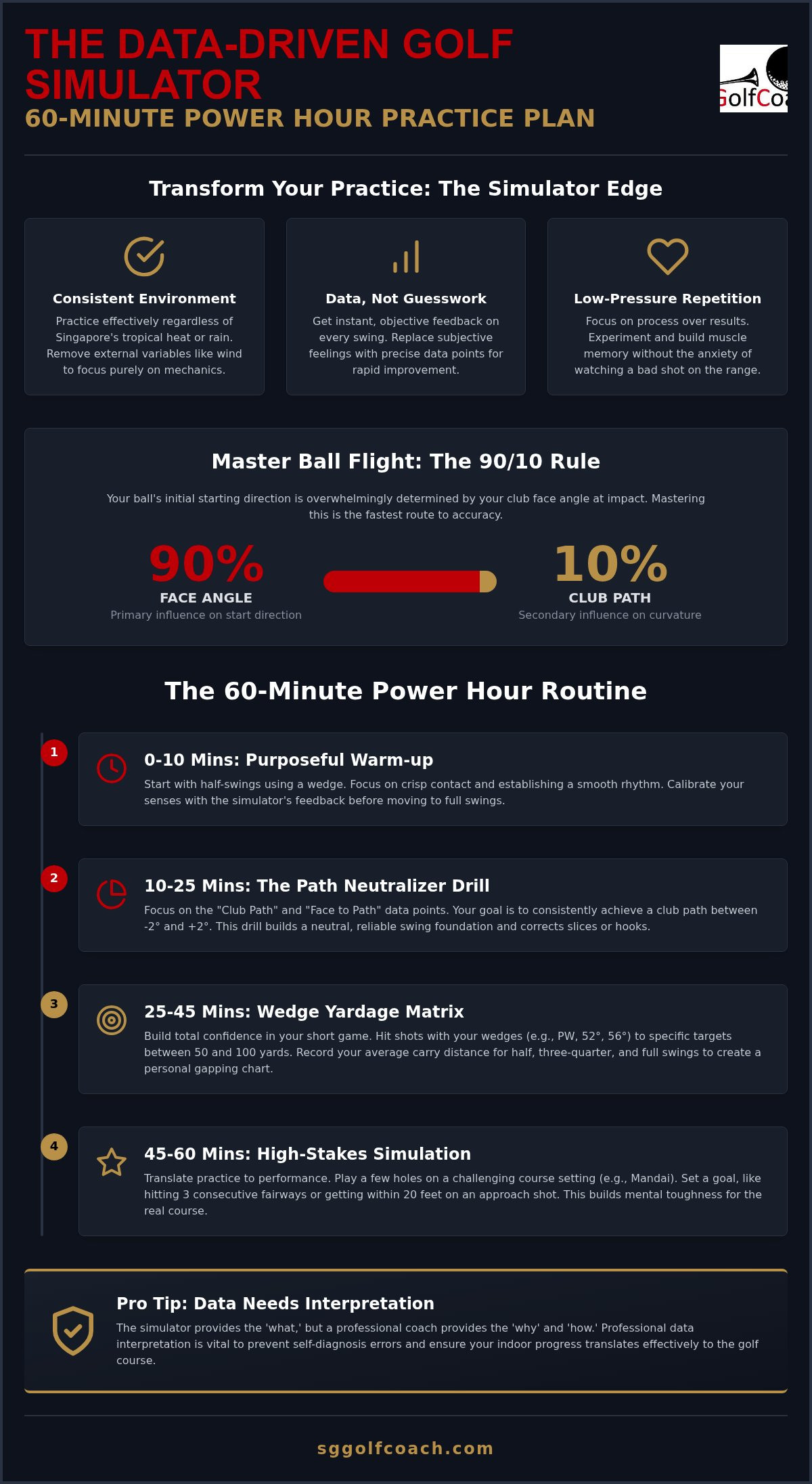
The 60-Minute Power Hour: A Structured Simulator Practice Routine
To maximize your gains, you must move beyond the "hit and hope" mentality. A structured 60-minute routine ensures that you aren't just burning calories but actually building a repeatable, resilient swing. By partitioning your time into specific phases, you can address technical flaws while still maintaining the "feel" required for the course. This methodical approach is what separates a social session from the most effective golf simulator practice drills Singapore has to offer for serious improvement.
Phase 1: The Warm-Up and Calibration (10 Minutes): Begin with dynamic stretching and short wedge shots. Use this time to check your baseline data for the day, ensuring your alignment and setup are neutralized before moving into full swings.
Phase 2: Block Practice for Technical Changes (20 Minutes): Focus on a single mechanic, such as the Path Neutralizer drill discussed earlier. The goal here is repetition and data confirmation to engrain new motor patterns.
Phase 3: Random Practice for Course Readiness (20 Minutes): Switch clubs and targets on every shot. This mimics the reality of a round where you never hit the same club twice in a row.
Phase 4: Pressure Testing and Performance Games (10 Minutes): End with a high-stakes challenge to see if your mechanics hold up when the "score" matters.
Transitioning from Block to Random Practice
Repeating the same swing with a 7-iron 50 times creates a false sense of security. While block practice is essential for technical changes, random practice is where real learning happens. Try simulating a "Three-Hole Stretch" from a local course like Mandai. If the first hole is a par 4, hit a driver, then an iron, and then a wedge. Incorporating your full pre-shot routine into every virtual swing bridges the gap between the indoor bay and the first tee. This variety forces your brain to solve new problems with every swing, which is the cornerstone of golf simulator practice drills Singapore professionals use to prepare for tournaments.
The "Pressure Test" Finale
Finish your hour with a "Closest to Pin" challenge or a three-hole virtual shootout. Most modern simulators allow you to save these performance profiles, making it easy to track your progress over weeks or months. If you can't hit the target when the virtual stakes are high, your technical changes haven't yet become permanent. Finishing your session with a high-stakes virtual challenge builds the mental fortitude and focus required to perform under pressure on a real course. If you want to ensure your practice hour is truly optimized, book a bespoke coaching session to have a professional audit your routine.
Beyond the Screen: Why Professional Coaching Complements Simulator Practice
While a structured 60-minute routine is a powerful tool for improvement, the wealth of data provided by modern launch monitors can sometimes lead to "paralysis by analysis." Technology shows you the result of your swing, but it doesn't always reveal the physical root cause. This is where the expertise of a professional becomes indispensable. Relying solely on self-diagnosis often leads to "band-aid" fixes that might temporarily improve your numbers on the screen but fail to hold up during a high-pressure round at Mandai. To truly master the game, you must bridge the gap between digital metrics and physical mechanics.
Professional instruction ensures that your golf simulator practice drills Singapore sessions are aligned with your long-term goals. Whether you are working toward your PC handicap golf Singapore milestones or refining a competitive edge, a coach acts as a filter. We help you focus on the two or three metrics that actually matter for your specific swing profile, preventing the common mistake of trying to "fix everything at once."
The Coach as a Data Interpreter
A simulator might tell you that your swing path is four degrees outside-in, but it won't explain that your lead hip is clearing late because of poor weight transfer. Our coaches translate abstract numbers like "Launch Angle" and "Spin Rate" into actionable body cues. By combining high-speed video analysis with launch monitor metrics, we provide a holistic view of your progress. Premium indoor golf Singapore facilities offer the perfect, distraction-free environment for these technical deep dives. It's an efficient way to make significant changes before testing them on the driving range or the course.
From Junior to Pro: Tailored Growth
The visual nature of simulators makes them an incredible tool for younger players. We use the screen to make junior golf program Singapore lessons engaging and interactive, turning technical drills into fun, data-driven challenges. For adults and juniors alike, the goal is a balanced development plan. This involves alternating between the precision of indoor technology and the "real-world" feel of outdoor play. This hybrid approach ensures that the confidence you build in the bay translates directly to the first tee. If you're ready to stop guessing and start growing, book your bespoke coaching session with SgGolfCoach today!
Step Into the Future of Your Game
Transforming your indoor sessions from casual play into a precision-based training routine is the most effective way to lower your scores. By utilizing structured golf simulator practice drills Singapore golfers can now refine their club path and face control with absolute data certainty. Whether you're building a meticulous Yardage Matrix or mastering the 60-minute Power Hour, every session becomes a deliberate step toward mastery. At Mandai and Royce Luxury, we provide access to premium TrackMan and Screen Golf technology to ensure your practice is as accurate as possible.
Our professional instructors are ready to help you translate complex data into lasting body mechanics through bespoke adult and junior programs. Combining these high-tech tools with expert mentorship ensures that your hard work indoors leads to real results on the course. Book Your Premium Indoor Practice Session Now and take the first step toward a more confident, data-driven game. The journey to excellence is best traveled with a partner who understands your potential. We're excited to be part of your transformation.
Frequently Asked Questions
Are golf simulator practice drills really effective for outdoor play?
Yes, simulator drills are exceptionally effective for outdoor play because they allow you to isolate specific swing mechanics in a controlled environment. By removing variables like wind and humidity, you can focus entirely on the data points that govern ball flight. Many professionals use golf simulator practice drills Singapore facilities provide to build a repeatable swing that holds up under pressure at local courses like Mandai. It's about building muscle memory that remains consistent regardless of the setting.
What is the most important data point to watch on a simulator?
While several metrics matter, Face Angle is arguably the most important data point for most players to monitor. Since the face dictates approximately 90% of the ball's initial starting direction, mastering this number is the fastest way to improve accuracy. Simulators provide this feedback in precise degrees, allowing you to make micro-adjustments that would be impossible to detect at a traditional driving range. Focusing on a square face at impact ensures your shots start on your intended target line.
How often should I practice on a simulator to see results?
Practicing on a simulator once or twice a week is typically enough to see measurable results in your swing consistency. The key is the quality of the session rather than the total volume of balls hit. A structured 60-minute session using specific golf simulator practice drills Singapore coaches recommend is often more productive than hours of aimless hitting. Regular, data-driven practice helps you identify patterns in your game, making it easier to maintain your progress over the long term.
Can beginners benefit from simulator drills in Singapore?
Beginners can benefit immensely from simulator drills because they provide a low-pressure environment to learn the fundamentals. Traditional ranges can be intimidating, but an indoor bay offers privacy and immediate visual feedback on every shot. This instant reinforcement helps new players understand the relationship between their body movements and the resulting ball flight. It's an excellent way to build confidence before stepping onto a full course, making the learning curve much more manageable and enjoyable.
What is wedge gapping and why does it matter?
Wedge gapping is the process of identifying exactly how far you carry each wedge in your bag at different swing lengths. This is a vital part of scoring because it removes the guesswork from short-game shots within 100 yards. By creating a Yardage Matrix on a simulator, you can establish reliable numbers for your 50, 75, and 100-yard shots. This precision allows you to attack pins with confidence, knowing your ball will land exactly where you intended.
Do I need my own clubs for indoor simulator practice in Singapore?
You don't necessarily need your own clubs to enjoy a session at a premium indoor facility. Most venues in Singapore offer high-quality rental sets for both adults and juniors, allowing you to practice even if you haven't invested in equipment yet. However, using your own clubs is recommended if you're working on specific yardages or wedge gapping. This ensures the data you collect is perfectly tailored to the gear you'll be using during your actual rounds on the course.
How does indoor golf help with getting a Proficiency Certificate (PC)?
Indoor golf is a powerful tool for those working toward their Proficiency Certificate (PC) because it accelerates the learning of technical fundamentals. The ability to see your swing in slow-motion and analyze club path data helps you correct errors that might prevent you from passing the PC test. Our bespoke coaching programs often incorporate simulator sessions to ensure students have the ball-striking consistency and rules knowledge required to transition successfully to the golf course and earn their handicap.
What is the difference between TrackMan and other simulator technologies?
TrackMan technology is widely considered the gold standard because it uses dual Doppler radar to track both the clubhead and the ball throughout its flight. Other technologies, such as photometric systems, use high-speed cameras to capture images of the ball at impact. While both are highly accurate, TrackMan excels at providing detailed "outdoor" ball flight data in an indoor setting. This level of precision is why our facilities at Mandai and Royce Luxury utilize these premium systems for coaching.


Comments