

How to break 90 in golf by fixing weaknesses and avoiding blow-up holes

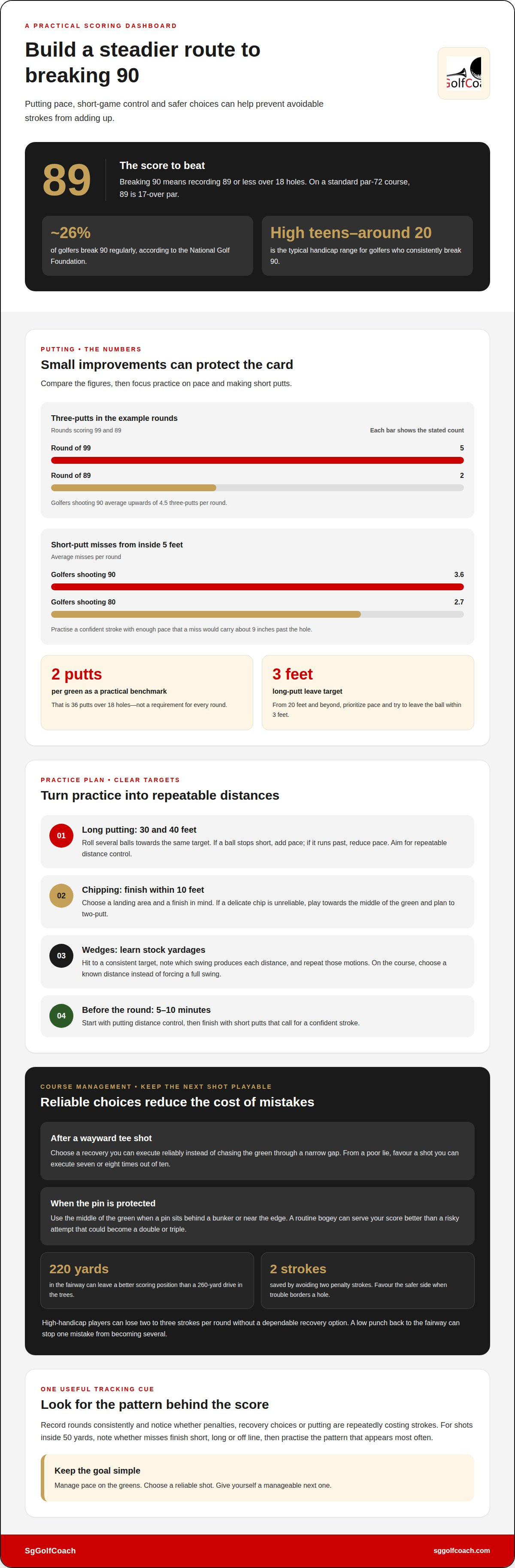
Roughly 26% of golfers break 90 regularly, according to the National Golf Foundation. To break 90 in golf, you need to record 89 or less over 18 holes; on a standard par-72 course, that means finishing at 17-over par or better.
You don’t need a string of birdies to get there. A steady round built on manageable bogeys can beat one undermined by penalty strokes, three-putts and risky recovery shots. The key is to identify where your score is leaking, then practise the shots and decisions that can prevent those costly holes.
This guide explains how handicap relates to breaking 90 and where focused practice can make a practical difference. You’ll learn why putting, chipping and wedge control deserve attention, how to limit penalties with smarter course management, and when coaching can help pinpoint weaknesses and build a more reliable plan for your game.
Table of Contents
1. Practising putting, chipping, and wedge distances
A practical part of learning how to break 90 in golf is improving distance control on long putts. From 20 feet and beyond, focus first on pace, not on trying to hole every putt. A useful target is to leave the ball within three feet, giving yourself a shorter, lower-stress next putt. This approach helps turn a long attempt into a manageable two-putt.
Practise from 30 and 40 feet to develop a feel for how far the ball rolls on the greens you play. Roll several balls towards the same target, then adjust your stroke length according to where each one finishes. A putt that stops short needs more pace; one that runs well past needs less. The goal is repeatable distance control, not a perfect stroke on every attempt.
Three-putts can have a clear impact on your card. A comparison of rounds of 99 and 89 includes five three-putts in the 99 and two in the 89. Golfers shooting 90 average upwards of 4.5 three-putts per round. Reducing that total by improving your first-putt pace gives you more chances to avoid adding an extra stroke on the green.
Give short putts a separate practice routine. From inside five feet, golfers shooting 90 miss an average of 3.6 putts per round, compared with 2.7 for golfers shooting 80. Practise making short putts with a firm pace that would carry the ball nine inches past the hole if it misses. That pace helps the ball hold its line rather than dying short.
On the practice green, chip with a landing area and finish in mind. Aim to leave each chip within 10 feet of the hole, rather than judging success only by whether the ball reaches the green. If a delicate chip is unreliable, play a simple shot towards the middle of the green, then plan to two-putt. For golfers learning how to break 90 in golf, that is a sound outcome that avoids wasting strokes.
Use wedge practice to learn your stock yardages and control partial shots. Hit to a consistent target, note which swing produces each distance, then repeat those motions until they feel familiar. On the course, choosing a known wedge distance makes it easier to play a controlled shot instead of forcing a full swing.
Before a round, spend five to ten minutes on putting distance control. Roll long putts towards a target, then finish with short putts that call for a confident stroke. This brief routine gives you a practical reference for pace on the greens and helps carry your practice into the round.
2. What handicap is breaking 90?
Golfers who consistently break 90 typically have a handicap in the high teens to around 20. On a standard par-72 course, a score of 89 is 17-over par, so breaking 90 means scoring 89 or less. Handicap offers useful context, but your score also depends on course difficulty and how well you manage mistakes that day.
For putting, aim to average two putts per green, or 36 putts over 18 holes. That’s a practical benchmark, not a requirement for every round. A missed green followed by a chip and one putt can offset a longer two-putt sequence elsewhere.
Course management can protect your score when a hole starts poorly. After a wayward tee shot, choose a recovery you can execute reliably rather than chasing the green through a narrow gap. A 220-yard drive in the fairway can leave a better scoring position than a 260-yard drive in the trees.
Use the middle of the green as your target when a pin sits behind a bunker or near the edge. That choice may leave a longer first putt, but it avoids turning a manageable approach into a difficult recovery. When trying to break 90, a routine bogey often serves scoring better than a risky attempt that could become a double or triple.
Penalty strokes add up quickly. Avoiding two penalty strokes saves two strokes, so weigh the trouble before choosing a tee shot or approach. If a hazard borders one side of the hole, favour the safer side rather than aiming at a narrow landing area. Keep the ball in play and give yourself a manageable next shot.
When recovering from a poor lie, choose a shot you can execute seven or eight times out of ten. A low punch back to the fairway may feel conservative, but it can stop one mistake from becoming several. High-handicap players can lose two to three strokes per round without a dependable recovery option, so a safe reset is a valuable scoring skill.
Three-putts are another avoidable source of lost strokes. Reducing one or two per round can help move a score below 90, especially when the rest of your game is steady. Focus on leaving a long first putt close enough for a comfortable second, rather than forcing a low-percentage attempt to hole it.
Consistent score records can reveal whether penalties, recovery choices or putting are holding you back. Using PC & Handicap can support tracking your rounds and understanding your handicap as you work towards lower scores.
3. Focusing practice on shots inside 100 yards
Shots inside 100 yards offer a practical place to sharpen scoring consistency. Practise wedges from 50 to 100 yards, where controlling carry and landing point can set up a manageable putt. Choose a target, hit several balls with the same club, then note which swing length produces each distance. Repeat with another wedge, building stock yardages you can trust rather than guessing during a round.
For approach shots, choose a target that leaves room for a safe miss. Aim for the wider part of the green instead of a tucked pin beside a bunker, water or steep edge. If the green is out of reach, choose a landing area that gives your next shot a clear path. This strategy can help you hit more greens when possible and leave a simpler chip when you miss.
Track what happens from inside 50 yards, not just your total score. Golfers shooting 90 fail to hit the putting surface from that range 3.2 times per round, compared with 2.1 times for golfers shooting 80. Note whether each miss finishes short, long or off line, then practise the pattern that appears most often. A handicap reflects scoring over time, while these details point to the shot that needs attention.
Build a repeatable practice plan instead of hitting random balls. One suggested split is 60% short game and 40% full swing. In a 30-minute session, spend 20 minutes around the practice green, then use the remaining time on longer shots. Work through three categories: wedges from 50 to 100 yards, chips from varied lies, and putts that start outside comfortable range. Review the plan every couple of months and adjust it as your results change.
Short putts deserve pressure practice. Set a target of 10 consecutive makes from three feet. If you miss, restart the count, then vary the putt’s direction so you don’t rely on one comfortable line. This drill gives each stroke a clear consequence and helps build confidence when a short putt matters after a chip or approach.
Scrambling is part of trying to break 90, because missed greens still offer chances to save a bogey. Practise a chip from a tight lie, then another from longer grass, and judge success by whether each ball finishes in a makeable range. Keep a simple record of the lie, club and result. Over several sessions, that record can reveal which shots you execute consistently and where focused practice could save strokes.
4. Reducing penalty strokes and blow-up holes
Penalty strokes commonly follow a lost ball, a ball out of bounds or a ball in a penalty area. The applicable relief procedure determines how play continues, so identify the situation before taking your next shot. A rushed decision can compound the trouble and turn one poor swing into several costly strokes.
For safer driving, choose a tee shot that keeps the ball in play. A fairway wood or hybrid may be a better choice than a driver when a narrow landing area leaves little margin for error. Match your club to the hole: if trouble guards one side, favour the wider side of the fairway rather than aiming through a tight gap.
Average 90-shooters have 4.9 troublesome tee shots per round, compared with 3.3 for average 80-shooters. That difference makes driving decisions worth reviewing. Track whether missed tee shots finish in trees, rough or penalty areas, then notice which club and target produced the safest result. Distance matters less if the next shot starts from trouble.
Protect your score after a mistake. If trees block a direct route to the green, punch the ball sideways into a clear position rather than attempting a low-percentage shot through branches. A safe recovery may leave a longer approach, but it prevents a second miss from adding more trouble. Choose shots you can execute seven or eight times out of ten, not hopeful hero shots.
Keep penalty strokes and triple bogeys to 0-1 per round while trying to break 90. One penalty stroke is manageable; two or more make the target much harder. In one comparison, the 99 round included three penalty strokes and three triple bogeys, while the 89 round included one penalty stroke and one triple bogey. The useful lesson is to limit the damage, not chase a perfect scorecard.
After a penalty, reset your plan before swinging again. Identify the safest landing area, choose a club that reaches it comfortably and commit to that target. If your ball is in a difficult lie, take the route that restores a playable position. A conservative next shot can prevent a double mistake from becoming a triple.
At the tee, picture the widest safe corridor first, then choose your club and aim within it. If your driver repeatedly brings hazards into play, use a fairway wood or hybrid until the driver becomes reliable. Fewer troublesome tee shots mean fewer recovery swings, fewer penalty risks and more chances to approach the green from a controlled position.
5. Golf coaching and identifying weaknesses
A lower score starts with finding the strokes you can realistically save. A coach can review your scorecard alongside your tee shots, approaches, short game and putting. Rather than treating every missed shot as a swing fault, look for patterns: a driver that repeatedly misses right, wedge shots that finish short, or a putter that struggles from longer distances.
Bring examples from recent rounds to a coaching session, including the club you used and what happened next. A tee shot into trouble followed by a recovery and a penalty tells a different story from a safe drive and a missed green. That context helps distinguish a technique issue from club selection or decision-making.
Numbers can guide the conversation. A typical golfer shooting 90 hits 3.6 greens in regulation per round, while an average 80-shooter hits 5.4. That gap doesn’t mean every golfer needs a more powerful swing. A coach can assess whether approach direction, distance control or inconsistent contact is limiting your chances of reaching greens.
Use a focused session to examine one part of your game at a time. At the driving range, a coach can observe your setup and ball flight with the driver, then connect those observations to your tee-shot pattern. In another session, focus on wedge contact or how your putter starts the ball. A clear focus makes it easier to practise a change without collecting conflicting swing thoughts.
Good coaching also links practice to the course. If your scorecard shows repeated trouble after aggressive tee shots, work on a reliable alternative and decide when it suits the hole. If you often miss greens from a particular approach distance, practise that shot and plan a safe miss. Each adjustment should address a pattern, not one disappointing swing.
After instruction, keep your practice plan manageable. Choose one swing cue, one target and one way to judge the result. For example, track whether a tee shot finishes in a playable position instead of judging success only by distance. Review your next scorecard to see whether the change helps you avoid trouble and create more straightforward next shots.
Coaching is especially useful when repeated practice hasn’t resolved a clear weakness, or when you’re unsure whether the problem comes from technique, strategy or both. SgGolfCoach’s Bespoke Coaching can help connect those pieces with a focused plan for your game. Arrange bespoke golf coaching to work on the specific parts of your game that are holding your scores back.
SgGolfCoach: Screen Golf Booking
SgGolfCoach offers Screen Golf Booking for golfers who want an indoor setting to keep practising. It can complement focused work on ball striking, club selection and course management, especially when you want to repeat a shot without playing a full round.
If you’re unsure which weakness to address, Adult Lessons offer a coaching route to refine your technique and build a more focused practice plan. PC & Handicap can also help you keep your scores and handicap in view as you work on your game. These options serve different needs: screen golf for practice, lessons for guidance, and score tracking to understand your progress.
Turn your next round into a clear plan
Progress comes from making each round useful, not from judging yourself by one score. Choose one pattern to work on, then give it your attention in practice and on the course. A steadier routine for how to break 90 in golf begins with a specific focus, such as committing to safer targets or making more deliberate decisions after a missed shot.
Keep your next step simple: identify the part of your game that most often disrupts your round, then get guidance on how to address it. A fresh perspective can help turn a recurring challenge into a focused plan you can follow at your own pace.
Contact SgGolfCoach about coaching and take the next step towards playing with greater purpose and confidence.
Frequently Asked Questions
What percentage of golfers break 90?
Roughly 26% of golfers break 90 regularly, according to the National Golf Foundation. “Regularly” matters: this figure doesn’t mean every golfer in that group scores below 90 in every round. Your own results can vary with course difficulty, conditions and how consistently you keep score. Treat the percentage as context, then focus on the patterns in your rounds that you can influence.
Should I get fitted for clubs to break 90?
Club fitting can help if your current clubs feel difficult to control or produce inconsistent contact, but it isn’t a requirement for breaking 90. Start by noticing whether the same clubs repeatedly cause problems, such as a driver that misses in one direction or irons that feel uncomfortable at address. A fitting can assess how your clubs suit your swing; practice and course decisions still shape your scores.
What club should I use off the tee if my driver is inconsistent?
Try a fairway wood or hybrid if it helps you keep the ball in play. Choose based on the hole’s landing area and the club you can swing with control, not simply the club that travels farthest. For example, if a narrow fairway is bordered by trouble, a shorter, more reliable tee shot may leave you in a better position than an aggressive driver swing.
What does it mean to break 90?
Breaking 90 means recording 89 strokes or fewer over 18 holes. On a par-72 course, 89 is 17-over par, while 90 is exactly 18-over. The course’s par provides the comparison, so the same total score can represent a different result on a course with a different par. Count every stroke, including penalty strokes, to know whether your final card meets the target.
What handicap is breaking 90?
Golfers who consistently break 90 typically have a handicap in the high teens to around 20. Handicap is a guide to playing ability, not a promise that every round will fall below a particular score. A golfer in that range can still have higher or lower rounds as conditions and performance change. Use your score history alongside your handicap to see whether your results are becoming more consistent.
What is the average golf score for amateurs?
The National Golf Foundation puts the average amateur golf score at around 91 strokes per 18-hole round. An average describes a broad group, not a standard every golfer should reach immediately. It also doesn’t predict your score on a specific course or day. Compare your own rounds over time, and consider whether a high score came from repeat mistakes or one unusual stretch of play.
Does short game really matter that much?
Yes. Short-game shots often determine how many strokes you need after an approach misses the green. A chip that leaves the ball close can set up a straightforward putt, while a difficult chip may leave a longer attempt. Practising different lies and landing spots prepares you for real situations, such as a ball sitting in longer grass or near the edge of the green.
How many bogeys can I make and still break 90?
On a par-72 course, 17 bogeys and one par total 89, so that pattern breaks 90. There isn’t one fixed bogey limit for every scorecard, because pars, double bogeys and other results change the total. For instance, a birdie gives you room for an additional over-par score, while a double bogey uses more of that room. Add your scores across all 18 holes.



Comments