

What Makes a Good Golf Coach: The Essential Guide to Choosing the Right Instructor in 2026

What if the swing advice keeping you stuck isn't your fault, but the result of an instructor trying to squeeze your natural movement into a rigid, one-size-fits-all model? If you have ever walked off a driving range feeling more confused than when you arrived, you already know the sinking feeling of wasting time and hard-earned money on contradictory tips. Understanding what makes a good golf coach is the single most vital step in transforming your ball-striking, because genuine progress never comes from forcing a textbook position that ignores how your body naturally moves.
You deserve an instructor who acts as an empathetic partner in your development, using diagnostic precision rather than cookie-cutter theories. In this comprehensive 2026 guide, you will discover the essential credentials, technical proficiencies, and communication skills that separate world-class mentors from ordinary instructors. We will examine how to audit a potential coach before committing to a package, verify meaningful credentials, and establish a personalized roadmap toward lower scores and lasting consistency.
Table of Contents
Beyond Playing Ability: What Defines a Truly Exceptional Golf Coach?
Essential Credentials and Technical Acumen: Evaluating Coach Competency
Teaching Philosophy: Swing Method Dogma vs Adaptable Biomechanics
The First Lesson Audit: Step-by-Step Guide to Vetting Your Instructor
Long-Term Partnership: How Quality Coaching Accelerates Mastery
Beyond Playing Ability: What Defines a Truly Exceptional Golf Coach?
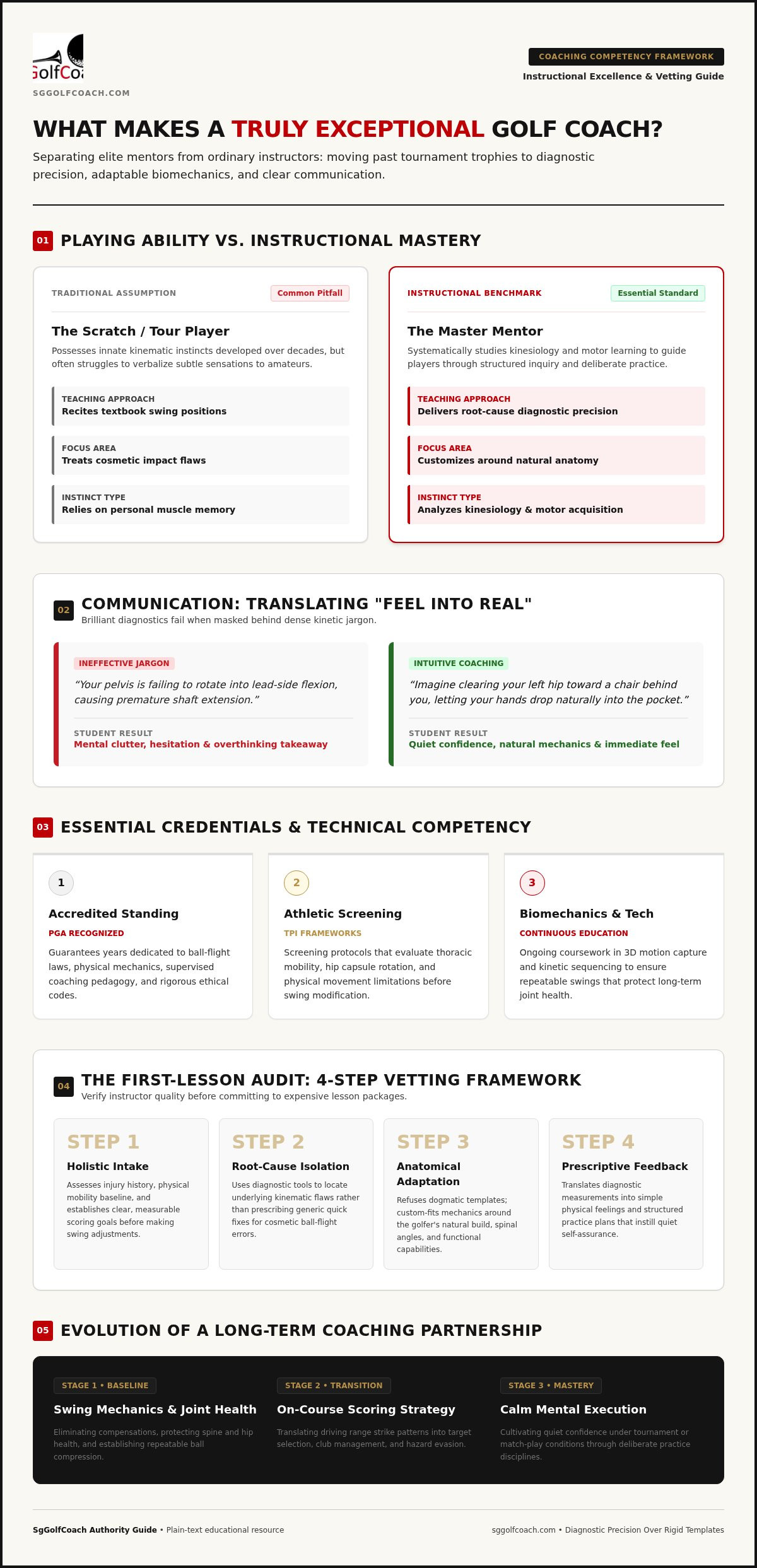
Many golfers assume that a player with a scratch handicap or tournament trophies makes an elite teacher. That assumption often leads to disappointment. Striking a golf ball with pure compression requires remarkable hand-eye coordination and muscle memory, but explaining how to execute that strike requires a completely separate skillset. True instructional excellence is built on diagnostic precision, active listening, and an empathetic approach that meets students exactly where they are.
At its highest level, sports instruction mirrors the formal discipline of coaching, where a mentor partners with a learner through structured inquiry, deliberate practice, and continuous feedback. A master mentor establishes clear baseline expectations before touching a single mechanic. They evaluate your mobility, ask about past athletic injuries, and define measurable goals. This diagnostic foundation is fundamentally what makes a good golf coach distinct from a technician who merely recites textbook swing positions.
The Distinction Between Elite Player and Elite Teacher
Tour professionals often possess innate kinematic instincts developed over decades. Because their movements feel entirely natural to them, verbalizing those subtle sensations to an amateur struggling with a steep downswing is remarkably challenging. Outstanding instructors systematically study kinesiology and motor skill acquisition. When evaluating potential guidance, look past personal trophies and focus on student transformations. Prioritize an instructor who identifies the root cause of errant ball flight rather than endlessly treating cosmetic flaws at impact.
Clear Communication and Translating Feel into Real
A brilliant diagnostic eye is worthless if an instructor cannot communicate findings simply. The wrong instructor overwhelms you with dense jargon about ground reaction forces, leaving your mind cluttered before you even begin your takeaway. Exceptional mentors excel at translating complex kinetic data into intuitive feelings tailored to your background.
Consider how different communication styles impact learning on the range:
Ineffective Jargon: "Your pelvis is failing to rotate into lead-side flexion, causing premature shaft extension."
Intuitive Coaching: "Imagine clearing your left hip toward a chair behind you, letting your hands drop naturally into the pocket."
By connecting internal physical cues with objective ball-flight metrics, a skilled mentor demystifies your mechanics. This clarity replaces frustration with quiet confidence, showing you exactly what makes a good golf coach the cornerstone of your athletic progress.
Essential Credentials and Technical Acumen: Evaluating Coach Competency
Anyone can claim to teach the game, but verified credentials separate qualified professionals from amateur enthusiasts. A recognized certification proves that an instructor has invested years studying ball-flight laws, physical mechanics, and supervised coaching pedagogy. According to the authoritative PGA of America guide, verifying professional standing guarantees that your instructor adheres to structured training codes and rigorous ethical standards.
Credentialing provides an essential baseline, but continuing education reveals true dedication. A passionate mentor actively updates their knowledge base by completing coursework in golf biomechanics, 3D motion capture, and functional physical movement. They understand that a tight hip capsule or limited thoracic mobility directly affects swing path and spinal angles. When you review structured beginner golf lessons, you will notice that accredited instructors always prioritize healthy, repeatable mechanics that safeguard long-term joint health.
Accreditation and Continuous Professional Education
Top-tier professionals hold formal memberships with recognized bodies like the PGA, complemented by certifications in athletic screening frameworks like the Titleist Performance Institute (TPI). In high-level associations, members maintain their standing by earning professional development credits through ongoing seminars in kinesiology and skill acquisition. A coach actively investing in specialized education brings modern, research-backed insights to every practice bay.
Technology Integration: Tool vs Crutch
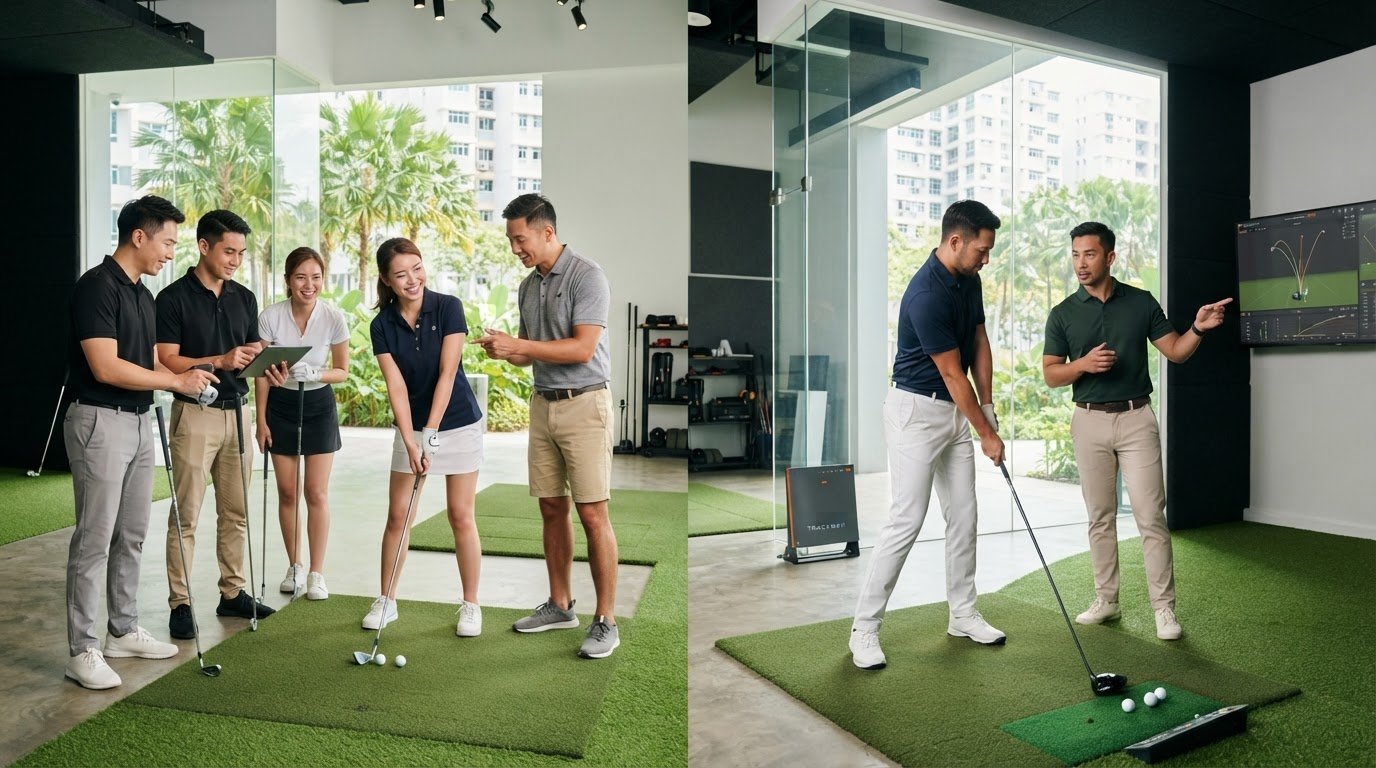
Modern coaching environments leverage high-speed cameras, pressure plates, and optical launch monitors. How an instructor uses this equipment defines what makes a good golf coach in a data-rich era. An inexperienced instructor hides behind the monitor, drowning you in launch angles, spin axes, and closure rates without offering solutions. A skilled mentor uses numbers quietly to validate their physical diagnosis, filtering complex metrics down to one or two actionable adjustments.
The Technician Trap: Staring at the screen, pointing out multiple flaws, and leaving you paralyzed by numbers.
The Master Diagnostic: Isolating the root clubhead delivery metric, such as face-to-path relationship, and providing a physical drill to correct it.
Advanced diagnostic bays should bridge the gap between digital analysis and green-grass confidence. If you want structured guidance that marries state-of-the-art simulator feedback with individualized progression, consider booking dedicated adult lessons tailored to your exact physical baseline.
Teaching Philosophy: Swing Method Dogma vs Adaptable Biomechanics
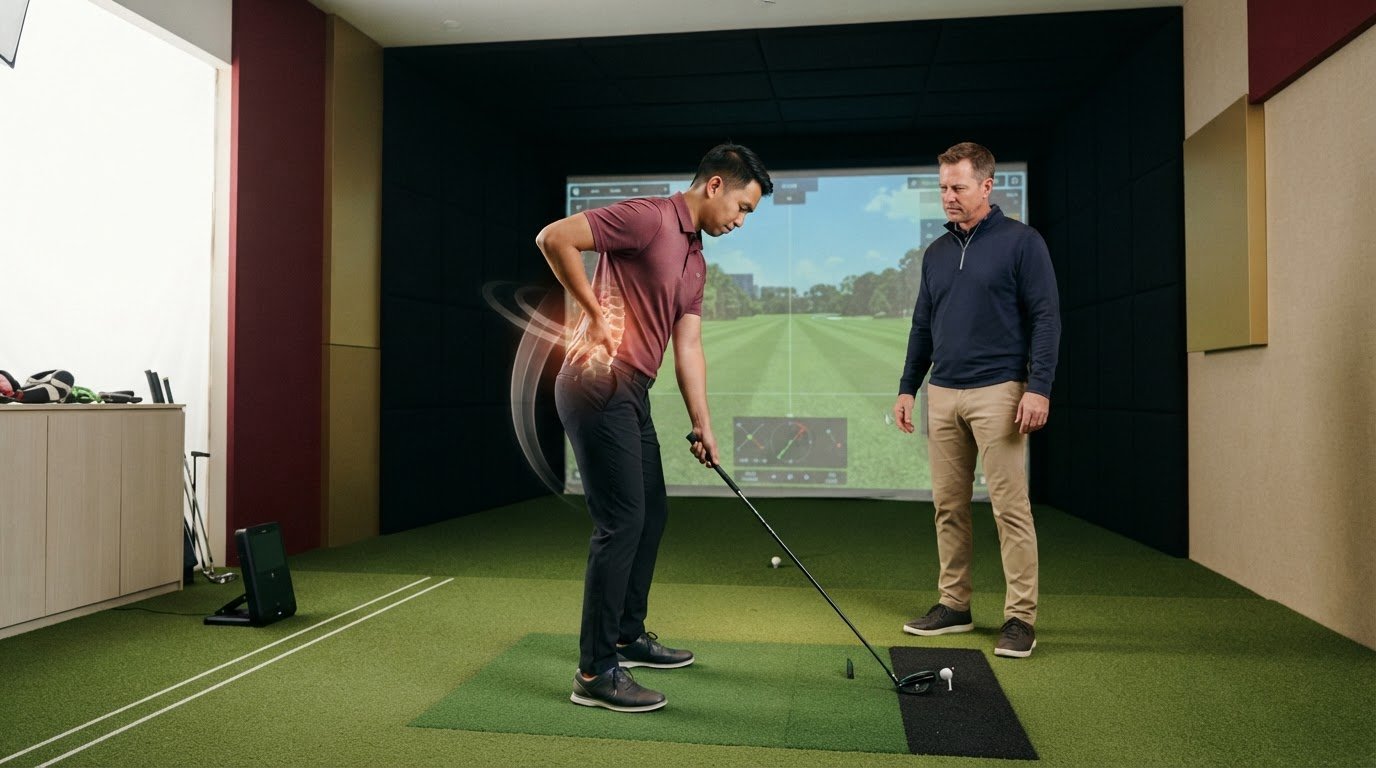
Every golfer possesses a distinct physiological blueprint. Variations in limb length, spinal flexibility, and wrist hinge mean no single movement pattern works identically across two different bodies. Despite this anatomical reality, dogmatic instructors often force every student into a rigid, singular pattern. This cookie-cutter mindset harms performance and frequently causes chronic lower back strain or wrist tendinitis. Discovering how to choose a golf coach who respects your unique biomechanics protects both your score and your physical health.
A transformative coach crafts a personalized blueprint around your natural range of motion. Instead of forcing your body into arbitrary shapes, they tailor delivery mechanics to your strengths, leading directly to sustainable ball-striking. This philosophy underpins true bespoke golf coaching, where swing changes honor joint mobility rather than aesthetic trends.
The Dangers of One-Size-Fits-All Swing Templates
Rigid instruction models ignore personal physical limitations. When an instructor insists on maximum hip-shoulder separation without assessing your thoracic spine, your lumbar vertebrae end up bearing the brunt of that rotational force. An astute mentor conducts a brief physical movement check to identify tight hamstrings or stiff shoulders before prescribing technical adjustments. They work within your functional mobility to create clean leverage and repeatable clubhead speed without physical discomfort.
Prioritizing Impact Dynamics Over Aesthetic Positions
A golf ball cares about impact physics, not cosmetic beauty. The ball reacts purely to clubhead speed, face orientation, angle of attack, dynamic loft, and point of contact. Many players with unconventional swings have won major championships because their delivery remains remarkably stable through impact. Assessing how an instructor approaches these dynamic variables reveals what makes a good golf coach on the lesson tee.
Look for these differences between dogmatic and adaptable coaching:
Dogmatic Teaching: Obsesses over backswing checkpoints, forces unnatural shaft angles, and values photographic positions over clean strikes.
Adaptable Biomechanics: Optimizes centered contact, stabilizes face-to-path relationships, and embraces an unorthodox movement if it delivers functional consistency.
By prioritizing efficient impact over cosmetic perfection, an adaptable coach builds a swing that feels intuitive, repeatable, and comfortable for your body for years to come.
The First Lesson Audit: Step-by-Step Guide to Vetting Your Instructor
Committing to a multi-session package before testing an instructor is a risky gamble. The introductory session serves as an active interview where you assess their diagnostic skill, communication clarity, and instructional philosophy. Paying attention to specific checkpoints during your initial sixty minutes will quickly reveal what makes a good golf coach worthy of your time and financial investment.
Every reputable professional should offer a transparent pathway toward your goals, whether that means breaking ninety or completing your formal PC and golf handicap certification. Evaluating your coach against a structured framework ensures your money translates into real scoring gains.
The Discovery Phase: Goal Setting and Physical Assessment
Before asking you to hit a single shot, an elite mentor conducts a thorough intake conversation. They inquire about past injuries, joint tightness, previous sports experience, and current practice habits. If an instructor hands you a 7-iron and orders you to swing immediately without asking about your athletic history, that is a glaring warning sign. True partners prioritize your developmental vision rather than imposing their own predetermined preferences.
Diagnostic Execution and Prescriptive Simplicity
Weak teachers overwhelm students with a laundry list of faults, trying to adjust grip, takeaway, hip turn, and head position all at once. Elite instructors isolate the singular root issue triggering your downstream compensations. If an open clubface at the top forces you to cast the club, they fix the wrist alignment at the top rather than berating you for the steep downswing.
Use this sequential audit checklist during your first session:
Holistic Intake: Do they ask about past injuries, athletic background, and personal goals before you swing?
Singular Focus: Do they isolate one mechanical priority rather than flooding your mind with five different thoughts?
Targeted Drills: Does the prescribed drill exaggerate the correct feel so your body quickly grasps the movement?
Ball Flight Evidence: Does the adjustment produce an immediate, noticeable shift in strike quality or launch window?
Post-Session Accountability and Practice Roadmaps
A lesson should never end with a vague parting wave. The final ten minutes reveal whether an instructor cares about your independent growth. Exceptional coaches provide a concise video recap or structured practice drills with specific rep counts. You should leave the bay knowing exactly what to practice, how to assess your own contact, and how to track measurable progress.
Ready to experience structured, results-driven mentorship firsthand? Book your bespoke evaluation through our dedicated Bespoke Coaching program today.
Long-Term Partnership: How Quality Coaching Accelerates Mastery
Golf mastery is rarely a straight line. Many players experience initial breakthroughs after a lesson, only to revert to old habits weeks later when playing under pressure. This plateau happens when instruction treats golf as an isolated mechanical exercise rather than an ongoing developmental journey. A sustained partnership with a dedicated coach provides the accountability, mental conditioning, and strategic refinement required to convert mechanical progress into lower scores.
True mentorship evolves as your game matures. Understanding what makes a good golf coach valuable over time means looking beyond swing positions to how an instructor guides you through course dilemmas, shifting confidence, and competitive anxiety.
From Driving Range Mechanics to Course Management
Hitting pure shots off a flat driving range mat is very different from managing uneven lies, swirling crosswinds, and firm greens. Exceptional mentors deliberately transition students from technical bays out onto the fairways. Playing lessons uncover critical blind spots that launch monitors simply cannot track:
Target Selection: Aiming toward fat parts of greens rather than attacking tucked flagsticks.
Lie Evaluation: Adjusting setup for thick rough, hardpan, or ball-above-feet lies.
Emotional Regulation: Developing bulletproof pre-shot routines that steady your breathing over critical putts.
Course management mistakes inflate scorecards far more than minor swing flaws. Learning how to eliminate double bogeys through intelligent risk management creates rapid score drops without requiring a rebuilt swing.
Structured Progression Across Every Life Stage
Developmental needs differ dramatically across age brackets. Adult learners often juggle busy corporate schedules and physical wear, demanding efficient, time-conscious practice plans that maximize limited training hours. Conversely, our specialized junior golf programs focus on athletic fundamentals, hand-eye coordination, and genuine enjoyment, cultivating a lifelong passion without burnout.
Continuous quarterly reviews ensure your training remains aligned with your evolution. Whether you are pursuing a formal handicap or polishing your short game for weekend matches, partner with an empathetic mentor who measures success by your sustained transformation. Connect with the instructional team at SgGolfCoach to begin your customized coaching roadmap.
Elevate Your Game with the Right Instruction Partner
Finding the right instructor is the most impactful decision you will make for your game. As you evaluate potential mentors, remember that what makes a good golf coach goes far beyond personal playing accolades. True instructional excellence requires empathetic communication, deep diagnostic precision, and an adaptable approach that honors your body's natural movement patterns rather than forcing a rigid template.
Whether you are starting from scratch or aiming for single-digit consistency, working with a dedicated mentor shortens the learning curve dramatically. Combining advanced simulator analytics with practical on-course strategy ensures your mechanics hold up when the pressure is on.
Your journey toward effortless ball-striking begins with personalized guidance. Ready to unlock your genuine potential on the fairways? Experience tailored golf instruction with SgGolfCoach and start building a confident, repeatable swing designed specifically for you.
Frequently Asked Questions
How do I know if my current golf coach is the right fit for me?
Your coach is the right fit if you leave lessons with mental clarity, simple physical cues, and measurable improvements in ball flight. If you feel confused by complex jargon, suffer persistent joint pain after swinging, or receive identical advice regardless of your physical build, they aren't matching your needs. Clear communication and visible progress are the ultimate litmus test.
Is it better to hire a tour-playing professional or a dedicated certified teaching instructor?
A dedicated certified teaching professional is usually the superior choice for amateur development. Elite playing skill doesn't naturally translate into instructional competence; tournament players often rely on subconscious feels they can't verbalize. Dedicated teachers systematically study motor learning, biomechanics, and kinematic sequencing, which is exactly what makes a good golf coach capable of diagnosing swing faults accurately.
What qualifications should I verify before booking an introductory golf lesson?
Verify that your instructor holds recognized credentials from an established professional golfer association, such as a Class A PGA membership or equivalent sports coaching body. Check whether they pursue ongoing education in functional movement screening, biomechanics, or modern launch monitor diagnostics. Continuous education proves they adapt modern science rather than recycling outdated swing dogmas.
How many lessons does it typically take to see noticeable improvements in my swing?
Most golfers experience cleaner ball contact within their very first session when an instructor isolates the primary flaw. Lasting muscle memory, however, generally takes three to five structured lessons combined with deliberate range practice. Real mastery requires moving beyond mechanical drills into playing lessons that test your decision-making and shot consistency under genuine course conditions.
Can a good golf coach help me choose the correct clubs and custom shaft specifications?
A qualified instructor provides invaluable guidance on equipment specs by analyzing your dynamic delivery metrics. By reviewing your launch monitor numbers, such as swing speed, angle of attack, and face angle, they recommend appropriate shaft flex profiles, clubhead lie angles, and grip sizes. This diagnostic assessment highlights what makes a good golf coach an essential guide before you buy new gear.
What is the main difference between taking individual private lessons and group classes?
Private lessons deliver bespoke, one-on-one diagnostic attention tailored specifically to your unique anatomy, physical mobility, and scoring goals. Group classes offer an engaging, social environment ideal for grasping basic etiquette and general fundamentals. While group clinics deliver excellent community engagement at an approachable entry point, private sessions accelerate individual technique and handicap progression significantly faster.

Comments