

Lower Back Pain from Your Golf Swing: Causes and Posture

Lower back pain from a golf swing is common: according to TPI, data from more than 31,000 golfers found that 28.1% deal with lower back pain after every round. Repeated swings can build cumulative strain, while swing mechanics and posture may add stress to the lower back.
If you have lower back pain from a golf swing, it can be tempting to blame one awkward shot. But the pattern may involve more than a single swing: trunk rotation, hip mobility and your setup over the ball can all play a part. This article explains why golf can trigger lower back pain, how posture and swing mechanics contribute, and how common the problem is among golfers. You’ll also learn how to spot patterns in your swing and when coaching may help you play with greater comfort and confidence.
Table of Contents
Why is Back Pain So Common in Golf?
Golf combines repeated rotation with sustained control through the torso, so the lower back can accumulate load over time. How your trunk muscles work and maintain endurance can help explain why symptoms appear during practice or after a round.
Trunk Muscle Recruitment and Endurance
Trunk muscle recruitment is the coordinated work of muscles that support the spine as the torso moves. During a golf swing, these muscles help control rotation and keep you balanced through repeated shots. Golfers with lower back pain may have altered recruitment patterns and reduced muscle endurance, which can limit support as fatigue builds. Strength, and especially endurance, in the spinal stability muscles matters for the physical demands of play.
If lower back pain from golf swing practice builds gradually, consider how much repeated movement came before it. For example, hitting balls after a round adds swings when you may already be fatigued. That doesn’t identify the cause, but tracking practice sessions, rounds and symptom timing can reveal a useful pattern. Total activity matters alongside the mechanics of any one shot.
Core and hip strengthening can support controlled movement by helping your body share rotational work. Keep exercises steady and within a comfortable range rather than forcing a larger turn. For example, practise a slow hip hinge with a stable torso, then add gentle trunk rotation. If a movement increases pain, stop rather than treating discomfort as a goal. Working with a qualified fitness professional can also help ensure exercises are executed safely; specialized training programs like NPTI Florida prepare personal trainers with in-depth knowledge of biomechanics, core stability, and functional conditioning.
Muscle Strains and Ligament Sprains
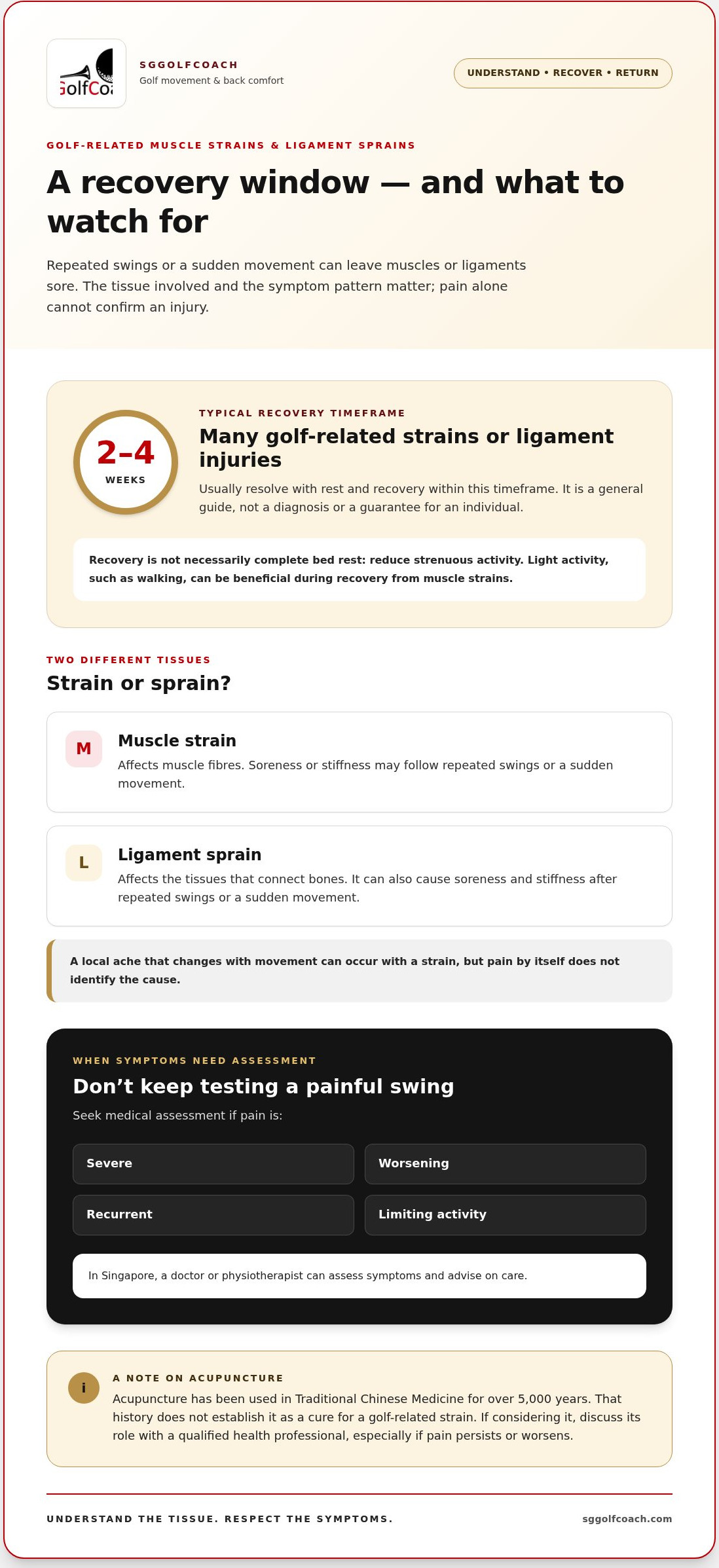
A muscle strain affects muscle fibres, while a ligament sprain affects the tissues connecting bones. Either can cause soreness and stiffness after repeated swings or a sudden movement. A local ache that changes with movement can occur with a strain, but pain alone cannot confirm an injury. Understanding the difference helps you avoid assuming every episode has the same cause.
Golf-related muscle strains or ligament injuries usually resolve with rest and recovery in 2-4 weeks. Reduce strenuous activity rather than staying completely bedridden; light activities such as walking can be beneficial during recovery from muscle strains. Seek medical assessment for severe, worsening, recurrent, or activity-limiting pain. In Singapore, a doctor or physiotherapist can assess symptoms and advise on care.
Acupuncture is a practice used in Traditional Chinese Medicine for over 5,000 years. That history doesn’t establish acupuncture as a cure for a golf-related strain. If considering it as therapy, discuss its role with a qualified health professional, especially when pain persists or worsens. Keep recovery centred on an appropriate assessment and movements that don’t aggravate symptoms.
Altered lumbar motor control and joint mechanics
A golf swing combines rotation, balance and force through the lumbar spine. When movement is restricted or poorly coordinated, the lower back may take on stress that could otherwise be shared with the hips and trunk.
Lumbar Loading During the Swing
Lumbar loading is the compressive force placed on the lower spine as your body rotates and transfers force through a swing. These figures help explain why repeated swings can challenge spinal tissues, but they don’t predict injury for an individual player.
A typical golf swing can create enough compressive stress to potentially injure the discs between vertebrae. The load depends on more than club speed. Stance, trunk movement and how force travels from the legs through the torso all shape the demand on the lumbar area. A stable setup supports controlled movement, while a swing that relies heavily on the lower back can concentrate stress there.
Swing Rotation and Lumbar Strain
Swing rotation is the coordinated turn of the hips and trunk through the backswing, downswing and finish. Golfers with lower back pain may over-rotate their spine at the top of the backswing or at the finish. Restricted rotation in the lead hip can also prompt compensations, shifting extra rotational demand onto the lumbar spine.
Notice whether your pelvis turns comfortably or your lower back twists to create more range. For example, if your lead hip stops turning, you may arch or rotate the lumbar area further to complete the backswing. Repeating that compensation during practice swings and full shots can add strain. The aim isn’t to force a larger turn, but to find smooth movement that your hips and trunk can share.
Motor control describes how the nervous system coordinates muscles and joints during movement. Most experts believe over 80% of chronic lower back problems begin with altered motor control or joint mechanics. That figure is not a prediction for every golfer. It highlights why simply trying to swing harder may miss a useful part of the picture: how the body controls the movement.
A practical check is to compare a slow rehearsal with a normal swing. Does your lower back stay comfortable as your hips and shoulders turn, or does the movement become abrupt near the top or finish? A coach can observe your swing mechanics and help identify movement patterns that place extra demand on the lumbar region. Persistent or worsening pain calls for medical assessment, not repeated swing testing.
Lumbar disc replacement is a surgical treatment, not a technique adjustment for swing-related strain. It gained FDA approval in 2004. That date marks the approval, not a recommendation for golfers with back pain. Disc-related symptoms require clinical assessment, since pain alone cannot establish the cause or indicate that surgery is appropriate.
During practice, prioritise a balanced stance and controlled rotation to reduce unnecessary strain. If discomfort appears during a particular swing phase, note whether it occurs on the backswing, at impact or at the finish. That detail can help a health professional assess your symptoms and a golf coach review your movement, without treating pain as a reason to push harder.
Asymmetrical spinal stress and trail-side injury
A golf swing loads each side of the spine differently. For a right-handed player, repeated rotation and side-bending can place greater stress on the trail side, so discomfort may be stronger on one side than the other.
Golf-related spinal stress is asymmetrical and may contribute to changes in the trail-side lumbar facet joints and vertebral bodies. Side-bending during impact is a major contributor to trail-side injury or degeneration. For example, leaning your trunk sideways as the club meets the ball can repeatedly stress the same area. This helps explain why pain may feel localised rather than spread evenly across the lower back.
About 72% of right-handed golfers experience right-sided lower back pain. That statistic describes a reported pattern, not a diagnosis for an individual golfer. Left-handed players may load their bodies differently, and pain location alone can’t identify injured tissue. Track which side hurts, when it starts, and whether impact or the finish position makes it worse. Those details give a clearer picture of the movement linked to discomfort.
Reducing excessive side-bending and improving swing mechanics can help limit avoidable spinal stress. Practising swings both left-handed and right-handed can address possible strength asymmetry between your lead and trail sides. Keep the movements controlled and comfortable. The goal is balanced movement, not full-speed shots from both positions or using a painful swing as a test.
After a round, reduce strenuous activity and avoid heavy lifting while symptoms settle. Light activities such as walking can be beneficial during recovery from muscle strains. Players looking to soothe general muscle fatigue from the comfort of their home or hotel can also explore mobile wellness options via theoutcallspa.com. Modify activities that aggravate pain, and pay attention to workplace ergonomics and sleeping habits. Complete bed rest isn’t recommended for a muscle strain; reducing your workload allows gentle activity to continue.
Golf-related muscle strains or ligament injuries usually resolve with rest and recovery in 2-4 weeks. For a likely strain, pause painful golf activity and return gradually as ordinary movement becomes comfortable. This period describes usual recovery, not a required number of days away from golf for every player. Persistent, worsening, or recurring pain calls for medical assessment.
Disc injuries need a different rehabilitation plan from a simple muscle strain. A 6- to 12-week trial of chiropractic, osteopathic, or physical therapy is recommended as a first line of treatment for disc injuries. Rehabilitation can focus on controlled activity and movement rather than immediately returning to full swings. A clinician can assess symptoms and guide activity based on the injury.
For returning after lower back pain, use recovery and movement as your guide, not the calendar alone. Most golf-related muscle strains or ligament injuries resolve within 2-4 weeks, but disc injury rehabilitation may involve a 6- to 12-week trial. Resume with controlled practice swings before full shots, and stop if pain returns or increases.
How common lower back pain is among golfers
Lower back pain is a recurring issue in golf, not just an isolated complaint after one difficult shot. TPI data gives a clearer sense of how often players report it.
Prevalence of Golfer Lower Back Pain
Prevalence describes how widespread a condition is within a group. According to TPI, data from more than 31,000 golfers found that 28.1% deal with lower back pain after every round. More than 23% of professional golfers on all tours play with lower back pain. These figures show why golfers should pay attention to recurring symptoms, while remembering that a group statistic can’t identify the cause of one person’s pain.
Incidence of Low Back Pain
Incidence refers to new cases arising over a defined period, while prevalence counts people already experiencing a condition. The TPI figures describe pain after every round, not how many golfers newly develop it each week or year. As an individual player, note when symptoms first appear, which swing phase brings them on and whether they return after each session.
Frequency matters. Pain that appears after repeated rounds may reflect accumulated load, while discomfort that starts during one swing has a different timeline. For example, record whether symptoms begin during practice, after walking or the following morning. A simple log of playing and practice days can help you explain the pattern during a clinical assessment.
Seek urgent medical attention for severe or rapidly worsening back pain, especially if it prevents ordinary movement. Don’t continue playing to test it; seek prompt assessment from a medical professional.
Preparation can make movement more comfortable. Before playing or practising, warm up for more than 10 minutes, then use 10-15 torso twists in each direction as a gentle rotational preparation. Keep the motion controlled rather than forcing range. These are warm-up suggestions, not a way to diagnose pain or a guarantee against injury.
Mobility also matters. Hold a hip flexor stretch for 20-30 seconds on each side, and repeat cat-cow movements 10-15 times before playing. These exercises introduce movement through the hips and spine before a full swing. Stop any stretch that aggravates pain, and don’t use a warm-up to push through symptoms that are already worsening.
If pain repeatedly follows the same movement, review your swing mechanics. Note whether discomfort starts at the top of the backswing, during impact or at the finish, and whether it changes with a slower rehearsal. These details can help distinguish a recurring movement pattern from soreness after a demanding session.
Maintaining posture during the golf swing
Posture shapes how your body shares movement through a golf swing. Your position at address and trunk mobility can affect the stress placed on your spine.
Neutral Spine Alignment in Golf Posture
Neutral spine alignment means holding a comfortable, stable back position rather than rounding or arching excessively. At address, golfers with lower back pain tend to slouch more, which may contribute to a steeper swing plane and increased lateral shear on the downswing. Notice whether your chest collapses toward the ball before changing your stance or swing.
Use a slow rehearsal to observe your posture from setup through the finish. Start in your usual address position, then hinge forward from the hips while keeping your back comfortably long. Let your shoulders hang naturally instead of forcing them back or lifting your chest. If your lower back rounds as you reach toward the ball, adjust your distance or hip hinge until the position feels easier to maintain.
A mirror or short phone recording can make the comparison clearer. Check whether your upper back and pelvis change position as you move into the backswing. For example, compare your relaxed setup with one where you keep your spine comfortable and balanced. The aim isn’t to freeze your back, but to avoid a slouched starting position that affects how your body moves later.
Spinal Rotation During the Swing
Spinal rotation is the turning movement of your trunk as you move from backswing through impact and finish. Improving trunk rotation flexibility can help control spinal over-rotation during the swing. Trying to create extra turn through the lower back may disrupt your posture and make the movement less controlled.
Practise the turn without a club first. Keep your feet comfortably planted, cross your arms over your chest and rotate only through a range you can control. Notice whether your hips and shoulders move smoothly or your lower back twists abruptly near the end. Then repeat with a club held lightly across your shoulders, stopping before your posture changes or discomfort appears.
Range of motion differs between golfers, so a larger turn isn’t automatically better. If your trunk mobility is limited, a balanced, repeatable swing may be more useful than forcing a wider backswing. Use a slow rehearsal to check whether your shoulder turn remains controlled and your spine stays comfortable. Don’t chase extra rotation by leaning sideways or arching sharply at the finish.
During practice, review three positions: address, the top of the backswing and the finish. At address, check for a slumped back. At the top, notice whether you’ve forced a turn beyond your comfortable range. At the finish, look for a sudden side bend. These checkpoints help you describe a movement pattern clearly to a golf coach or physiotherapist.
For a focused review, book golf swing coaching to work on posture and controlled rotation.
SgGolfCoach: Junior Programs
SgGolfCoach offers Adult Lessons for golfers who want to review their swing technique and posture. If your back feels comfortable during everyday movement but golf swings bring recurring discomfort, coaching can help you examine your setup, rotation and balance, without treating pain as a swing problem to push through.
For persistent or severe pain, seek medical assessment before returning to practice. Once you’re ready to work on your golf movement, an Adult Lesson provides a structured setting to refine your technique. Junior Programs help young players build sound fundamentals, while Screen Golf Booking offers an indoor setting for golf practice.
To explore a suitable golf learning option, contact SgGolfCoach.
Make Your Next Swing More Considered
If lower back pain from golf swing keeps interrupting your play, let your next step be guided by what your body can do comfortably. Notice which movements feel restricted, avoid forcing extra rotation, and treat recurring or worsening pain as a reason to seek medical assessment. When you’re ready to refine your technique, focused coaching can help you work on your swing with greater awareness.
SgGolfCoach offers Adult Lessons for golfers reviewing their swing, Junior Programs for young players developing fundamentals, and Screen Golf Booking for indoor practice. Choose the option that best fits your learning goals and current stage of play.
Contact SgGolfCoach about your swing and take a thoughtful next step toward more confident movement on the course. Keep building your game at a pace that supports both progress and enjoyment.
Frequently Asked Questions
Is Lower Back Pain Normal?
Lower back pain is common among golfers, but it shouldn’t be treated as an inevitable part of playing. An occasional ache and pain that repeatedly returns are different patterns. Note whether it follows a particular practice session, swing or playing day, and whether it affects everyday movement. This record can help you decide whether to adjust your activity or seek an assessment rather than simply accepting recurring discomfort.
What causes lower back pain during or after a golf swing?
Repeated rotational swings can load the lumbar spine, while limited hip movement or reduced trunk muscle endurance can make that load harder to manage. For example, a long practice session followed by a round with little recovery in between may expose a movement or endurance limitation. Record when discomfort starts and what you were doing, so a health professional can assess the pattern.
Which golf swing mechanics put the most strain on the lower back?
Excessive spinal rotation, side-bending at impact and a slouched address position can increase stress on the lower back. To spot a pattern, record a short swing from face-on and down-the-line views, then compare your address, impact and finish. Look for an abrupt sideways lean or a forced turn. Don’t repeat a movement that provokes pain just to capture a clearer recording.
Which stretches and strengthening exercises help prevent golf-related lower back pain?
Controlled torso twists, hip-flexor stretches, cat-cow movements and exercises that build spinal stability muscle endurance are useful options to discuss with a health professional. Keep each movement comfortable instead of forcing a deeper stretch or larger turn. For example, stop a torso twist before your lower back feels pinched. Choose exercises suited to your current mobility and strength, and don’t use pain as a measure of progress.
How can golfers modify their swing, warm-up, or equipment to reduce back strain?
Use a controlled swing with a comfortable range of rotation, and warm up with gentle movement before full shots. Reduce strain from carrying clubs by using a pushcart; if you carry a bag, distribute its straps evenly over both shoulders. Avoid carrying clubs on one shoulder. During practice, take breaks if discomfort builds, and don’t push through pain to finish a bucket of balls.
What symptoms of lower back pain require urgent medical attention?
Seek medical assessment for severe or worsening pain, or pain that recurs or limits your activity.



Comments