

Self-Taught Golfer Problems: Why Progress Stalls and What Helps

What if practising more is reinforcing the very swing habits you’re trying to change? That’s one of the most frustrating self-taught golfer problems: you put in the effort, but without reliable feedback, it’s hard to tell whether a new move is helping or creating another issue. Conflicting tips from videos, posts and playing partners can make practice feel like guesswork.
Learning on your own builds initiative and gives you room to explore. A stall doesn’t mean you lack potential; it may mean you need a clearer way to assess what’s happening. This article will help you recognise common self-teaching traps, focus on one priority at a time and decide whether professional guidance fits your goals. We’ll look at why swing changes are difficult to judge alone, how to make feedback more useful and how adult lessons or bespoke coaching can complement independent practice.
Table of Contents
Self-Taught Golfer Problems: Why Practice Can Stop Producing Progress
Learning golf at your own pace has real appeal. You can explore the game on your terms, repeat a drill when it feels useful and enjoy working something out for yourself. But inconsistent results can make that independence frustrating: one session feels promising, then the next brings back the same poor contact or wayward shots.
Effort matters, but effort alone doesn’t make practice productive. A session needs a purpose, and feedback helps you judge whether your approach is working. Without those, it’s easy to repeat familiar movements without knowing what they’re meant to change. That doesn’t mean you aren’t working hard. It means your practice may need a clearer focus.
Look for a pattern instead of judging your potential from a handful of shots. Common signs of a plateau include:
Switching between swing thoughts from session to session.
Making inconsistent contact without knowing what changed.
Struggling to tell whether a new idea is helping over time.
These are learning challenges, not proof that you lack ability. Start by separating what you can observe from what you’re guessing. You may see that a shot started right, for example, without knowing which part of your setup or swing contributed to it. The overview of golf instruction describes different elements of learning the game, including feedback and mental performance, and helps explain why improvement involves more than simply hitting balls.
How to recognise a self-teaching plateau
A plateau can hide inside a busy practice routine. If you repeat the same drills each time but can’t explain what each one is meant to improve, it’s difficult to know whether the session has helped. A good shot followed by a poor one adds to the uncertainty: was the change effective, or was the result temporary?
Before you begin, choose one observable goal, such as making more consistent contact during a specific drill. Afterward, note what you noticed rather than relying only on whether the session felt good. A brief record of the goal, drill and result gives you something concrete to compare next time.
Why conflicting golf advice can make things harder
Golf tips aren’t always universal. Advice that suits one golfer’s movement or goal may not fit yours, so two credible sources can seem to recommend opposite actions. Taking on several tips at once creates another problem: if your shots change, you won’t know which adjustment made the difference.
Pause the stream of new advice long enough to identify one specific problem you want to address. Set other ideas aside, and ask whether the adjustment relates to the result you’re trying to change. A narrower focus makes it easier to assess your practice and choose what to work on next.
Why Golf Is Difficult to Diagnose Without Reliable Feedback
A feedback gap is the difficulty of connecting what a swing feels like, or what the ball does, with an observable cause. You might feel that you swung smoothly and see the ball curve right, but those clues alone don’t reveal exactly what happened. The challenge isn’t noticing the result; it’s identifying which part of the movement, setup or timing may have contributed.
Ball flight is useful information, but it isn’t a diagnosis. A shot that starts right could have more than one possible explanation, and one visible symptom doesn’t prove a single fault. Treat what you observe as a question to investigate, not a verdict about your swing. As The Importance of Feedback in Golf Instruction explains, feedback helps connect an intention with what actually happens, so you can assess a change instead of relying on guesswork.
Feedback helps golfers test a change against what they can observe, instead of guessing from feel alone. That distinction is central to addressing self-taught golfer problems: evidence won’t automatically tell you what to change, but it can make the next question clearer.
Feel, video, and ball flight: useful clues with limits
Feel can direct your attention, but it may not match the movement you actually made. Video adds a visual reference, yet a clip is only a snapshot, and a different camera angle can make the same movement look quite different. Ball flight, feel and video each offer clues, not a complete explanation on their own.
If you record practice, use a consistent camera position and similar setup conditions so you can compare clips more fairly. Look for a repeatable pattern rather than drawing a firm conclusion from one swing. When you’re unsure what a difference means, a coach can help interpret the footage and relate it to your goal.
How swing changes can create a cycle of confusion
Suppose you change your stance, grip and swing thought before the next shot. If the ball flies better, it’s hard to know which adjustment mattered; if it doesn’t, you may be tempted to change everything again. A single promising shot can be encouraging, but it doesn’t show that a change will hold up across practice.
Instead, choose one manageable adjustment and keep other variables steady during the drill. Record a simple observation, such as whether contact or direction was more consistent, then review it before adding another change. This gives you a clearer basis for deciding what to keep, revisit or set aside.
If you’d value help interpreting recurring patterns, tailored adult coaching can provide an outside perspective while leaving room for independent practice.
Self-Taught Practice vs Golf Coaching: Which Approach Fits Your Goal?
Independent practice and professional coaching can both play a useful role in learning golf. Solo sessions let you explore at your own pace, repeat familiar drills and build a routine around your schedule. Coaching adds an outside perspective and structure, which can help you decide what deserves attention. The right mix depends on your current goal, how confidently you can assess your practice and how much guidance you want.
Use this comparison as a starting point, not a rule that one approach suits every golfer:
These approaches can complement each other. You might practise independently to become familiar with a movement, then seek guidance when you’re unsure how to assess it. A coach’s input doesn’t have to replace self-directed learning; it can make your own practice more intentional. That balance can be especially useful when self-taught golfer problems make it hard to choose what to work on next.
When self-directed practice may be enough
Solo practice may suit a goal such as building a consistent routine, becoming more comfortable with a drill or exploring how different practice tasks feel. Keep a brief record of what you worked on, what you noticed and what you want to revisit. If you’re putting in effort but still can’t identify a learning focus, pause and reassess your plan.
When a coach’s perspective may add value
Consider guidance if recurring uncertainty, frustration or competing swing thoughts make practice difficult to direct. Tailored feedback can help narrow your focus to a priority that relates to your goals, without promising a particular score or outcome. If you’re new to structured instruction, this guide to beginner golf lessons offers a helpful starting point.
To decide, review your recent practice notes. Can you explain what you were working on and what you observed? If so, keep building on that independent routine. If not, a lesson or bespoke coaching can provide a clearer framework while leaving you free to practise on your own.
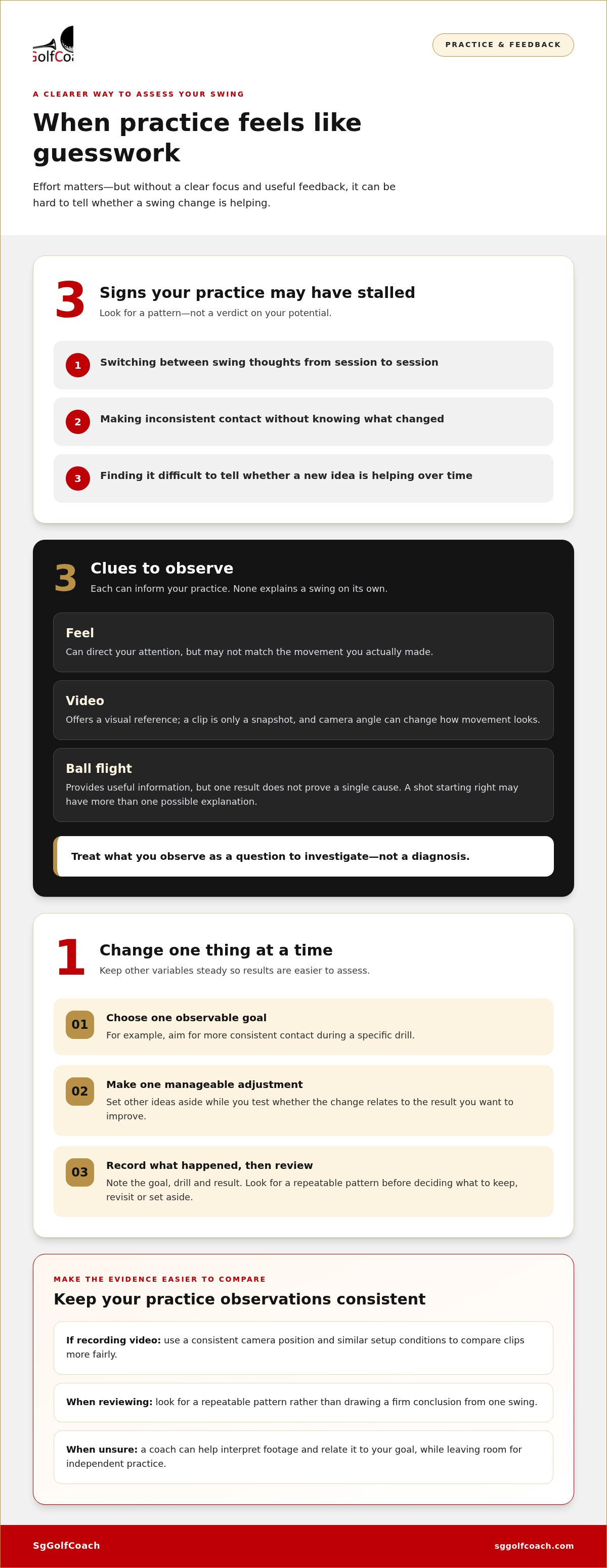
A Practical Reset: Build a More Focused Golf Practice Routine
A useful practice session doesn’t need to overhaul your swing. Give it one clear purpose, then make room to notice what happens. This simple reset turns an unfocused session into a small experiment: decide what to work on, choose a related drill, observe the results and use what you notice to plan your next session.
Choose one goal, practise it with purpose, observe the pattern and review before deciding what comes next.
Choose one goal. Name a specific skill or recurring challenge, such as making more consistent contact with one club. Avoid broad aims like “fix my swing”; they’re difficult to assess in a single session.
Pick a related drill. Select an exercise that gives you a chance to focus on that goal. For contact, shorter, controlled swings with the same club can help you pay attention to how cleanly you strike the ball.
Practise deliberately. Repeat the drill while keeping your main focus consistent. Set aside other swing thoughts so you can give the chosen priority your attention rather than changing several things at once.
Observe and review. Look for patterns across your attempts, then write down one useful observation and one question to revisit. Use those notes to choose the next session’s focus.
Set one session goal and choose a suitable drill
Before you begin, finish this sentence: “Today I’m working on…” Make the answer specific enough to guide your choice of drill. If your focus is contact, a controlled half-swing exercise may help you attend to the strike without adding another priority. Make sure you can explain the drill’s purpose. Keep unrelated swing thoughts aside, and resist adding a new tip midway through the session.
Review practice without overreacting to one shot
A single excellent or poor shot can grab your attention, but it doesn’t tell the whole story. Consider the pattern across repetitions: did the contact feel similar, or did the result vary? Note one observation in plain language, such as “contact felt more centred when I slowed down,” and one question for next time. If a drill leaves you more confused, pause it or simplify the task before continuing.
Keep your notes brief: goal, drill, observation, next question. You don’t need elaborate tracking to make practice easier to review. Over time, your notes can show which priorities you’ve explored and where you still feel uncertain, without treating every session as a final verdict on your swing.
If you’d like help choosing a personal practice priority, explore bespoke golf coaching to add professional feedback to your independent work.
Turn Golf Frustration into a Personal Coaching Next Step
Coaching isn’t a requirement for every golfer, and choosing it doesn’t mean giving up on learning independently. It can help if you want to set priorities, interpret a recurring challenge or shape practice around a personal goal. The aim isn’t to replace your initiative, but to add a considered outside perspective.
SgGolfCoach offers adult lessons, one-to-one coaching, group classes and bespoke instruction. These options provide different ways to learn, whether you want focused individual attention, a shared setting or instruction shaped around your goals. Indoor screen-golf experiences offer another environment for practice. Treat coaching as a complement to the work you already do, not a promise of a particular score or outcome.
What to bring into a first coaching conversation
Be ready to describe what you want from your golf and what your practice currently looks like. You don’t need a perfect explanation or technical diagnosis. Your own observations are a useful starting point, even when you’re unsure what they mean.
Your goal: Explain what you’d like to focus on, such as feeling more confident with a particular part of your game.
Your routine: Share what you practise, how you structure a session and which drills or swing thoughts you tend to use.
Your questions: Note the shots, movements or practice situations that leave you uncertain, along with any observations you’ve recorded.
A coach can use that context to discuss a manageable focus for future practice. Treat your notes as clues, not conclusions: “I notice this result when I try this” leaves room to explore, while “this proves my swing has this fault” may close off other explanations. A clear starting point makes the coaching conversation more relevant to you.
Choose a format that supports your learning style
One-to-one coaching suits golfers who prefer focused individual attention and want to centre the conversation on their own questions. Group classes offer a shared learning format for those who enjoy learning alongside others. For practice in an indoor setting, screen-golf experiences provide another option. The right fit depends on how you prefer to learn and the guidance you’re looking for.
If you’re weighing up what matters in professional instruction, this guide to choosing a golf coach can help you think through your preferences. You can also explore bespoke golf coaching to bring your goals and practice questions into a coaching conversation. Guidance can offer a fresh perspective while leaving you in charge of your learning journey.
Make Your Next Practice Session Count
A frustrating stretch doesn’t have to define your golfing journey. Treat it as a prompt to get curious: what would you most like to understand about your game next? One clear question can give your practice direction, and professional input can offer a fresh perspective when you’re ready. The self-taught golfer problems that feel discouraging now can become useful clues for deciding where to focus.
You can keep learning independently while drawing on tailored guidance to suit your goals. SgGolfCoach offers adult lessons and bespoke coaching in one-to-one and group formats, as well as indoor screen-golf experiences for practice. Choose the support that fits your next step.
Explore tailored golf coaching with SgGolfCoach and keep building your game with patience, purpose and confidence.
Frequently Asked Questions
Can a self-taught golfer improve without taking lessons?
Yes, a self-taught golfer can improve without taking lessons, especially by practising consistently with a clear purpose. Start with a skill you can observe, such as keeping short putts on line, and use the same exercise across sessions to notice patterns. Independent learning can be rewarding, but progress may be harder to assess when you’re working on several areas at once. Professional guidance is an option, not a requirement.
How can I tell whether a golf swing change is working?
Look for a repeatable change across comparable shots, not one unusually good result. Before testing an adjustment, note what you want it to affect, such as contact or the direction the ball starts. Use the same club and drill where practical, and avoid changing other parts of your swing at the same time. If you can’t explain what the adjustment is meant to change, clarify that before continuing.
Is recording my golf swing on video enough to diagnose a problem?
No. Video can show what a swing looked like from one angle, but it doesn’t automatically explain why a shot behaved as it did. Camera position, timing or the selected frame can also make details difficult to interpret. Use footage to compare similar swings or discuss a specific question with a coach, rather than labelling a visible movement as the definite cause of a miss. One clip is a clue, not a full assessment.
How often should a self-taught golfer practise?
There isn’t one ideal practice frequency for every golfer. Choose a rhythm that fits your schedule and lets you stay attentive, rather than setting a demanding target you can’t maintain. A shorter session with one clear intention may be more useful than a longer session spent repeating shots without focus. Note when you practised and how engaged you felt, then adjust your routine if it becomes difficult to sustain.
Can indoor golf help a self-taught golfer practise?
Yes, indoor golf can provide another setting for practice, particularly when you want to work on a defined task away from an outdoor range. Decide what you’re practising before you begin, and keep the session centred on that goal rather than treating every shot as a test of your whole game. SgGolfCoach offers indoor screen-golf experiences that can form part of a broader routine alongside other practice.
What should I do if online golf tips keep contradicting each other?
Stop adding new tips for a moment and decide what question you’re trying to answer. Advice may be aimed at different swing patterns, skill levels or goals, so two suggestions aren’t necessarily intended to work together. Save useful ideas for later, but test only one relevant change at a time. If you can’t work out which advice applies to your situation, bring the question to a coach instead of combining suggestions.
When should a self-taught golfer consider professional coaching?
Consider coaching when you’re unsure what to practise, keep cycling through swing ideas or feel that your independent routine no longer answers your questions. You don’t need to wait until you’re highly frustrated or ready to change your entire swing. Bring a recent practice note and explain what you hope to learn; that gives the conversation a useful starting point. A focused coaching session can complement independent work without tying it to a particular performance goal.


Comments