

Mastering the Golf Swing Technique for Beginners: A Premium Guide for 2026

What if the secret to a professional grade strike isn't more power, but a more intentional approach to the basics? Mastering the golf swing technique for beginners often feels like a puzzle with too many pieces, especially when you're standing on a crowded driving range in Singapore feeling the weight of every missed shot. It's easy to feel overwhelmed by a sea of conflicting digital tutorials that leave you more confused than when you started. Most new players struggle with inconsistent contact because they're chasing a specific look rather than understanding the underlying mechanics of a quality swing.
You deserve a learning journey that feels as refined as the game itself. This guide replaces that frustration with a clear, sophisticated roadmap to building a repeatable and powerful technique from your very first session. We'll explore the essential pillars of bespoke posture, the effortless rhythm of a balanced follow-through, and the science behind why specific movements create that satisfying, crisp sound of a perfect strike. By focusing on precision and professional foundations, you'll gain the confidence to transition from the simulator to the fairways with total ease.
Table of Contents
The Foundation: Why Setup Dictates Your Entire Swing Path
Your journey toward a masterful game begins long before you take a backswing. In the world of high-end coaching, we emphasize the "Premium Setup" philosophy. This approach suggests that looking like a professional at address is the first step toward moving like one. A polished, intentional stance isn't just about aesthetics; it's the structural blueprint that governs the mechanics of a golf swing. When your foundation is flawed, your body must compensate with inefficient movements that lead to frustrating inconsistency. By treating your setup as a meticulous ritual, you eliminate variables and set the stage for a repeatable, powerful motion.
The Grip: Your Connection to Power
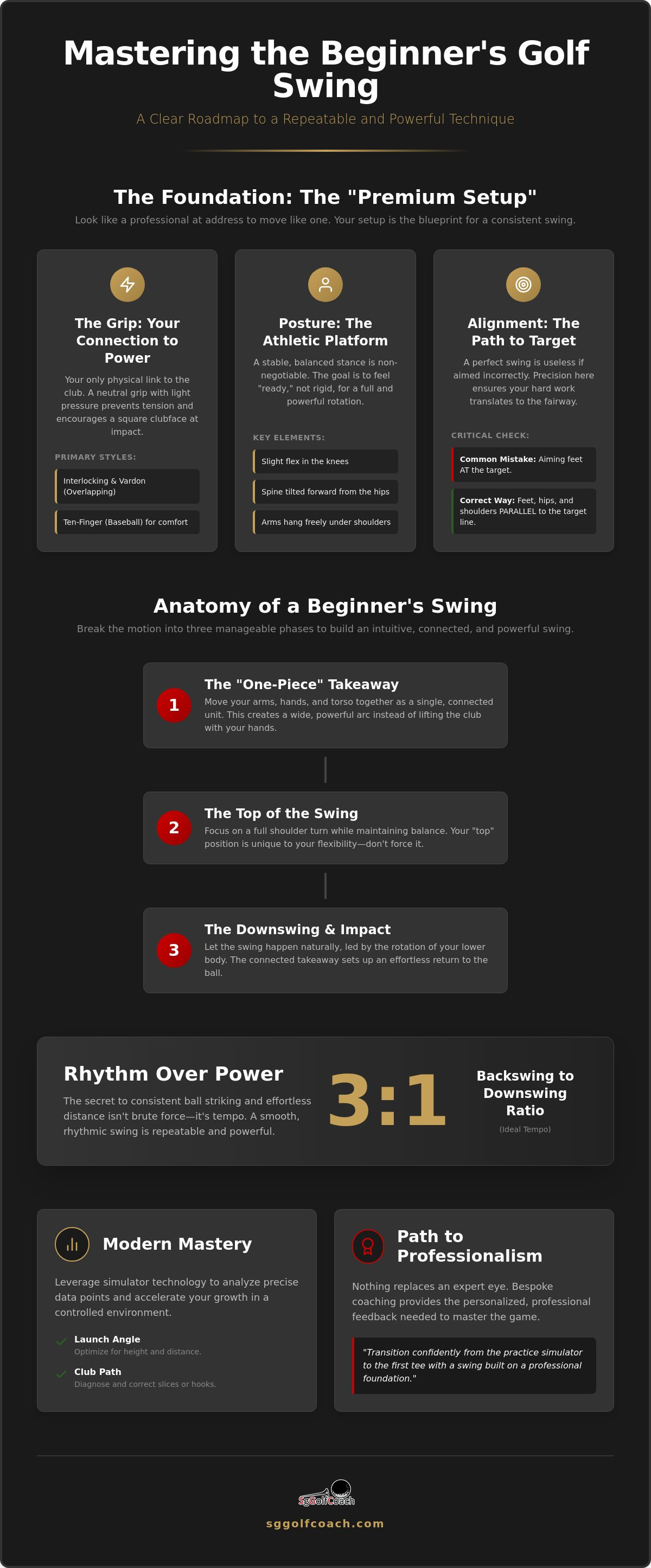
Everything begins with the hands. As the only physical connection to your club, your grip determines how the clubface returns to the ball at impact. Most players find success by choosing between three primary styles. The interlocking grip is often preferred by those with smaller hands, while the overlapping Vardon grip remains the standard for many professionals. Some beginners start with the ten-finger baseball grip for maximum comfort, though it offers less unity between the hands. Regardless of the style, your grip pressure should remain light and supple. Squeezing the club too tightly creates tension that travels up your arms, restricting your ability to release the club naturally through the hitting zone. A neutral grip is the industry standard for beginners because it places the hands in a position that encourages a square clubface at impact.
Posture and Alignment
A stable, athletic platform is essential for a high-quality golf swing technique for beginners. You want to feel "ready" rather than rigid. Achieving this requires a slight flex in the knees and a spine that tilts forward from the hips, which allows your arms to hang freely under your shoulders. This "athletic ready" position provides the balance necessary for a full, powerful rotation without losing your center of gravity. Mastery of this golf swing technique for beginners also requires precise alignment.
Even a technically perfect swing will fail if your body is aimed thirty yards away from your target. We recommend using alignment sticks during every practice session to calibrate your internal compass. These simple tools ensure your feet, hips, and shoulders are perfectly parallel to your target line. Many novices make the mistake of aiming their feet at the target rather than parallel to it. This subtle error often leads to an "over-the-top" swing path, which is the root cause of the dreaded slice that sends the ball curving wildly off course. Taking the time to align correctly at the range ensures your hard work translates directly to the fairways of Singapore's premier courses.
The Anatomy of a Beginner’s Swing: Breaking Down the Motion
Understanding the anatomy of a motion is what separates a student from a master. While many tutorials dive into micro-movements that confuse the novice, we focus on a streamlined golf swing technique for beginners that prioritizes connection and fluidity. By breaking the motion into three distinct phases: the takeaway, the top, and the downswing, you can build a swing that feels intuitive rather than mechanical. This structured approach ensures that every movement has a purpose, leading to the consistent ball striking every golfer dreams of.
The journey starts with the "One-Piece Takeaway." This concept requires your arms and torso to move together as a single unit during the first few feet of the swing. By maintaining the "V" shape formed by your arms and shoulders, you prevent the common mistake of picking the club up with just your hands. This connection is the secret to a wide, powerful arc that generates effortless speed. It's about moving the big muscles of the core to lead the way, rather than relying on the smaller, less reliable muscles in the wrists.
The Takeaway and Backswing
A common pitfall in the golf swing technique for beginners is the "inside" takeaway, where the club head is pulled behind the body too early. This ruins your swing plane and forces compensations later in the motion. Instead, focus on a full shoulder turn while keeping your weight centered. Your natural "top of the swing" is determined by your personal flexibility; there's no need to force a parallel club position if it compromises your balance. For more detail on these early movements, you can consult the PGA's guide to golf swing basics.
The transition is the most critical moment in the sequence. It's the split second where the backswing ends and the downswing begins. Rather than pulling down with your arms, the motion should be initiated by your lower body. A subtle shift of weight toward your lead side creates the "lag" necessary for a professional-grade strike. This sequence ensures you're using the ground for power, a hallmark of elite players.
Impact and Follow-Through
At the moment of truth, your goal is to deliver a square clubface to the back of the ball. This is achieved through a smooth weight transfer from your back foot to your lead foot. A balanced follow-through is the ultimate indicator of a well-executed swing. You should aim to "finish like a pro," standing tall with your chest facing the target and your weight fully supported by your front leg. If you find these transitions challenging to feel on your own, engaging in bespoke coaching can provide the immediate, high-level feedback required to refine these athletic movements. A beautiful finish isn't just for show; it's proof that your entire swing was in harmony.
Rhythm Over Power: The Secret to Consistent Ball Striking
Many beginners arrive at the range with the misconception that distance is a product of raw physical strength. In reality, the most elegant swings you'll see at Singapore's premier clubs are fueled by rhythm, not effort. Chasing power often leads to "over-swinging," where the body loses its structural integrity in an attempt to move the club faster. By adopting an 80% effort mindset, you actually improve your ball striking because your muscles remain fluid rather than tense. This relaxed state allows the clubhead to accelerate naturally through the impact zone, often resulting in more distance than a forced, high-tension strike.
The core of a sophisticated golf swing technique for beginners lies in the 3:1 tempo ratio. Scientific analysis of professional players shows that the backswing consistently takes three times longer than the downswing. This deliberate pace ensures that you have ample time to complete your shoulder turn and set the club in the correct position at the top. Maintaining soft hands is equally vital; tight fingers restrict the natural hinging of the wrists, which is where a significant portion of your speed is generated. For a deeper look into how these physical components interact, the PGA of America's guide to the golf swing offers an excellent technical breakdown.
Developing a Repeatable Tempo
Creating a consistent internal clock is essential for long-term growth. We often suggest a simple "One-and-Two" count to help students synchronize their movements. The "One" covers the takeaway and backswing, the "and" represents the transition at the top, and the "Two" is the downswing through impact. This rhythmic approach does more than just improve your score; it protects your body. A smooth, timed motion reduces the jarring impact on your back and wrists that often comes from a "hit-at-the-ball" mentality. Coordination between your upper and lower body becomes effortless when you stop fighting the club and start swinging it.
Managing the Mental Game
Mastery of the golf swing technique for beginners requires a disciplined mind as much as a disciplined body. We teach the "Box" method to help players separate analysis from execution. Behind the ball is your "Thinking Box," where you visualize the shot and check your alignment. Once you step into your "Execution Box" over the ball, the thinking stops. You focus on a single, simple swing thought or a feeling of rhythm. Staying patient during the early plateau phases is part of the journey. Progress in golf isn't always linear, but a commitment to tempo ensures that your "bad" days are still respectable and your "good" days are truly transformative.
Modern Mastery: Using Simulators and Feedback to Accelerate Growth
The traditional driving range has its charms, but for those seeking rapid refinement, the indoor simulator is the ultimate laboratory. We view these high-tech spaces as a sanctuary where you can deconstruct your movement without the distractions of wind, heat, or the prying eyes of other golfers. In fact, nearly two-thirds of all new golfers are now introduced to the game through off-course experiences like simulators. This shift isn't just about convenience; it's about the precision that only digital feedback can provide. Mastering a golf swing technique for beginners becomes significantly more efficient when you replace guesswork with hard data.
The Advantages of Screen Golf
In the heart of Singapore, where tropical humidity and sudden downpours can disrupt your practice schedule, screen golf offers a premium, climate-controlled environment. These facilities utilize high-speed cameras that capture thousands of frames per second, revealing swing flaws that are entirely invisible to the naked eye. This instant feedback loop allows you to bridge the gap between what you "feel" and what is actually happening. By seeing your swing on video immediately after impact, you can make micro-adjustments to your posture or takeaway in real-time. This accelerated learning curve builds "on-course" confidence much faster than traditional methods alone.
Every session in a simulator is an opportunity to engage with the physics of the game. You'll begin to understand how specific metrics influence your ball flight, including:
Ball Speed: A direct reflection of how efficiently you're transferring energy from the clubhead.
Launch Angle: The vertical angle at which the ball leaves the clubface, essential for maximizing distance.
Club Path: The direction the club is moving at impact, which determines whether your ball flies straight or curves.
Translating Data into Improvement
The challenge for many novices is avoiding "analysis paralysis" when faced with a screen full of numbers. We recommend focusing on one or two key metrics per session to keep your mind clear and your movements fluid. Setting "SMART" goals, such as achieving a specific club path five times in a row, turns a repetitive drill into a goal-oriented challenge. This gamification makes the learning process engaging and deeply rewarding. However, the true value of this data is unlocked through professional interpretation. If you’re ready to see your progress in real-time, consider a Screen Golf Booking to experience this high-precision environment firsthand. A mentor can help you filter the noise and focus on the specific data points that will transform your unique golf swing technique for beginners into a professional-grade motion.
The Path to Professionalism: Transitioning from Practice to Performance
The transition from the serene environment of a simulator to the first tee of a championship course is a significant milestone. It requires a mental shift from technical analysis to situational execution. While you've spent hours refining your golf swing technique for beginners, the real game introduces variables like uneven lies, varying wind speeds, and the psychological pressure of a scorecard. Achieving professionalism isn't about reaching a static, "textbook" swing that exists only in manuals. It's about developing a bespoke motion that works in harmony with your specific physical attributes, flexibility, and fitness levels.
Bespoke Coaching for Adults and Juniors
Generic online tutorials often fail because they treat every body as if it were identical. In reality, a sixty year old executive and a ten year old student require vastly different approaches to the game. Our Adult Lessons focus on maximizing efficiency based on individual mobility, ensuring the swing is sustainable and powerful. In contrast, our Junior Programs are designed to build character and discipline alongside technical skills, fostering a lifelong appreciation for the sport. While group classes offer a vibrant social environment and shared motivation, personalized one on one sessions remain the fastest route to true mastery. This individualized attention ensures that your golf swing technique for beginners is built on a foundation that respects your unique physique rather than forcing a one size fits all model.
Your First Round of Golf
In Singapore, the journey to the course typically involves obtaining your Proficiency Certificate (PC) and eventually a formal Handicap. These benchmarks are essential. They ensure you understand the fundamental rules and can maintain a proper pace of play on our busy local courses. Your first round should be less about the final score and more about embracing course etiquette and the social spirit of the game. Repair your pitch marks on the green, keep up with the group ahead, and stay patient with yourself. Every seasoned professional started exactly where you are today. If you're ready to bridge the gap between the range and the green, you can book a bespoke coaching session today to receive the expert guidance needed for a confident debut. Focus on the progress you've made, stay present in the moment, and enjoy the refined lifestyle that the game of golf provides.
Elevate Your Game with Professional Precision
Building a masterful swing is a journey of intentional refinement rather than a race for raw distance. By prioritizing a polished setup and embracing the 3:1 rhythm of a professional stroke, you've already established the groundwork for long-term success on the course. This intentional approach ensures that your golf swing technique for beginners evolves into a repeatable, powerful motion that feels both intuitive and sophisticated. Modern technology and personalized feedback act as the final catalysts, turning your practice sessions into a clear, data-driven path toward excellence.
Beyond technical mastery, the sport offers a gateway to world-class travel experiences. For those planning a visit to the home of golf, choosing luxury lodges with hot tubs perthshire ensures your time off the course is as restorative and high-end as your time on it.
Our comprehensive programs for both adults and juniors are designed to meet you at your current skill level and guide you toward your full potential. We provide expert coaching at our network of premium facilities, featuring state-of-the-art indoor simulators to analyze your progress with meticulous care. You don't have to navigate the complexities of the game alone when you can have a dedicated partner in your growth. Begin your journey to golf mastery with SgGolfCoach today. The fairways are waiting, and your most confident round of golf is just a few sessions away.
Frequently Asked Questions
How long does it take for a beginner to learn a proper golf swing?
Most students can establish a functional golf swing technique for beginners within 10 to 15 hours of professional instruction. While basic contact often happens within the first few sessions, achieving a repeatable and polished motion requires consistent refinement over several months. Your individual progress depends on your existing athletic coordination and the dedication you bring to your practice sessions between formal lessons.
Is it better to learn golf at a driving range or on an indoor simulator?
A blend of both environments typically yields the most sophisticated results for new players. Indoor simulators act as a high-precision laboratory where you can analyze data points like club path and launch angle in a climate controlled setting. Once you've refined your mechanics, transitioning to an outdoor range allows you to witness actual ball flight and learn to adjust to environmental factors like wind and natural light.
What is the most common mistake beginners make in their golf swing?
The most frequent error is attempting to generate power through excessive physical tension and "swinging hard" rather than focusing on rhythm. This mistake often leads to a restricted follow-through and inconsistent ball striking. By maintaining soft grip pressure and prioritizing a balanced tempo, you allow the clubhead to do the work, which naturally increases both your accuracy and your total distance.
Do I need my own clubs to start taking beginner golf lessons?
You don't need to invest in a full set of clubs before your first lesson. Most professional coaching programs provide high quality equipment for students to use during their initial sessions. It's actually better to wait until you've developed a basic golf swing technique for beginners before purchasing clubs. This allows your coach to provide bespoke recommendations based on your evolving swing speed and physical stature.
How often should a beginner practice their swing to see progress?
Consistency is the vital ingredient for building lasting muscle memory. We recommend practicing at least two to three times per week, ideally in shorter, focused sessions of 45 to 60 minutes. Frequent, high quality practice is far more effective for long term mastery than a single, grueling three hour session once a week. This steady rhythm keeps the neural pathways for your new movements active and fresh.
What is a Proficiency Certificate (PC) and why do I need one in Singapore?
In Singapore, a Proficiency Certificate (PC) is a mandatory requirement for beginners to gain access to most golf courses. It serves as official proof that you understand basic rules, safety protocols, and course etiquette. To obtain your PC, you'll undergo a practical and theoretical assessment by a certified professional. This ensures you can navigate the course safely while maintaining an appropriate pace of play for the community.
Can I learn a good golf swing technique by watching YouTube videos?
While digital tutorials offer helpful insights, they lack the essential element of real time, personalized feedback. Without a professional mentor to monitor your specific movements, it's easy to misinterpret advice and develop ingrained habits that are difficult to correct later. A bespoke coaching approach ensures that every instruction you receive is tailored to your unique body mechanics and personal learning style.


Comments