

Fix Your Golf Swing: Professional Guide for 2026

What if the secret to a permanent breakthrough isn't a new swing thought, but a systematic audit of your setup? Most golfers in Singapore spend years chasing a "magic" move, only to find their game remains as unpredictable as a tropical afternoon storm. You've likely felt the frustration of a solid range session followed by a disappointing round, or the confusion that comes from trying every conflicting tip on your social feed. It's exhausting to rely on "band-aid" fixes that never seem to stick when you're actually standing on the tee box.
We understand that you're looking for more than just a temporary patch. You want to know exactly how to fix golf swing faults with precision and authority. This professional guide provides a sophisticated, bespoke approach to diagnosing your specific issues for a more consistent and powerful game. We're moving away from generic advice and toward a refined system that prioritizes long-term mastery over quick, unreliable results. It's about building a foundation that stays solid under pressure.
You'll gain a clear understanding of your unique swing mechanics and discover actionable drills that produce an immediate, tangible feel. We'll explore how professional feedback and modern simulator technology can validate your progress throughout 2026. By the end of this roadmap, you'll have the tools to transform your ball striking from a source of anxiety into your greatest competitive advantage.
Table of Contents
Why Your Golf Swing Feels Broken (and Why YouTube Fixes Fail)
Hitting that one perfect drive on the first tee at a Singapore course feels incredible, but the frustration sets in when the rest of the round becomes a struggle of topped shots and slices. This "one good shot per round" syndrome is a common plague for amateur golfers. You might spend hours searching for how to fix golf swing mechanics on YouTube, only to find that the "secret tip" you learned on Friday fails you by Sunday. These digital "Band-Aids" are dangerous because they treat the surface level without addressing the underlying fundamentals of the golf swing.
A golf swing is not a collection of isolated parts; it's a kinetic chain. Energy must flow seamlessly from your feet through your hips and torso, finally reaching the clubhead. When you attempt to fix a fault with a quick tip, you're often just adding a new complication to a broken sequence. Lasting improvement requires a systematic approach that views the swing as a unified movement rather than a series of disconnected positions. Without a professional diagnostic framework, you're simply guessing at which link in the chain is failing.
The Trap of the 'One Move' Fix
Many students try to replicate a specific move from a professional player, like Rory McIlroy’s hip rotation or Nelly Korda’s tempo. This is often a mistake. Your unique physical build and flexibility mean that a move that works for a pro might actually ruin your swing. There's a vital distinction between a "swing thought," which is a temporary mental cue to help with feel, and a "mechanical change," which is a structural adjustment to your motion. Relying on a carousel of different swing thoughts during a round leads to paralysis by analysis. You stop playing golf and start playing "golf swing," which usually results in tension and poor contact.
Root Causes vs. Symptoms
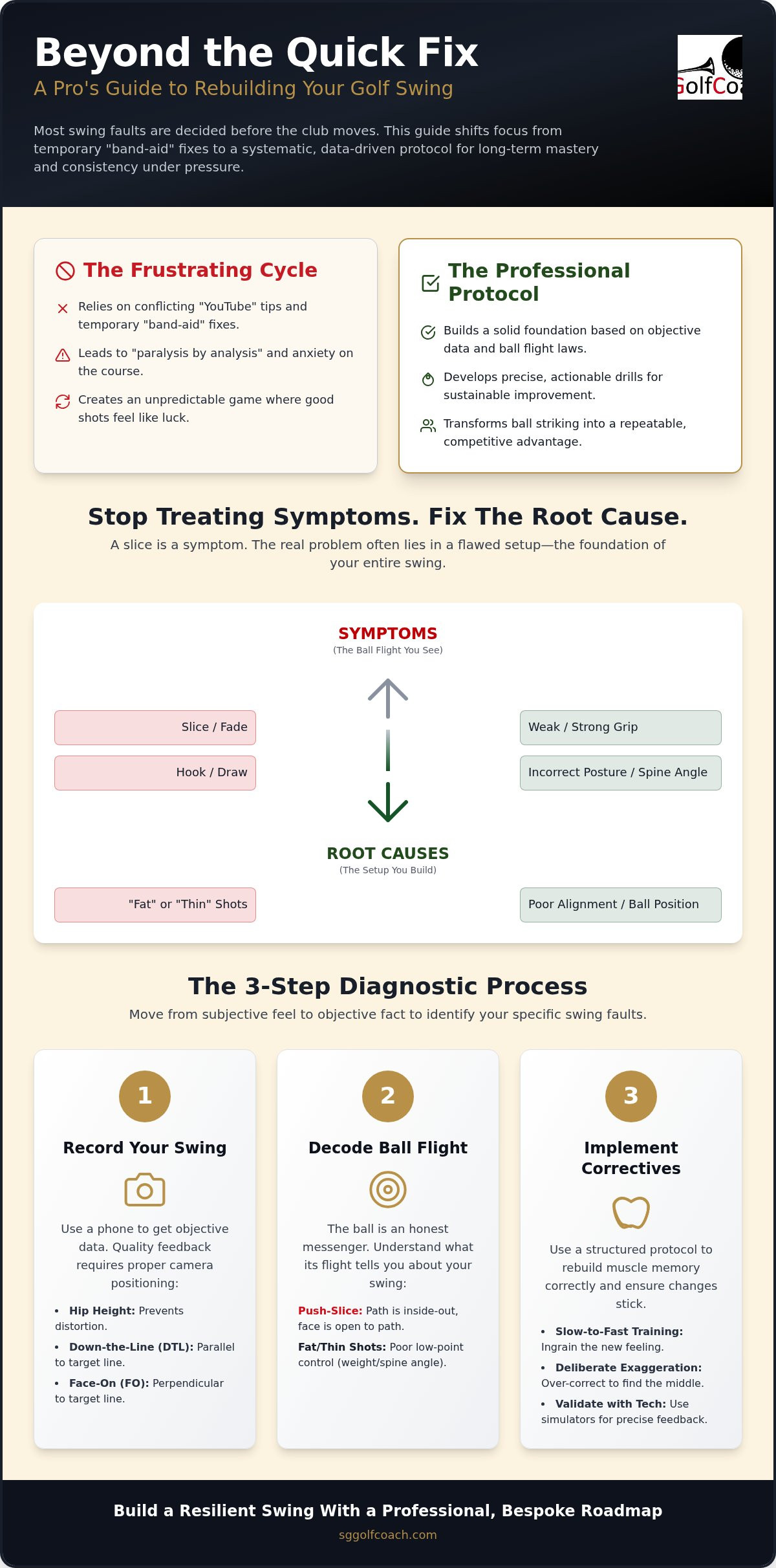
To truly understand how to fix golf swing faults, you must distinguish between a symptom and a root cause. A slice is a symptom; the root cause might be a weak grip or an incorrect takeaway that sets the club on a path to disaster. Trying to fix your impact position while ignoring a flawed setup is like trying to straighten a house built on a crooked foundation. Your muscle memory is incredibly resilient and will naturally resist new changes. Without professional guidance to identify the actual source of the error, you'll likely continue practicing the same faults; further ingraining the very habits you're trying to break.
The 3-Step Diagnostic Process: Identifying Your Swing Faults
To achieve mastery, you must first accept that "feel" is often a deceptive guide in the golf swing. Professional golfers rely on hard data and video evidence to refine their mechanics; you should do the same. Learning how to fix golf swing faults begins with a clinical diagnostic process that strips away guesswork. By observing your ball flight and swing through a lens of objective laws, you can pinpoint exactly where the sequence breaks down. This systematic approach ensures you aren't just changing your swing, but actually improving it.
Step 1: Record Your Swing Correctly
Quality data starts with proper camera positioning. Place your recording device at hip height for both "Down the Line" (DTL) and "Face On" views. For DTL, the camera must be parallel to your target line, ideally pointed between your hands and the ball. If the angle is off even by a few inches, it can create a distorted perception of your swing plane. Mobile apps that allow you to draw lines for your head position and swing path are invaluable tools for this initial audit. These visual markers provide the professional-grade feedback needed to see what your body is actually doing.
Step 2: Decode Your Ball Flight
The golf ball is an honest messenger. If you hit a "push-slice," it tells a specific story: your club path is moving inside-to-out, but your clubface is open relative to that path. Understanding these ball flight laws allows you to self-correct in real-time. For instance, "fat" or "thin" shots are usually symptoms of poor low-point control, suggesting your weight transfer or spine angle is failing mid-swing. Mastering this logic is a critical step in how to fix golf swing inconsistencies because it gives you a roadmap for every practice session.
Step 3: Compare to Professional Fundamentals
Once you have your footage, compare it against established benchmarks. A study from Stanford Medicine highlighted significant biomechanical differences in golf swings between elite players and amateurs, particularly in how they manage rotational speed and weight shift. Look for "power leaks" like casting or early extension, where the hips move toward the ball too soon. If you find your foundation is shaky, revisiting Mastering the Basics: Beginner Golf Lessons in Singapore can help you rebuild those essential movements. For those seeking the highest level of precision, Bespoke Coaching offers the professional feedback necessary to validate your self-diagnosis.
Rebuilding the Foundation: Fixing Setup and Address Errors
Many golfers obsess over the high-speed mechanics of the downswing, yet they ignore the reality that nearly 90% of swing faults are decided before the club even moves. If your setup is flawed, your brain is forced to make frantic, mid-swing compensations to find the ball. This leads to the inconsistency that plagues so many amateur games. As your premium mentor, I believe that perfection in the setup is a non-negotiable requirement for anyone serious about how to fix golf swing issues permanently. Mastery begins with the static fundamentals that every player, regardless of age or skill level, can control. Precision at address is the hallmark of a sophisticated game.
The Grip and Alignment Check
Your grip is your only connection to the club, and it dictates the clubface angle at the critical moment of impact. A neutral grip encourages a square face, while a "strong" or "weak" grip can lead to persistent hooks or slices. Beyond the hands, your alignment acts as the track for your swing motion. We often use the "train track" analogy: your clubface and ball are on the outer rail pointing to the target, while your feet, hips, and shoulders are on the inner rail. Utilizing alignment sticks during every practice session at a Singapore driving range ensures your body isn't subconsciously fighting a target that your eyes haven't properly locked onto.
Posture, Balance, and Ball Position
Achieving an "athletic ready" position is vital for generating power and maintaining a consistent swing plane. This involves a crisp spine angle and a slight, energetic knee flex. While technique is key, the physical ability to hold these positions often requires targeted strength work; facilities like Arete Gyms specialize in the conditioning necessary for such athletic transformations. A common mistake is sitting back on the heels, which kills your ability to rotate and causes you to lose balance. Instead, feel your weight centered over the balls of your feet. This balanced foundation allows for the fluid, rhythmic rotation seen in professional swings. Ball position must also be tailored to the specific club in your hand. For a driver, the ball should be forward, just inside your lead heel, to encourage an upward strike. For irons, move the ball back toward the center to ensure clean, downward compression. Small, intentional adjustments in these areas often provide the immediate "feel" that general tips cannot. Mastering these basics is the most direct path for those wondering how to fix golf swing faults for good.
Correcting a mechanical fault requires more than just hitting buckets of balls at a Singapore driving range. To truly master how to fix golf swing inconsistencies, you must adopt a protocol that prioritizes neurological adaptation over physical exhaustion. We utilize a "Slow-to-Fast" training methodology to ensure your brain has the bandwidth to process new positions before they're integrated into a high-speed strike. Quality repetitions are the currency of improvement; hitting ten mindful, perfect shots is infinitely more valuable than spraying fifty balls with a flawed pattern. You're building a new blueprint, not just burning calories.
A critical concept in this transformation is "Exaggeration." To break years of ingrained muscle memory, the new movement must feel extreme. If you're working to eliminate a slice, you might need to feel like you're swinging forty-five degrees to the right just to achieve a neutral path. This intentional over-correction is necessary to bridge the gap between what you feel and what is actually happening. Don't be afraid to feel "wrong" in the short term to be right in the long term.
The Slow-Motion Rehearsal
Swinging at 25% speed is the fastest way to learn a new motion. It allows you to monitor the club's path and your body's rotation without the distraction of impact results. Incorporate the "Pause at the Top" drill, where you hold your backswing for three seconds before starting the downswing. This pause eliminates momentum-based errors and forces you to use the correct muscles to initiate the transition. By focusing on impact awareness through these controlled half-swings, you develop a sophisticated "feel" for the clubface that translates directly to better ball striking.
Transition and Sequencing Drills
Proper sequencing is what separates a professional strike from an amateur one. The "Step Drill" is an exceptional tool for teaching weight transfer and ground force; you simply step toward the target with your lead foot just as you begin the downswing. To fix a common "Over-the-Top" move, try the "Wall Drill" by standing a few inches from a wall and ensuring your clubhead doesn't strike it during the takeaway or transition. As you refine these motions and lower your scores, you may want to consult our Guide to PC and Golf Handicap in Singapore to track your progress officially. For those ready to accelerate their journey with professional validation, our Bespoke Coaching sessions provide the precision feedback needed to solidify these changes.
30-Minute Correction Plan:
0-10 Minutes: Slow-motion rehearsals (no ball) focusing on the specific fault identified in your diagnosis.
10-20 Minutes: Focused drills (Step or Wall drill) using half-swings with a ball to prioritize contact over distance.
20-30 Minutes: Full swings with a single, clear focus, alternating between your "new" feel and a standard swing.
Elevating Your Game with Bespoke Professional Coaching in Singapore
While the diagnostic steps and drills outlined earlier provide a solid foundation, every amateur golfer eventually hits a plateau. Self-correction has a natural ceiling because your brain often filters out the very micro-movements that cause inconsistency. You might spend months trying to figure out how to fix golf swing path issues, only to realize the problem was actually hidden in your grip pressure or a slight shift in your center of gravity. This is where the transition from self-study to professional mentorship becomes transformative. It's the difference between guessing and knowing.
At SgGolfCoach, we act as your dedicated partner in progress. We don't just provide a list of corrections; we offer a bespoke roadmap tailored specifically to your unique biomechanics and goals. By eliminating the guesswork that often leads to frustration, we help you focus your energy on the specific changes that will actually lower your handicap. This refined approach ensures that every hour you spend practicing yields a measurable return in your performance on the course.
The Value of Instant Professional Feedback
A professional coach identifies "invisible" faults that are impossible to spot on a standard smartphone recording. These include subtle nuances like excessive tension in the forearms or a slight change in grip pressure during the transition. Beyond the technical, there is a significant psychological benefit to professional instruction. Instead of juggling ten conflicting tips from the internet, you leave each session with a singular, clear focus for your practice. If you're ready to take this step, our guide on Finding the Right Golf Coach in Singapore can help you navigate the options for high-quality instruction.
Technology-Driven Improvement
Our approach leverages the latest in indoor simulator technology to provide precision feedback that the naked eye simply cannot match. Within our screen golf facilities, we analyze data points such as launch angle, ball speed, and spin rates with clinical accuracy. This environment allows for year-round practice in Singapore, protected from the heat and unpredictable rain. We view screen golf as a high-performance training tool that validates every adjustment you make in real-time. To truly understand how to fix golf swing faults with long-term success, you need this blend of human expertise and data-driven insight. We invite you to book a Bespoke Coaching session today and begin the journey toward a more powerful, consistent game.
Step into a New Era of Consistency
Transforming your game requires moving beyond the cycle of temporary fixes and embracing a structured, professional philosophy. You now have the framework to understand that how to fix golf swing faults isn't about chasing the latest viral tip; it's about mastering the static fundamentals and validating your progress with objective data. By prioritizing a precise setup and utilizing deliberate, slow-motion rehearsals, you build a resilient motion that stands up to the pressures of the course.
The journey toward a lower handicap is most efficient when you have an expert partner to guide your development. At SgGolfCoach, we provide personalized one-on-one coaching led by professional instructors who specialize in identifying the subtle nuances of your unique biomechanics. Our premium indoor screen golf facilities offer the precise data analysis needed to turn your practice into performance. Whether you're interested in our tailored adult programs or specialized junior curriculums, we're here to elevate your experience of the sport.
Book a Bespoke Coaching Session with SgGolfCoach today and start your transformation. We look forward to seeing you on the green with a swing you can finally trust.
Frequently Asked Questions
How long does it take to fix a golf swing for a beginner?
It typically takes a beginner between eight to twelve weeks of consistent, professional instruction to build a reliable foundation. While you might see immediate improvements in feel after a single session, muscle memory requires approximately 1,000 to 2,000 deliberate repetitions to become permanent. We recommend a structured ten-lesson package to ensure you master the essential mechanics without reverting to old habits under pressure on the course.
Can I fix my golf swing by practicing at home without a club?
You can absolutely refine your mechanics at home by focusing on body rotation and weight transfer drills. Using a mirror to check your spine angle or practicing the "Step Drill" without a club helps solidify the kinetic chain. These dry rehearsals are excellent for those wondering how to fix golf swing sequences because they remove the distraction of ball flight, allowing you to focus entirely on your physical positions.
Why do I keep slicing the ball even after trying different fixes?
A persistent slice usually occurs because you're treating the symptom rather than the root cause. Most amateurs attempt to swing more left to compensate, which actually steepens the swing path and increases side-spin. To truly solve this, you need objective data from an indoor simulator to determine if your clubface is open relative to your path. Without this precision, you're likely applying "band-aids" that won't hold up during a full round.
Is it better to get a golf lesson or buy new equipment to fix my game?
Investing in a professional lesson is significantly more effective than purchasing the latest 2026 driver. While high-end equipment like the TaylorMade Qi4D can offer marginal gains in forgiveness, it cannot correct a fundamental flaw in your swing plane or grip. A bespoke coaching session provides the personalized feedback necessary to fix your mechanics, ensuring you get the most out of whatever clubs are currently in your bag.
How often should I record my golf swing to see progress?
We recommend recording your swing at least once every practice session to maintain objective awareness. Seeing your progress on video prevents feel from drifting away from reality, which is a common hurdle for many players. Frequent recording allows you to catch minor errors before they become ingrained habits. By comparing your current footage to previous sessions, you can validate that your corrective drills are producing the intended mechanical changes.
What is the most common swing mistake for golfers in Singapore?
The most frequent error we observe among golfers in Singapore is the "Over-the-Top" move caused by excessive upper-body tension. This often stems from a desire to hit the ball harder, leading to a steep downswing and inconsistent contact. Many players also struggle with early extension, where the hips move toward the ball too early. Addressing these faults through professional mentorship is the most direct way to achieve a more sophisticated and powerful motion.
How do I stop 'topping' the ball during my downswing?
Topping the ball is almost always a result of losing your spine angle or having poor low-point control during the downswing. If your chest rises or your weight stays on your back foot, the club will reach its lowest point before it reaches the ball. Focus on maintaining a consistent posture and ensuring your weight shifts toward your lead side. This adjustment ensures the club head compresses the ball before making contact with the turf.
Should I change my swing if I'm already hitting the ball straight?
You should only consider a change if your current motion is causing physical pain or preventing you from reaching your scoring potential. If you hit the ball straight but lack distance or struggle with certain club types, a refined adjustment might be necessary. However, if your current mechanics are reliable and consistent, we focus on polishing your existing motion rather than a total rebuild. Longevity and efficiency are the primary goals for any seasoned player.


Comments