

Mastering the Screen: Essential Golf Simulator Practice Drills in Singapore
- sggolfcoach

- 11 minutes ago
- 11 min read
Most golfers in Singapore use world-class simulator technology to do nothing more than play expensive video games. While it's tempting to simply "play a round" at a virtual course, hitting balls without a strategy often leads to stagnating progress and a lingering sense of boredom. You've likely searched for golf simulator practice drills Singapore players can rely on, only to feel overwhelmed by the flurry of data on a Trackman or Golfzon screen. It's frustrating when your frequent indoor sessions don't result in lower scores on actual Singapore courses.
We believe your time is too valuable for aimless practice. This guide transforms your sessions into high-precision training by introducing a structured 60-minute routine designed for maximum impact. You'll learn to interpret launch monitor data like a professional, allowing you to self-correct your swing path and face every tee box with newfound confidence. We'll explore how to replace guesswork with bespoke, data-driven mastery; ensuring that every hour spent on the screen translates to better performance on the grass and a more enjoyable journey toward excellence.
Table of Contents
The Digital Advantage: Why Simulator Practice Drills Outperform the Range
Core Mechanics: Data-Driven Drills for Club Path and Face Angle
The Precision Gap: Mastering Distance Control and Wedge Gapping
The Simulator Power Hour: A Structured 60-Minute Practice Plan
Beyond the Screen: Integrating Drills with SgGolfCoach Expertise
The Digital Advantage: Why Simulator Practice Drills Outperform the Range
Traditional practice at an outdoor range often becomes a frantic chase for ball flight. You hit a slice, you try to "fix" it on the next ball, but you're usually just guessing. In a simulator, you can ignore the ball flight entirely for a dedicated block of time to focus on pure mechanics. This is where golf simulator practice drills Singapore enthusiasts rely on become truly transformative. By removing the distraction of where the ball lands, you can build bulletproof muscle memory that holds up under pressure.
Singapore's extreme humidity is a silent performance killer that many golfers overlook. Practicing at an outdoor range in 90% humidity leads to rapid muscle fatigue and a gradual decline in practice quality. Inside a premium, climate-controlled facility, your body remains fresh; this allows for higher quality repetitions and more precise motor skill development. When you aren't fighting the heat, you can dedicate your full mental energy to seeing a 2-degree path shift on the screen rather than just trying to survive the session.
Range vs. Simulator: A Performance Comparison
Open-air ranges are filled with visual noise, including other golfers, shifting winds, and the subtle pressure of an audience. Simulators provide a private, enclosed environment that removes these distractions, allowing for a deeper level of concentration. Consider these advantages:
Total Accuracy: You receive 100% accurate distance tracking on every shot, whereas range balls often vary in quality and flight distance.
Psychological Safety: There's a distinct advantage to "safe" practice where you can experiment with radical swing changes without the fear of an audience.
Visual Clarity: Simulators reveal the club's behavior at the "moment of truth," visualizing the invisible forces that dictate your ball flight.
Understanding the Feedback Loop
Most players are addicted to "External Feedback," which is simply seeing where the ball went. Real improvement requires "Internal Feedback," or the sensory data from your muscles and joints. Simulators bridge this gap by providing immediate digital confirmation of a physical feeling. If you feel like you've neutralized your path and the screen confirms a move from 6 degrees out-to-in to 2 degrees, that's a reinforced learning moment. Smash Factor is the ultimate metric for strike efficiency in 2026, calculated by dividing ball speed by clubhead speed to reveal how centered your contact truly is. This data-driven approach replaces the "feeling" of a good shot with the objective reality of clubhead physics.
Core Mechanics: Data-Driven Drills for Club Path and Face Angle
Mastering your swing mechanics requires moving beyond the "hit and hope" mentality common at the range. In a simulator environment, every movement is quantified, providing a surgical level of detail that allows for rapid adjustment. The following golf simulator practice drills Singapore players can execute solo are designed to neutralize your path and stabilize your clubface at impact, turning high-tech data into lower scores.
The Path Neutralizer Drill
To conquer the "Zero-Path" Challenge, you must first establish your baseline. Hit five stock shots and look for your average club path number on the screen. If you see a significantly negative number (for right-handers), you're likely coming "over the top." Use these steps to recalibrate your swing plane:
Step 1: Identify your baseline club path number. If it's -5 degrees, your goal is to move it toward zero.
Step 2: Take three 50% swings focusing on an exaggerated "inside-out" feel. Don't worry about where the ball goes; focus entirely on seeing a positive path number on the monitor.
Step 3: Gradually increase your swing speed while keeping your path within a tight, professional window of +/- 2 degrees.
Mastering the Face Angle
The 80/20 rule is a fundamental law of ball flight: your face angle accounts for roughly 80% of the ball's initial starting direction. If your face is open at impact, the ball will start right regardless of your path. To gain control, try the "Clock Face" exercise. Visualize the clubface as the hand of a clock; 12 is perfectly square, 1 is slightly open, and 11 is slightly closed. Hit shots while intentionally trying to produce a "11:30" or "12:30" face angle to learn the subtle hand feels required for precision.
Use the simulator's slow-motion replay to verify your hand position at the top of the swing and through the transition. This visual confirmation ensures your "feel" matches the reality of the club's position. For those looking to refine their transition, focus on "Sequential Loading." Many modern simulators track weight transfer; look for a smooth, athletic shift into your lead side before the downswing begins. Using on-screen alignment aids to create a "Digital Gate" can further narrow your focus, forcing you to swing through a specific corridor. While these drills provide a solid foundation, having an expert interpret your specific data points through bespoke coaching ensures you aren't reinforcing the wrong habits.
The Precision Gap: Mastering Distance Control and Wedge Gapping
Precision is the hallmark of a refined golfer. While many players focus on raw power, the ability to dial in specific distances separates the enthusiast from the master. Using golf simulator practice drills Singapore golfers can access in premium bays allows you to eliminate the "guessing game" that often plagues the short game. By leveraging high-frequency data, you can turn your wedges into surgical tools rather than instruments of chance.
Creating Your Personal Yardage Matrix
To build a digital "cheat sheet," you must first collect a significant data sample. Hit 10 balls with each wedge in your bag, focusing on three specific swing lengths: a half-swing, a three-quarter swing, and a full release. In Singapore, our tropical climate often results in softer fairways where the ball doesn't roll out as much as it might in drier regions. This makes "Carry Distance" the most critical metric for navigating local courses. Knowing your true carry distance ensures you can clear hazards with confidence rather than hoping for a favorable bounce. It's why indoor golf Singapore is the best place to map your bag; the environment remains constant, allowing the data to be pure and actionable.
The 9-Shot Challenge
The 9-Shot Challenge is a rigorous test of skill that forces you to control both trajectory and shape. You must produce three heights (low, medium, high) across three flight paths (draw, straight, fade). This drill is a cornerstone of advanced beginner golf lessons Singapore students use to graduate toward intermediate play. Simulators make this visualization effortless by providing a "side-view" window to track your apex height in real-time. By hitting through these specific digital windows, you develop the versatility required to handle wind and difficult pin placements on the course.
Mastering trajectory control involves more than just club selection. Use the simulator’s side-view to analyze how your hand position at impact affects your launch angle. If you need to flatten your flight for a windy day at Mandai, the data will show you exactly how many degrees you've delofted the face. When it comes to short game realism, adjust your mindset for putting and chipping. Focus on the "initial velocity" and "launch angle" metrics rather than just the visual of the ball rolling. If you can master the first three feet of a virtual putt, you'll find your touch on actual greens becomes significantly more consistent.
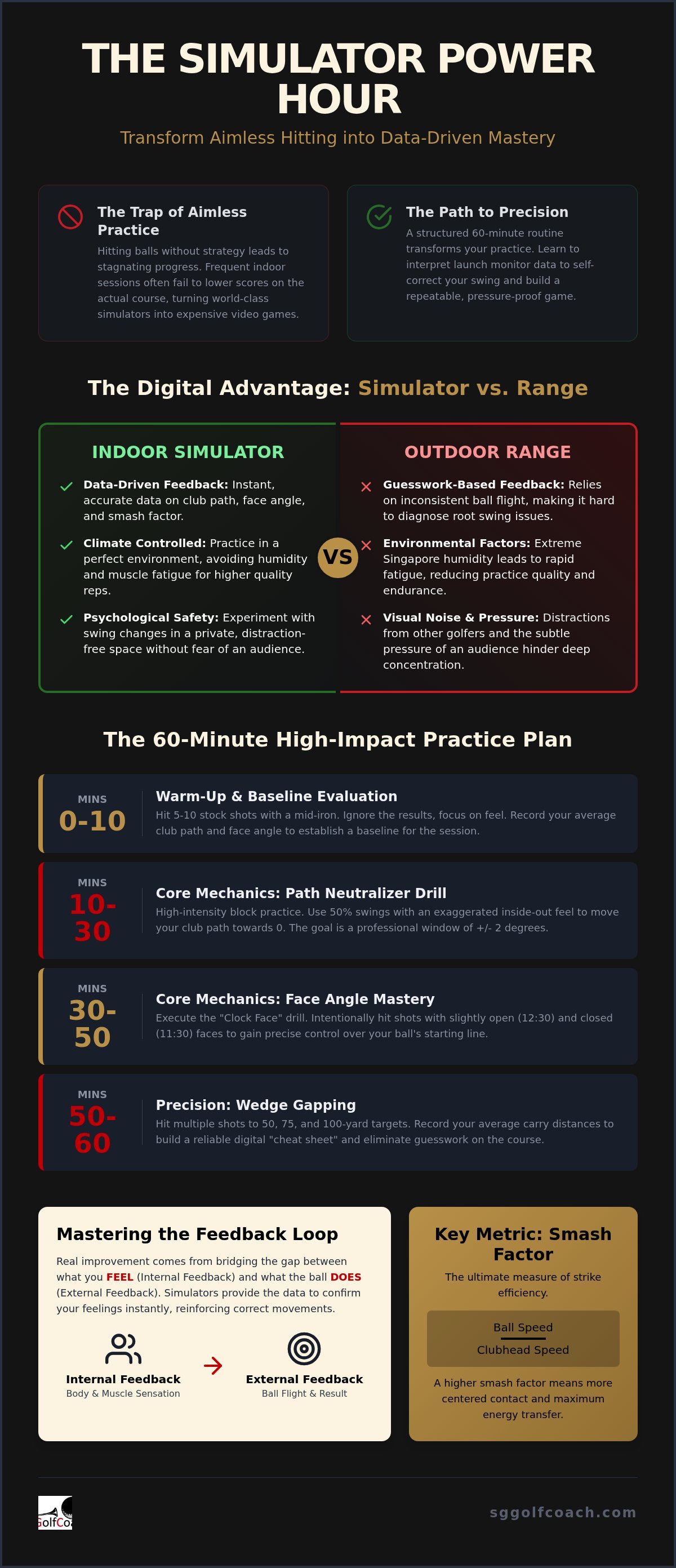
The Simulator Power Hour: A Structured 60-Minute Practice Plan
Most simulator sessions fail because they lack a defined objective. Hitting a hundred drivers in sixty minutes might feel productive, but without a menu of golf simulator practice drills Singapore players actually need, you're likely just reinforcing existing flaws. To maximize your investment, you must treat your session like a surgical strike. Your hour begins with a ten-minute dynamic warm-up and baseline evaluation; hit ten stock shots with a mid-iron to see where your swing is "living" today before diving into deeper work.
Phase 1: Block Practice for Muscle Memory
From the 10 to 30-minute mark, you enter the Block Practice phase. This is where you isolate a single technical change, such as a specific golf swing technique for beginners or a path correction identified in your baseline. Use the "3-Swing Rule" to accelerate learning: one slow-motion swing to feel the move, one at medium speed to verify the data, and one at full speed to lock it in. This methodical approach is a foundation of the junior golf program Singapore curriculums because it builds a reliable physical foundation through high-quality, intentional repetitions.
Phase 2: Random Practice for Course Readiness
The next twenty minutes shift from "how to swing" to "how to play." Random practice forces your brain to retrieve different skills on every shot, just as you would on the course. Switch your club and target for every single ball. You might hit a driver into a wide fairway, followed by a seven-iron to a tucked pin, and finish with a delicate wedge. Follow the "One Ball" Rule during this phase; never hit the same shot twice in a row and refuse the temptation of mulligans. Many premium simulators offer "Combine" modes or skills challenges that are perfect for this phase, providing a scored evaluation of your performance under changing conditions.
The final ten minutes are reserved for pressure testing. Finish your session with a "Virtual 3-Hole" challenge on a course you know well, like a digital recreation of a local Singapore favorite. If you miss a fairway or green, you must play the recovery shot as it lies. This finish bridges the gap between the hitting bay and the first tee, ensuring your mechanics don't crumble when a score is on the line. While a structured solo plan is powerful, the fastest way to see results is to book a bespoke coaching session to have a professional audit your Power Hour routine.
Beyond the Screen: Integrating Drills with SgGolfCoach Expertise
Solo practice is the engine of improvement, but professional guidance is the steering wheel. While executing golf simulator practice drills Singapore players find in this guide provides a solid foundation, raw numbers on a screen can often be deceptive without expert context. The "Premium Mentor" advantage lies in the ability to filter through the noise. A professional golf coach Singapore identifies the critical 10% of launch monitor data that actually impacts your ball flight, preventing the common trap of "over-fixing" minor fluctuations that don't truly matter.
Why Data Needs Context
Modern simulators provide a wealth of information, from spin axis to descent angle. Without a trained eye, many golfers fall into a cycle of chasing perfect numbers at the expense of a functional swing. At SgGolfCoach, we view technology as a sophisticated tool rather than a crutch. We use data to validate a physical feeling, ensuring that your golf simulator practice drills Singapore sessions are reinforcing habits that translate to the course. By tailoring drills to your unique physical screening and goals, we ensure your development is bespoke, not generic.
From Indoor Mastery to Outdoor Success
The ultimate test of your simulator work happens when you step onto the grass. Whether you are preparing for your PC handicap golf Singapore or aiming to break 80 at a premier local club, the transition requires a specific mental shift. We help you bridge this gap by integrating simulator sessions with on-range training at Mandai Executive Golf Driving Range. This hybrid approach allows you to take your "indoor swing" to the first tee with the confidence that your mechanics are backed by data and verified by a professional.
Combining solo simulator time with professional oversight is the most efficient pathway to mastery. Use your private sessions to build muscle memory and your coached sessions to audit your progress and refine your objectives. This balance ensures that every hour you spend in the bay is a step toward a more consistent, enjoyable game. Ready to transform your training? Book a bespoke coaching session or simulator bay today and start seeing the results your dedication deserves.
Elevate Your Game Beyond the Virtual Fairway
Transforming your indoor sessions into a high-precision training ground requires more than just hitting balls; it demands a structured approach and data-driven intent. By implementing a dedicated Power Hour and mastering the golf simulator practice drills Singapore professionals use, you replace aimless practice with measurable growth. You've learned how to neutralize your swing path and dial in your wedge gapping, ensuring that every digital shot contributes to lower scores on the actual grass.
True mastery happens when these technical insights are paired with the guidance of a premium mentor. Whether you're honing your skills at our premium indoor facilities at Royce Luxury or transitioning your progress to Mandai Executive Golf Driving Range, we provide the expertise to decode your data. Our dedicated Junior and Adult programs are designed to meet you at your current level and guide you toward your full potential. Elevate your game with bespoke coaching and premium simulator bookings at SgGolfCoach. Your journey toward a more precise and rewarding game starts with a single, intentional swing. We look forward to seeing you on the screen and the course.
Frequently Asked Questions
Can golf simulator practice drills really help lower my handicap in Singapore?
Yes, simulator drills are highly effective for lowering your handicap because they provide objective data that isn't available on a traditional range. By focusing on specific golf simulator practice drills Singapore players use to neutralize club path, you build a more repeatable swing. This precision reduces the number of "lost" shots on local courses where tight fairways and water hazards demand high accuracy and consistent ball striking.
What are the best simulator drills for beginners at SgGolfCoach?
Beginners should start with the "Path Neutralizer" and the "Digital Gate" drills to establish a sound swing plane. These exercises focus on the "Zero-Path" challenge, helping you avoid the common over-the-top slice. At SgGolfCoach, we recommend using the "3-Swing Rule" to bridge the gap between a new physical feeling and full-speed execution, ensuring your foundations are solid before moving to advanced shot-shaping.
How often should I practice on a simulator to see results?
To see significant improvement, aim for two to three structured 60-minute sessions per week. Consistency is more important than duration; frequent, shorter sessions help reinforce muscle memory without causing the fatigue often found in Singapore's humid outdoor environments. By following our "Simulator Power Hour" plan, you ensure that every minute is dedicated to specific technical gains rather than just aimlessly hitting balls into a screen.
Do I need my own clubs for indoor simulator practice in Singapore?
While most premium indoor facilities in Singapore provide high-quality rental sets, using your own clubs is highly recommended for accurate data collection. Your yardage matrix and wedge gapping numbers are specific to the loft and shaft flex of your personal equipment. Practicing with your own set ensures that the distances you map in the simulator are the same ones you'll rely on when playing at Mandai Executive Golf Driving Range.
Is simulator short game practice realistic for Singapore greens?
Simulator short game practice is incredibly realistic if you focus on launch conditions rather than just visual roll. Modern tech accurately captures the first few feet of a chip or putt, which are the most critical for distance control. While actual Singapore greens vary in speed, mastering your "initial velocity" data allows you to adjust your touch quickly when transitioning from the simulator to the real grass.
How do simulator drills help with course management?
Simulator drills improve course management by allowing you to practice high-pressure decision-making in a controlled environment. The "Random Practice" phase, where you change clubs and targets for every shot, forces you to visualize specific flight windows and landing spots. This mental discipline helps you avoid "hero shots" on the course, as you'll have a data-backed understanding of which shapes and distances you can reliably execute.
What data should I focus on during my first indoor session?
During your first session, prioritize "Club Path" and "Face Angle" data. These two metrics dictate the majority of your ball flight and starting direction. Don't get overwhelmed by the dozens of numbers available; instead, focus on achieving a path within +/- 2 degrees of zero. Mastering these fundamentals through golf simulator practice drills Singapore provides the quickest route to straighter shots and more confident play on any course.
Can junior golfers benefit from simulator-based training?
Junior golfers benefit immensely from simulator training because the immediate visual feedback makes learning engaging and gamified. Our Junior Programs use simulator data to teach the "Sequential Loading" drill, helping young players develop an athletic weight transfer from an early age. The indoor environment also allows juniors to focus on technique for longer periods without the distraction of Singapore's heat, leading to faster skill acquisition and better overall performance.


Comments