

How to Give Your Golf Coach Feedback: A Guide to Faster Improvement
- sggolfcoach

- 5 days ago
- 12 min read
What if the most effective way to lower your handicap in 2026 isn't a technical swing change, but a simple shift in communication? Many dedicated players find themselves feeling stuck despite investing in professional instruction. It's common to feel overwhelmed by complex jargon or hesitant to speak up for fear of appearing disrespectful to an expert. You deserve a coaching experience that feels like a bespoke partnership rather than a rigid lecture.
We understand that true golf mastery requires a two-way dialogue between the student and the mentor. This article will teach you exactly how to give your golf coach feedback to unlock personalized results and clear up any confusion regarding your swing mechanics. We'll explore professional communication strategies that transform your lessons into a high-performance collaboration. By mastering this essential skill, you will accelerate your journey toward your Proficiency Certificate and ensure every minute on the lesson tee brings you closer to your goals.
Table of Contents
Why Student Feedback is the Secret to Faster Golf Progress
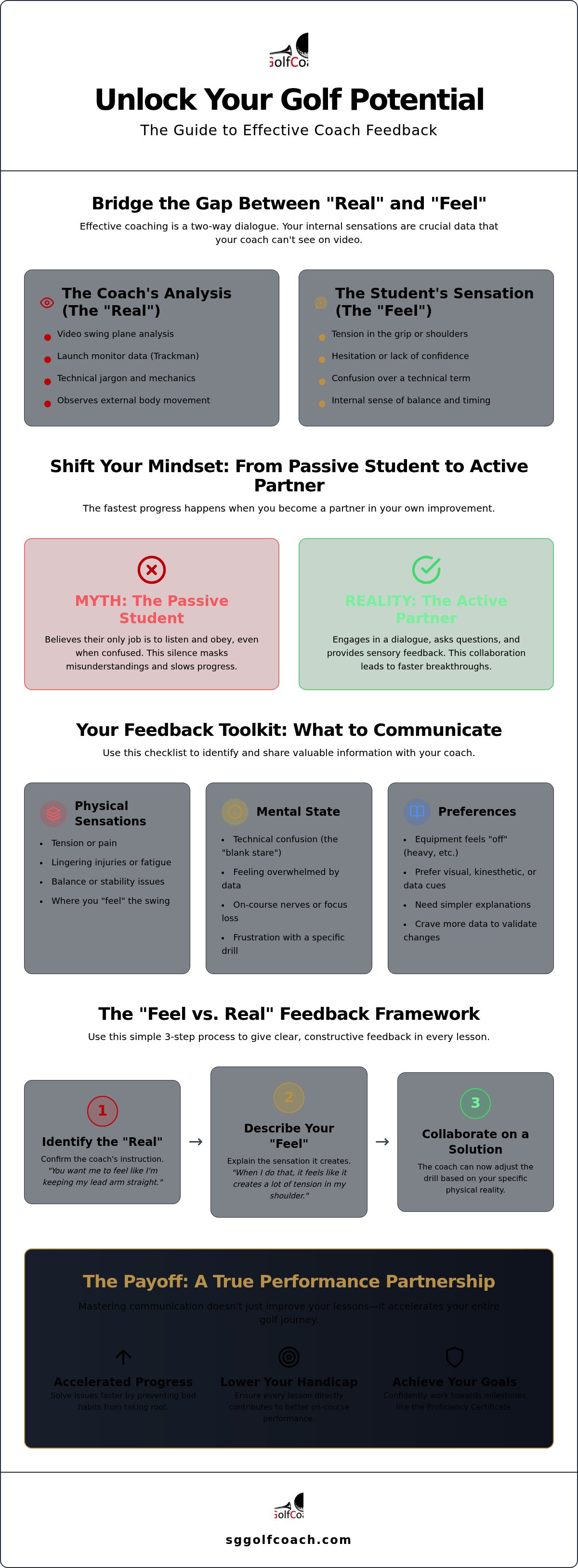
Golf is often perceived as a sport of quiet observation, but the most rapid technical breakthroughs happen in the heat of a conversation. While your instructor has the expert eyes to analyze your swing plane, they cannot feel the tension in your grip or the hesitation in your takeaway. The concept of feedback is rooted in creating a self-regulating system; in golf, this system is the partnership between your sensory experience and your coach's technical knowledge. Understanding how to give your golf coach feedback effectively closes the gap between what is happening on the video screen and what is happening in your mind.
Professional instructors actually prefer active students who engage with the process. When you speak up, you reduce lesson-day anxiety and build the confidence necessary to trust new swing changes. This dialogue isn't just about being social; it's about maximizing the ROI of your instruction fees. By providing clear data on what feels natural and what feels forced, you ensure that every minute on the tee is spent on productive adjustments rather than chasing a "feel" that doesn't resonate with your body.
The Myth of the Passive Student
Many learners believe that "just doing what you're told" is the quickest route to mastery. This passivity often masks hidden technical misunderstandings that can take weeks to surface. There is a profound difference between being a respectful student and being a silent one. A premium mentor views you as a partner in progress, not a vessel to be filled with jargon. Your feedback helps the coach identify whether you learn best through visual cues, data-driven analytics, or physical sensations. Without your input, even the most talented instructor is forced to guess which cues will click for you.
Bespoke Coaching Requires Bespoke Input
True bespoke coaching is a dynamic process, not a static curriculum. This is particularly vital during beginner golf lessons Singapore, where the foundations of your game are being established for the 2026 season. Your input allows for real-time adjustments that prevent bad habits from taking root. Consider the case of a student struggling with a persistent slice. While the camera showed an open clubface, it was the student's feedback about "feeling a pull in the lead shoulder" that allowed the coach to identify a mobility restriction. By adjusting the drill to match the student's physical reality, they solved the slice faster than video analysis alone ever could.
Identifying What to Communicate to Your Golf Coach
Effective communication begins with self-awareness. To master how to give your golf coach feedback, you must first learn to identify the specific signals your body and mind are sending during a session. Not every struggle is a sign of failure; often, it's the signature of growth. However, differentiating between the "good" struggle of ingrained habit-breaking and the "bad" friction of genuine confusion is essential for your progress in 2026.
You should also report physical limitations immediately. Whether it's a lingering shoulder injury or general fatigue after a long work week, these factors dictate what your body can realistically achieve in a session. Similarly, if your equipment feels heavy or "off" during a technical change, don't hesitate to mention it. Your mentor needs this context to decide whether to push through a drill or pivot to a more suitable approach. Reporting on-course nerves or a loss of focus during practice also provides valuable data for your mental game strategy.
Recognizing Technical Friction
Look for the signs of technical friction. If you find yourself giving your coach "the blank stare," it's a clear indicator that the technical jargon isn't translating into a physical move. Instead of nodding along, try to describe the sensation in your own words. Using a framework for constructive feedback involves reporting where you feel tension. If a new grip causes tightness in your forearms rather than a sense of control, that is vital information. Your vocabulary is often more descriptive of your reality than any textbook definition, and sharing it helps your coach refine their instructions.
Learning Style Preferences
Every golfer processes information differently. You might be a visual learner who needs to see a video replay of your swing, or a kinesthetic learner who needs a physical "stop-and-hold" drill to feel the move. If the technical data from a launch monitor feels overwhelming, ask for simpler cues. Conversely, if you crave the precision of Trackman numbers to validate a change, let your coach know. High-quality bespoke coaching relies on this level of personalization to ensure the pace of the lesson matches your natural rhythm and keeps you motivated.
A Practical Framework for Constructive Feedback
While being honest with your instructor is a great first step, vague comments like "it isn't working" often lead to defensive reactions or wasted time. To truly master how to give your golf coach feedback, you need a structured approach that turns your sensations into actionable data. By following a logical framework, you ensure your coach can make precise adjustments to your bespoke program during your 2026 sessions. This methodical approach respects the expertise of your mentor while prioritizing your personal progress.
The process begins well before you step onto the range for your next lesson. Step 1 requires you to observe your ball flight and physical sensations during your solo practice sessions between meetings. If you notice a consistent pattern, such as a push to the right, that becomes your primary data point. In Step 2, use the "Feel vs. Real" comparison to explain your confusion. You might feel like you're rotating fully, but if the results suggest otherwise, identifying this gap helps your coach choose more effective cues.
Once the session begins, Step 3 is about efficiency; state your specific goal for the first 30 minutes of instruction. Finally, Step 4 involves asking for a brief recap before the lesson ends. This ensures you and your mentor are perfectly aligned on the precise movements needed to reach your Proficiency Certificate milestones or handicap goals.
The Observation-Feeling-Goal Method
This method streamlines your communication into three clear components that prevent technical misunderstandings. Start with a concrete Observation: "I noticed my ball flight is consistently pushing right during practice." Follow this with the sensory Feeling: "When I try the new takeaway, it feels like my lead arm is disconnected from my torso." Conclude with a clear Goal: "Can we spend today ensuring my arm position is correct at the top of the swing?" This level of specificity allows your mentor to bypass the guesswork and dive straight into the technical solution that fits your unique swing.
Timing is Everything
Effective feedback isn't just about what you say, but when you say it. Handling difficult conversations or technical roadblocks is much easier when you set the stage early. Use the first five minutes of your session for a pre-lesson briefing to set the day's agenda based on your recent practice. Don't be afraid to provide "in-the-moment" feedback if a drill feels physically uncomfortable; waiting until the end of the hour wastes valuable instructional time. After the session, a brief text or note reflecting on what "clicked" helps your coach refine your future curriculum, ensuring your journey toward golf mastery remains steady and unhurried.
Handling Difficult Conversations and Plateaus
Even the most sophisticated coaching relationships encounter moments of friction or stagnation. When your progress feels like it has stalled, understanding how to give your golf coach feedback becomes your most valuable tool. It's perfectly normal to feel a sense of hesitation when telling an expert that their instructions aren't clicking. However, a premium mentor values your clarity over your compliance. If you're struggling to see the connection between a specific drill and your PC handicap golf Singapore goals, speaking up is the only way to realign your training plan for the 2026 season.
Moving from the controlled environment of the driving range to the complexities of the actual golf course often reveals new challenges. If you find your swing holds up during practice but collapses on the first tee, your coach needs to know. This might signal a need to pivot from technical mechanics to course management or mental game strategies. If you ever feel that your coach’s personality or teaching style isn't quite aligning with your learning preferences, a respectful conversation can often lead to a more productive, bespoke approach that feels personal and unhurried.
Scripts for Common Hurdles
Use these specific scripts to bridge the communication gap without feeling embarrassed or disrespectful:
For technical confusion: "I understand the theory behind this move, but I can't seem to translate it to my hands yet. Can we try a different drill or a different visual cue to help it click?"
For results-based frustration: "I've been diligently practicing the new grip, but my scores aren't moving. What are we missing in the transition from the range to the course?"
For junior parents: "My child seems less excited about their sessions lately. Can we incorporate more game-based learning to keep the experience dynamic and social?"
Navigating the Performance Plateau
Progress in golf is rarely a straight line. Most dedicated players only improve by 1 to 3 strokes per year, and plateaus are a natural part of the learning journey. Learning how to give your golf coach feedback during a plateau is about shifting the focus from frustration to objective data. Utilizing indoor golf Singapore technology allows you and your mentor to look at launch monitor stats and swing metrics. These numbers provide proof of technical improvement even when the scoreboard doesn't reflect it yet, giving you the confidence to stay the course.
If you're ready to experience a partnership that prioritizes your unique growth, explore our bespoke coaching programs today and unlock your full potential on the green.
At SgGolfCoach, we view the instructor-student relationship as a high-end partnership designed for long-term excellence. Our 'Premium Mentor' philosophy moves beyond the traditional model where a coach simply issues directives. Instead, we cultivate a boutique environment where your personal progress is treated with meticulous care, dedication, and precision. By mastering how to give your golf coach feedback, you transform your learning experience from a standard service into a truly bespoke journey that evolves alongside your skill level.
The SgGolfCoach Approach to Dialogue
Our instructors are specifically trained to solicit and value student input as the primary catalyst for technical breakthroughs. This collaborative approach is especially vital in our junior golf program Singapore, where we focus on nurturing both character and skill in the next generation. We view every lesson as a collaborative strategy session rather than a one-sided lecture. Your sensory data, such as what you feel at impact or during your follow-through, combines with our technical expertise to solve mechanical problems in real-time. This ensures that every swing change feels intentional, purposeful, and grounded in your unique physical capabilities.
Your Path to Mastery Starts with a Conversation
Becoming an 'engaged' student is the most efficient way to bridge the gap between your first tentative swing and your first official handicap. When you understand how to give your golf coach feedback, you take full ownership of your athletic growth. This consistent engagement builds a foundation of professional trust that allows for deeper technical adjustments and more sophisticated course management strategies. You aren't just another student on the range; you are a valued member of a vibrant community that celebrates the social, personal, and transformative aspects of the sport.
Your path to golf mastery doesn't have to be a solitary or confusing struggle. It begins with a simple, unhurried conversation between you and your mentor. By choosing to be active in your development, you unlock a level of customization that generic programs simply cannot provide. Book your next bespoke coaching session with SgGolfCoach today and discover how a dedicated partnership can accelerate your journey to the green in 2026.
Master Your Progress Through Partnership
Achieving golf mastery is a collaborative journey that relies on the strength of your communication as much as the precision of your swing. By understanding how to give your golf coach feedback, you transform every lesson into a high-performance strategy session tailored to your unique learning style. We've explored how identifying technical friction and using structured frameworks can bypass frustration and lead to faster breakthroughs on the green. Whether you are navigating a performance plateau or just starting your journey in 2026, your sensory data is the key to unlocking bespoke results.
At SgGolfCoach, we are dedicated to acting as your premium mentor through every stage of your development. Our team provides professional instruction tailored for all levels, offering bespoke programs for adults and juniors alike. From your first drive to expert guidance for PC and handicap registration, we ensure your path is clear and rewarding. Elevate your game with bespoke golf coaching from SgGolfCoach and experience the difference of a truly personalized partnership. Your best golf is waiting, and it starts with a simple conversation.
Frequently Asked Questions
Is it rude to tell my golf coach that their advice isn't working for me?
It is never rude to express that a specific instruction isn't yielding the expected results. Professional instructors actually view this as vital data for refining your training plan. Openly discussing what isn't working allows your mentor to pivot to a different drill or cue that resonates better with your natural swing. This level of honesty is the foundation of a high-end coaching partnership and ensures your sessions remain productive rather than frustrating.
How often should I provide feedback to my golf instructor?
You should provide feedback during every session to ensure real-time technical adjustments. A brief pre-lesson briefing about your practice results and an in-the-moment report on how a new move feels are both highly effective. Regular communication ensures your bespoke program stays aligned with your progress. By learning how to give your golf coach feedback consistently, you prevent minor technical misunderstandings from becoming ingrained habits that hinder your long-term mastery in 2026.
What if I don't know the technical terms to explain what I'm feeling?
You don't need technical jargon to communicate effectively with your mentor. Describing sensations in your own words, such as "tightness in the lead shoulder" or "a heavy feeling in the clubhead," is often more useful to a coach than textbook terms. A premium mentor is trained to translate your personal vocabulary into technical solutions. Focus on the "feel" of the move, as this sensory data provides the most accurate roadmap for bespoke adjustments.
Should I give my coach feedback during the lesson or wait until after?
Providing feedback during the lesson is the most efficient way to maximize your instructional time. If a drill feels physically uncomfortable or conceptually confusing, waiting until the end of the hour wastes valuable opportunities for correction. Immediate input allows your coach to make real-time refinements to your swing mechanics. While a post-lesson reflection is helpful for long-term planning, in-the-moment dialogue is the primary catalyst for immediate technical breakthroughs and faster improvement.
How do I know if my lack of progress is my fault or the coach's fault?
Lack of progress is rarely about "fault" and usually indicates a breakdown in the feedback loop. If you're practicing diligently but not seeing results, it's possible that the instructions aren't translating into your physical execution. Review your practice habits and ensure you're providing enough data to your coach. A collaborative review of your goals can help determine if the current approach needs a bespoke adjustment to better suit your unique learning style.
What should I do if my coach seems defensive when I give feedback?
If a coach becomes defensive, try reframing your feedback using "I" statements, such as "I feel disconnected during this move" rather than "This drill isn't working." This keeps the focus on your personal experience rather than their professional expertise. A true premium mentor should welcome dialogue and view it as a tool for success. If the defensiveness persists, it may be a sign that their coaching style is not the right fit for your journey.
How can I give feedback on my child's junior golf lessons?
Providing feedback on junior lessons should focus on your child's engagement and enjoyment levels. If they seem less excited or are struggling with a specific concept, share these observations with the instructor. Our junior programs prioritize character and skill development, so your input on their motivation is invaluable. Discussing how to give your golf coach feedback regarding a child's progress ensures the curriculum remains dynamic and social, fostering a lifelong love for the sport.
Can I request a change in coaching style midway through a lesson package?
You can absolutely request a change in coaching style at any point during your package. Bespoke programs are designed to be dynamic, meaning they should evolve as your technical needs change. If you find you need more visual data or fewer technical cues to succeed in 2026, simply initiate a conversation with your mentor. A professional instructor will appreciate the clarity and will adjust their delivery to ensure you remain on the fastest path to mastery.


Comments