

Golf Course Management Tips: The 2026 Guide to Lowering Your Score Without Changing Your Swing
- sggolfcoach

- Jul 31
- 13 min read
Updated: Aug 13
Most golfers believe that a lower score requires a complete swing overhaul, yet the most direct path to mastery often lies in the decisions you make before the club even leaves the turf. It's incredibly frustrating to strike the ball well only to find yourself staring down a double bogey because you chose the wrong target or the wrong club. You've likely felt that sting of a "blow-up" hole ruining a promising round, leaving you wondering why your best shots often end up in the worst places.
We understand that the journey to breaking 90 or 100 for the first time is as much about mental discipline as it is about physical talent. This 2026 guide reveals the strategic framework professionals use to navigate the course with precision, offering you the golf course management tips needed to lower your score without changing a single mechanic. We'll explore how to eliminate indecision, avoid high-risk hazards, and build a bespoke strategy that turns your current skills into a consistent, scorecard-improving machine. From understanding the latest 2026 local rule updates to mastering club selection, you're about to transform your approach to the game.
Table of Contents
The Strategic Edge: Why Golf Course Management Tips Matter More Than Your Swing
Mapping the Mission: The 'Green-to-Tee' Strategy for Consistent Scoring
Risk vs. Reward: Navigating Hazards and Knowing When to 'Take Your Medicine'
The Mathematical Advantage: Club Selection and Short Game Decision-Making
Elevating Your Game: Mastering Strategy with Bespoke Coaching
The Strategic Edge: Why Golf Course Management Tips Matter More Than Your Swing
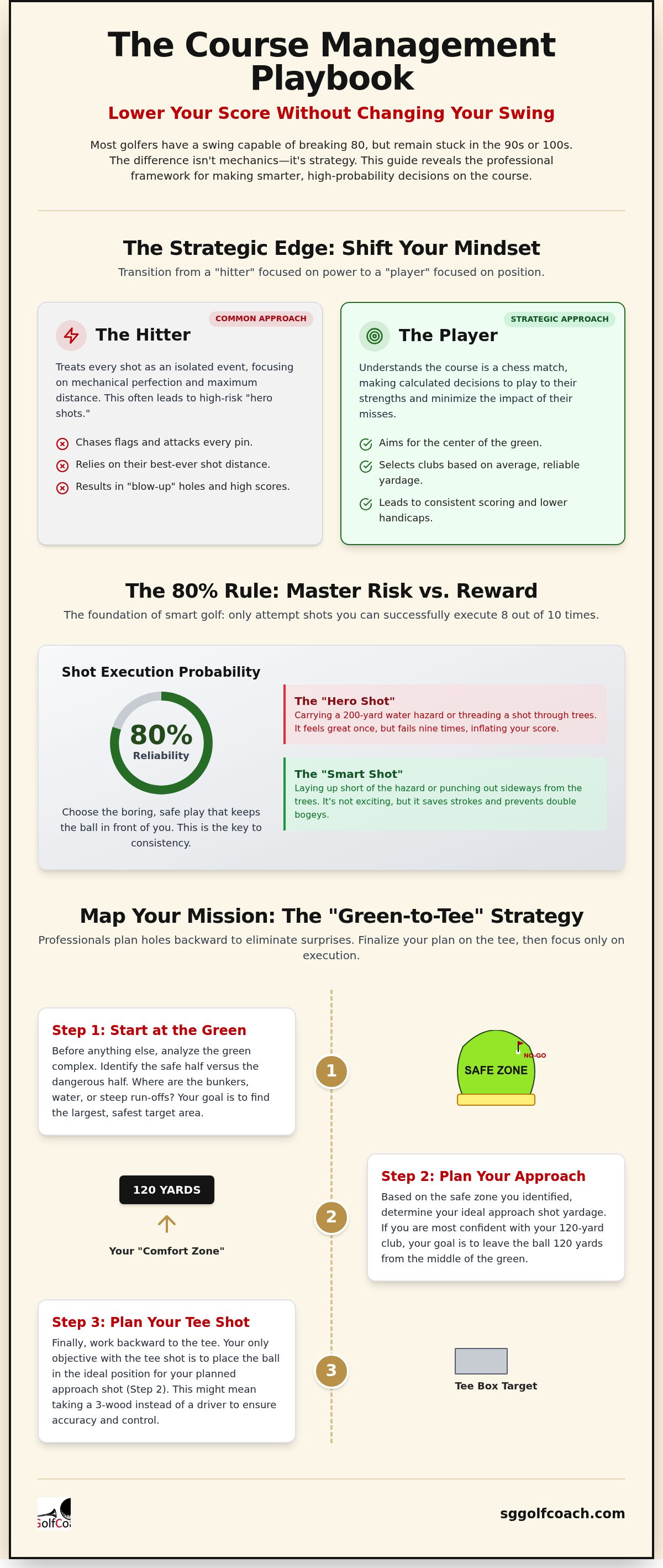
Course management is the refined art of making high-probability decisions based on your current skill level rather than your aspirations. Many golfers possess a swing capable of breaking 80, yet they remain stuck in the triple digits because they lack a coherent plan. They treat every shot as an isolated event rather than a single move in a larger, calculated game of chess. Understanding golf course management tips allows you to bridge the gap between your potential and your actual scorecard by playing to your strengths and neutralizing your misses.
This discrepancy is often seen in the "Range vs. Course" paradox. On the practice tee, you have no consequences, no hazards, and a flat lie every time. On the course, every shot carries weight. Without a strategic framework, the pressure of the environment forces you into poor decision-making. In 2026, the most successful recreational golfers are those who prioritize mental strokes over mechanical adjustments. They recognize that a smarter choice on the tee box is worth more than five hours of technical swing practice. This strategic shift is particularly vital for those navigating the PC handicap golf Singapore journey, where demonstrating consistent, controlled play is the key to securing your national handicap.
The Psychology of the 'Hero Shot'
Our brains are naturally wired to crave the "Hero Shot." There is a significant dopamine rush associated with carrying a 200-yard water hazard or threading a ball through a narrow gap in the trees. However, this is a dangerous trap. One successful miracle shot often lures a golfer into attempting ten more that result in lost balls and inflated scores. Transitioning from a "hitter" to a "player" means valuing the boring, safe play that keeps the ball in front of you. It's about choosing the shot you can execute eight out of ten times, rather than the one that only works once in a blue moon.
Lowering Scores Without Swing Changes
The mathematics of a double bogey are simple: they are almost always the result of a bad decision compounded by a physical error. If you find yourself "pin-seeking" on every hole, you are inviting disaster. By shifting your focus to Green in Regulation (GIR) percentages, you provide yourself with a much larger margin for error. Aiming for the fat of the green ensures that even a slight mis-hit leaves you with a putt rather than a delicate flop shot over a bunker. Course management is the essential software that runs the hardware of your physical swing. By upgrading your mental approach, you can discover Golf State of Mind and its system for calm confidence to see immediate results in your scoring average without ever stepping foot on a lesson tee for a mechanical fix.
Identify your "miss" and aim accordingly.
Prioritize the center of the green over the flagstick.
Accept a bogey to avoid a double or triple.
Mapping the Mission: The 'Green-to-Tee' Strategy for Consistent Scoring
Most golfers make their most significant errors before they even pull a club from the bag. While the average player stands on the tee box and looks forward, the professional begins at the hole and works backward. Effective golf course management tips often center on reversing your perspective to eliminate surprises. By the time you reach the tee, your plan should already be finalized, leaving your mind clear to focus on execution. This backward-mapping technique is particularly useful for those navigating golf handicap registration Singapore, as it builds the consistency required for official scoring and handicap maintenance.
The goal is to identify your "comfort zone" yardage and the "no-go" zones where a single mistake leads to a double bogey. When you visualize the hole from the cup back to the tee, you remove the temptation to hit the ball as far as possible without a purpose. Instead, you create a series of manageable targets that play to your strengths. If you find yourself struggling to visualize these paths, bespoke coaching can provide the personalized insights needed to map your game to any course layout.
Step 1: Identify the Safe Half of the Green
Precision begins by dividing the green into four quadrants and identifying which areas are guarded by bunkers or water. Ignore the pin entirely. For most amateurs, the "Center-Green" rule is the most effective way to lower scores instantly. Aiming for the widest part of the putting surface provides a margin for error that accounts for a slight push or pull. You must also consider the slope and grain; an entry point that leaves an uphill putt is far superior to a closer shot that results in a terrifying downhill slider.
Step 2: Choose Your Approach Yardage
Every golfer has a "favorite" club that feels automatic. Perhaps you're more confident with a full 9-iron than a delicate half-wedge from 40 yards. Working backward allows you to choose a lay-up point that leaves you with that preferred full-swing distance. Use a rangefinder or GPS to map these specific points on the fairway. Leaving a full shot often produces better spin and control, reducing the likelihood of the "thinned" or "chunked" wedge shots that plague high-handicappers.
Step 3: Selecting the Tee Club
The tee shot is not an opportunity to showcase power; it is a tactical move to enable your next shot. If a narrow fairway or a hidden hazard makes the driver a high-risk choice, the 3-wood or a hybrid becomes the superior weapon. Aim for the "fat" part of the fairway where the landing area is widest. Remember, the primary objective of any tee shot is simply to ensure your ball is in a position where you can reach the green on your next swing.
Identify the most dangerous hazard near the green and stay away from that quadrant.
Select a target on the fairway that provides the best angle for your approach.
Choose the club that guarantees the ball stays in play, even if it's not the longest one in your bag.
Risk vs. Reward: Navigating Hazards and Knowing When to 'Take Your Medicine'
The essence of effective golf course management tips isn't found in being fearless; it's found in being calculated. Professionals don't simply hit the ball and hope for the best. They operate under a disciplined "Penalty Avoidance Protocol." This framework recognizes that water hazards and out-of-bounds (OB) markers are non-negotiable boundaries that demand respect. Before you commit to a shot, apply the 80% Rule. Ask yourself if you can execute the required ball flight eight out of ten times. If you can't answer with a confident yes, the risk is statistically too high to justify the potential reward.
Adopting a "Boring Golf" philosophy is often the fastest way to shave strokes off your scorecard. For many, a par is an exceptional result, and a bogey is a perfectly acceptable outcome that keeps a round on track. The real damage to a handicap occurs when a single mistake leads to a "blow-up" hole. Learning to manage your expectations and ego is crucial, especially when you start playing golf Singapore courses for the first time. The natural nerves of a debut or a competitive round can cloud your judgment, making the safe play your most valuable asset for maintaining composure.
When to 'Take Your Medicine'
Accepting a poor lie or a blocked shot is a sign of strategic maturity, not weakness. The "One Shot, One Penalty" rule dictates that you should never follow a physical error with a mental one. If your ball finds the trees, your only priority is to return it to the fairway using a low-lofted club. Don't attempt to thread the needle through a narrow gap for a miracle recovery. Take your medicine, accept the bogey, and move to the next tee. A 5 on the scorecard is a minor setback; a 7 or 8 is a round-killer that is entirely avoidable.
Navigating Bunkers and Water
Visualizing "Buffer Zones" around hazards helps you select targets that prioritize safety. If water runs down the left side of a hole, aim for the right rough if that's what it takes to stay dry. It's always better to be chipping from the grass than dropping a ball under a penalty. When facing a water carry, always club up. Most recreational players only reach the front of the green with their best strike, so taking an extra club ensures you clear the trouble even on a mediocre hit. This disciplined approach ensures hazards remain part of the scenery rather than part of your score.
Never follow a bad shot with a stupid shot.
Aim for the "safe side" of every dogleg to open up the green.
Prioritize staying in play over gaining extra yardage.
The Mathematical Advantage: Club Selection and Short Game Decision-Making
Success on the scorecard is often a game of averages rather than a pursuit of peak performance. One of the most common errors recreational players make is falling into the "Max Yardage" trap. They select a club based on the one perfect strike they hit months ago rather than their 70% strike. To apply effective golf course management tips, you must play for your typical yardage. If you know your 7-iron carries 150 yards when struck perfectly but usually lands at 140, you should play it as a 140-yard club every time. This shift in mindset ensures that even your mediocre shots find the putting surface.
Your driving range yardages are often misleading because they don't account for the variables of a live round. Range balls are frequently limited-flight, and the lack of consequence on the mat creates a false sense of distance. Mastering your real-world numbers is a critical step for those researching how to get golf handicap Singapore credentials, as official testing requires a level of consistency that only comes from knowing your true distances. By playing to your "stock" yardage, you eliminate the guesswork that leads to costly errors.
The 'Club Up' Philosophy
Amateurs under-club on nearly 90% of their approach shots. Being "long" is rarely as dangerous as being "short," as course designers typically place the most punishing hazards in front of the green to catch mishits. In 2026, Singapore's high humidity levels can also subtly heavy the air, making the ball travel less distance than you might expect on a dry day. We recommend creating a "Stock Yardage" card for your bag that lists your carry distances in ten-yard increments. This simple tool provides the confidence to take an extra club and swing smoothly rather than trying to "force" a shorter club to reach the target.
Short Game: The 'Texas Wedge' and Beyond
The hierarchy of the short game is simple: putt whenever possible, chip when you can't putt, and only pitch if you have no other choice. The "Texas Wedge" (putting from off the green) is the highest percentage play because it removes the risk of a "chunked" or "thinned" wedge shot. Statistical data consistently shows that a poorly struck putt by a beginner will almost always finish closer to the hole than a poorly struck chip. While the flop shot looks impressive on television, the bump-and-run with a 7-iron or 8-iron offers a much larger margin for error and a higher probability of a one-putt finish.
To dial in your specific numbers with precision and master these strategic choices, our bespoke coaching sessions utilize premium indoor simulators to map your real-world yardages in a controlled, data-driven environment.
Club for your 70% strike, not your 100% strike.
Prioritize the putter from the fringe to eliminate high-risk wedge errors.
Account for environmental factors like humidity and wind before selecting your club.
Elevating Your Game: Mastering Strategy with Bespoke Coaching
While self-study provides a solid foundation, bespoke coaching is the most efficient path to uncovering the hidden strategic flaws that inflate your score. It's often difficult to see your own patterns when you're in the heat of a round, especially when emotions and adrenaline are involved. A professional mentor acts as an external eye, identifying exactly where your decision-making deviates from high-probability golf. SgGolfCoach bridges the gap between your technical swing mechanics and tactical play, ensuring that every movement you've refined on the range has a purposeful, score-lowering application on the course.
This personalized approach is particularly vital for players moving through the Proficiency Certificate process. It isn't enough to simply hit the ball; you must understand how to navigate the specific challenges of Singapore's premier layouts. By translating raw range data into on-course performance, you'll find that your "good" rounds become more frequent and your "bad" rounds become significantly more manageable. Mastering these golf course management tips with a professional ensures that you aren't just practicing, but practicing with a clear, strategic objective.
The Power of On-Course Lessons
On-course lessons offer a rare opportunity to watch a professional "think" through a hole in real-time. It isn't just about where to hit the ball; it's about understanding why a specific target is chosen over another based on the day's conditions. During these sessions, you'll learn to identify your "Personal Par" for every hole. If a long par 4 consistently leads to a double bogey, redefining it as a par 5 in your mind can remove the pressure to hit a high-risk approach. We also customize your strategy based on your unique shot shape. If you naturally play a fade, your aiming points must be structurally different from a player who draws the ball, and a coach helps you map those lines with precision.
Simulators as a Strategic Laboratory
Indoor simulators serve as a sophisticated laboratory where you can test "What-If" scenarios without the penalty of a lost ball or a ruined scorecard. By using screen golf to play world-class courses, you can practice complex decision-making in a controlled, data-rich environment. These systems allow us to analyze your "dispersion patterns," which is the statistical cluster of where your shots actually land over time. Knowing your dispersion helps you choose better aiming points; if your miss is consistently ten yards right, you'll learn exactly how far left you need to aim to keep the ball on the green. This turns abstract theory into a concrete, personalized blueprint for your game.
Ready to lower your scores? Book a bespoke coaching session with SgGolfCoach today.
Gain real-time feedback on your decision-making process during on-course play.
Use data-driven simulators to understand your true shot dispersion and miss-patterns.
Develop a "Personal Par" strategy to eliminate the pressure of difficult holes.
Master the Mental Game for Lasting Success
Lowering your scores in 2026 doesn't require a radical swing change; it requires a radical shift in how you navigate the course. By adopting a "green-to-tee" perspective and respecting your true yardage averages, you eliminate the high-risk errors that derail a promising round. These golf course management tips are the foundation of a resilient game that performs under pressure, whether you're chasing your first handicap or looking to break into the single digits. Playing smarter is the fastest way to see the results your hard work deserves.
At SgGolfCoach, we specialize in turning these strategic concepts into instinctive habits. Our expert mentors provide bespoke coaching tailored specifically to your PC and handicap goals, ensuring your technical progress is always matched by tactical maturity. You can even test these strategies in our high-tech indoor simulators, allowing you to refine your decision-making in a risk-free environment before heading out to the first tee. We view ourselves as your partner in progress, guiding you toward mastery with precision and care.
Refine your strategy with a professional SgGolfCoach instructor and discover how much faster you can reach your potential when you play the game with a professional's clarity. Your best round is already within your reach, and it's time to start playing the golf you're truly capable of.
Frequently Asked Questions
What is the single best golf course management tip for beginners?
The most effective strategy for any beginner is to prioritize the center of the green over the flagstick. Most novices lose strokes by attempting to "pin-seek" near dangerous hazards, which frequently leads to bunkers or lost balls. By aiming for the widest part of the putting surface, you provide yourself a generous margin for error. This simple adjustment ensures that even a slightly off-center strike keeps you in a position to two-putt for a respectable score.
How do I calculate my 'average' yardage for club selection?
To find your true average, track the carry distance of ten shots with a specific club on a simulator or during a practice round. Discard your absolute best and worst strikes, then average the remaining eight. This realistic number represents your "stock" yardage rather than your maximum potential. Relying on this data allows you to select clubs with confidence, ensuring you reach the target even when your contact isn't perfect.
Should I always aim for the center of the green?
While aggressive players enjoy hunting pins, aiming for the center of the green remains the statistically superior choice for recreational golfers. This strategy minimizes the impact of a push or pull, keeping the ball on the grass and away from short-side bunkers. Unless you're holding a wedge and have a clear, safe line, the "center-green" rule is the most reliable way to maintain consistency and avoid high scores.
When should I use a driver instead of a 3-wood or hybrid off the tee?
You should choose a 3-wood or hybrid when the landing area for your driver is narrow or guarded by hazards that are statistically likely to catch your ball. The primary goal of a tee shot is to put the ball in play for the next shot. If a shorter club offers a higher chance of hitting the fairway, the sacrifice in distance is nearly always worth the improved angle and lie for your approach.
How does course management help in getting a Proficiency Certificate (PC)?
Course management is essential for the PC process because it demonstrates your ability to navigate a layout safely and efficiently. Examiners look for golfers who show control and avoid dangerous situations that slow down play or risk safety. Applying these golf course management tips helps you stay calm during your assessment, proving you have the tactical maturity to handle a live course without needing a tour-level swing.
Can I practice course management on a driving range or simulator?
Yes, you can practice strategic thinking by "playing" specific holes from your local course while on the range. Visualize the fairways and hazards for each shot. However, premium indoor simulators offer the best environment for this practice. They allow you to test specific "What-If" scenarios and analyze your dispersion patterns without the physical penalty of a lost ball, making them a perfect laboratory for refining your decision-making.
What is the '80% rule' in golf strategy?
The 80% rule states that you should only attempt a shot if you're confident you can execute it successfully eight out of ten times. This framework forces you to evaluate the risk of "hero shots" versus the reliability of a safe lay-up. By sticking to this discipline, you eliminate the low-probability gambles that usually result in penalty strokes, ensuring your scorecard reflects your actual skill level rather than your luck.
How do I avoid 'blow-up holes' during a round?
Avoiding "blow-up" holes requires a commitment to "taking your medicine" the moment you find trouble. Most double bogeys or worse happen when a golfer follows a physical mistake with a high-risk recovery attempt. By choosing the safest path back to the fairway after a poor shot, you limit the damage to a single bogey. Implementing consistent golf course management tips ensures that one bad swing doesn't turn into a catastrophic score.


Comments