

Common Golf Swing Mistakes Beginners Make: 5 Myths Sabotaging Your Game in 2026
- sggolfcoach

- Aug 2
- 12 min read
Updated: Aug 13
Trying to keep your head perfectly still or "muscling" the ball might feel like the logical way to gain control, but these instincts are often the very things keeping your handicap high. Most new golfers feel the sting of a "duffed" shot or the persistent frustration of a slice that refuses to straighten out, especially when conflicting online tutorials only add to the confusion. It's exhausting to leave the driving range with more physical tension than when you arrived. By understanding the common golf swing mistakes beginners make, you can stop fighting your own body and start working with the physics of the club.
We'll strip away the noise to help you identify the counter-intuitive myths that are currently sabotaging your progress. You'll gain a clear understanding of basic swing mechanics and learn how to build a professional-grade foundation that replaces soreness with fluid power. This guide previews the essential shifts needed to reduce those inconsistent strikes, giving you the confidence to step onto any course with a swing that feels as sophisticated as it looks. Let's transform your approach from a struggle of strength into a journey of precision and mastery.
Table of Contents
Why the Golf Swing Feels Counter-Intuitive for Most Beginners
Golf is a game of contradictions. Most newcomers arrive at the driving range with a lifetime of athletic reflexes that, unfortunately, don't translate to the tee box. When you try to "help" the ball into the air or use your arms to generate power, you're falling into a hidden trap. These natural impulses are the primary drivers behind the common golf swing mistakes beginners make during their first few months of play. We call this the "Beginner's Paradox," which is a cycle where increased effort leads to decreased results, often leaving the player frustrated and physically sore.
In 2026, the educational journey for new golfers has changed. Serious students are moving away from the "hit and hope" method, opting instead for professional instruction that utilizes indoor simulators to reveal what the naked eye misses. This data-driven approach allows you to build a foundation of excellence before bad habits become permanent fixtures in your game. Investing in bespoke coaching early on isn't just about technical skill; it's about protecting your long-term enjoyment of the sport by ensuring your progress is steady and measurable.
The Difference Between a 'Hit' and a 'Swing'
The urge to "hit at" the ball is a difficult reflex to break. When you focus on the impact alone, your swing often becomes jerky and loses its natural fluidity. Professional golfers don't think about the ball as the final destination; they view it as a point of transit within a larger, graceful arc. The swing arc is a continuous, circular motion that happens to intersect with the ball's position rather than a series of rigid, disconnected poses. By shifting your focus toward a balanced finish, you allow the club's design to do the heavy lifting for you.
Why 'YouTube University' Can Delay Your Progress
While the internet offers endless tips, it lacks the context of your specific physical needs. New players in Singapore often find themselves overwhelmed by conflicting advice, leading to a "Frankenstein swing" that feels disjointed and unreliable. This lack of a unified philosophy is why many common golf swing mistakes beginners make become so difficult to correct. Relying on a singular, expert mentor provides the clarity and consistency required to turn a series of movements into a cohesive, high-performance skill that lasts a lifetime.
Debunking the Top 5 Beginner Golf Swing Myths
Success in golf often requires doing the exact opposite of what your brain suggests. With over 3 million new players joining the sport annually since 2020, many find themselves battling the same common golf swing mistakes beginners make when starting out. These errors stem from "logical" impulses that actually defy the physics of the game. By identifying these myths early, you can avoid the frustration of plateauing and instead build a swing that feels effortless and powerful. Let’s dismantle the five most pervasive misconceptions that are likely holding your game back in 2026.
Myth 1: The 'Lifting' Instinct vs. Compression
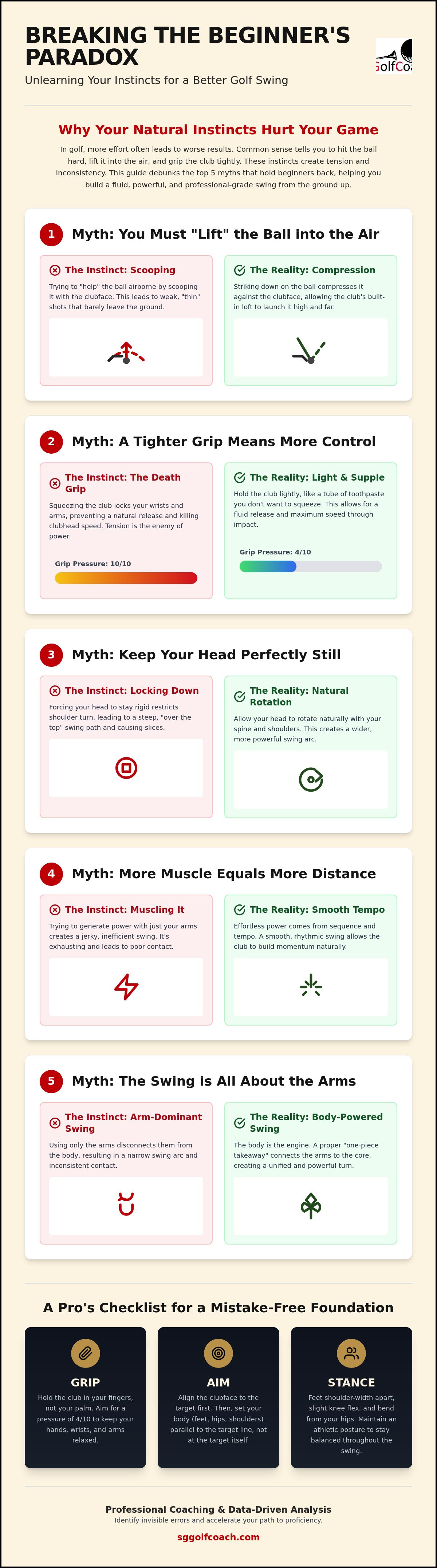
New golfers often feel they must "help" the ball into the air, leading to a scooping motion at impact. This instinct is counter-productive because golf clubs are designed to strike the ball with a descending blow. This downward strike creates "compression," where the ball is squeezed against the clubface and the ground, allowing the built-in loft to launch it high and far. Attempting to lift the ball usually results in "thin" shots that skitter across the grass. During beginner golf lessons Singapore, instructors use indoor simulator technology to show you how hitting "down" is actually the secret to getting the ball "up."
Myth 2: The 'Death Grip' vs. Fluidity
While it seems like a tighter grip would offer more control, the opposite is true. Excessive tension in your hands travels up your arms and into your shoulders, locking your joints and preventing a natural hinge. Think of your grip pressure like holding a tube of toothpaste; you want to be firm enough to keep the club from flying out of your hands, but light enough that you don't squeeze any paste out. A soft, supple grip allows for a fluid "release" of the clubhead through the impact zone, which is where true speed is generated. This transition from tension to fluidity is a key focus in our bespoke coaching sessions, helping you find that premium feel of a professional strike.
The remaining myths are just as damaging to your progress. Many players believe a "perfectly straight" lead arm is the key to power, yet over-stiffening the elbow only creates rigidness that destroys tempo. Similarly, trying to keep your head "perfectly still" can actually block your body's natural rotation, leading to a restricted and painful swing. Finally, don't fall for the trap of swinging as hard as you can. Distance is a byproduct of center-face contact and efficient mechanics, not brute strength. Focusing on these corrections will drastically reduce the common golf swing mistakes beginners struggle with most.
The Ripple Effect: How Setup Mistakes Ruin the Entire Swing
Many golfers believe the swing begins the moment the clubhead leaves the turf, but in reality, your success is largely decided before you even move. A flawed setup acts as a catalyst for a chain reaction of compensations, forcing your body to make athletic "saves" just to make contact. This is the underlying cause of many common golf swing mistakes beginners face; they try to fix a mid-swing error that actually started with their feet, hips, or shoulders at address. By refining your static position, you remove the physical ceilings that prevent a fluid, professional-grade motion.
Transitioning from a static stance to a dynamic swing requires a foundation that supports rotation. If your body is out of alignment or your center of gravity is off, your brain will instinctively prioritize "not falling over" over "hitting the ball." This leads to the jerky, inconsistent strikes that plague newcomers. In our bespoke coaching sessions, we use indoor simulators to highlight these invisible setup flaws, ensuring your blueprint for success is flawless before you ever take a full rip at the ball.
Posture: The Foundation of Athletic Motion
Finding a neutral spine is the first step toward a repeatable swing. Many beginners fall into "C-Posture," where the shoulders slump forward, or "S-Posture," where the lower back arches excessively. Both positions restrict your ability to turn and often lead to lower back soreness after a session at the range. To address this, many golfers use functional training programs like those offered by Diamond Fitness to develop the core stability required for a proper hip hinge, which allows your arms to hang naturally and creates the space needed for the club to travel on the correct path. Balance at address dictates balance at impact.
Grip and Alignment: The Only Links to the Target
Your grip is your only physical connection to the club, making it the most critical component of your setup. A neutral grip, where the "Vs" formed by your thumbs and forefingers point toward your trailing shoulder, is the gold standard for consistent ball striking. Alignment is equally vital, yet it remains a silent killer of accuracy on Singapore's driving ranges. Most beginners aim their feet too far to the right of the target, which subconsciously forces an "over the top" swing path to pull the ball back on line. This is the classic recipe for a slice.
Use Alignment Sticks: Lay a club or stick along your feet and another parallel to your target line to calibrate your internal compass during solo practice.
Check Ball Position: Placing the ball too far forward can encourage a pull, while too far back often leads to a "pushed" shot or a heavy strike.
Verify Shoulder Alignment: Ensure your shoulders are parallel to your footline, as "open" shoulders are a primary cause of the dreaded slice.
Correcting these setup elements doesn't require extra strength or flexibility; it simply requires meticulous attention to detail. When you master the art of the address, the rest of the swing often falls into place with surprising ease. This precision is what separates a frustrating afternoon from a rewarding journey toward mastery.
A Pro’s Checklist for Building a Mistake-Free Foundation
Precision is the hallmark of a great golfer. Reducing the common golf swing mistakes beginners encounter requires more than just high-volume practice; it demands a structured approach to every session. With a record 3 million new players joining the sport annually since 2020, the difference between those who improve and those who plateau often comes down to their practice habits. By establishing a methodical pre-shot routine, you ensure that every swing begins from a place of stability and intent, rather than a frantic scramble to find your balance.
To build a swing that stands up under pressure, follow this four-step checklist before every strike:
The GAS Routine: Always check your Grip, Aim, and Stance in that specific order. This ritual creates a mental "reset" that prevents old habits from creeping back in.
70% Tempo: Most beginners swing at 100% effort, which leads to a loss of balance and poor contact. Aim for 70% power to prioritize hitting the center of the face, which actually produces more distance through efficiency.
Practice with Purpose: Never "rake and hit" balls rapidly. Take a full practice swing between every shot to feel the correct movement, treating the driving range like a laboratory rather than a gym.
Objective Feedback: Use a tripod to record your swing or visit a facility with launch monitor technology. What you "feel" you are doing is rarely what is actually happening on camera.
The One-Piece Takeaway Drill
One of the most effective ways to stabilize your motion is to master the one-piece takeaway. This move involves using the "triangle" formed by your shoulders and arms to move the club back, rather than using your wrists to lift it immediately. By keeping the clubhead "outside your hands" during the first two feet of the swing, you prevent the club from getting stuck behind your body. This simple drill builds a wide, powerful arc and eliminates the "inside takeaway" that causes so many inconsistent strikes.
Leveraging Technology: The Indoor Simulator Advantage
Modern indoor golf Singapore facilities offer a significant edge by providing instant, data-driven feedback on your club path and face angle. In a controlled environment, you can ignore the ball flight and focus entirely on the mechanics of your motion. This objective data helps bridge the gap between "feel" and "real," allowing you to see exactly where your path deviates from the ideal. Seeing a 3D replay of your swing makes it much easier to identify and correct the common golf swing mistakes beginners often miss with the naked eye.
If you're ready to bypass years of trial and error, our bespoke coaching provides the personalized roadmap you need to turn these drills into a permanent, professional-grade swing.
Elevating Your Game with Professional Coaching
While understanding the technicalities of the swing is vital, the most efficient path to mastery is through the guidance of a Premium Mentor. Identifying the common golf swing mistakes beginners make is only half the battle; the other half is having an expert eye to ensure your body actually performs what your mind understands. At SgGolfCoach, we view our students as partners in a transformative journey, offering a boutique experience that prioritizes your long-term success over quick, temporary fixes. This bespoke approach ensures that your dedication at the range translates into tangible results on the scorecard.
The modern professional in Singapore values efficiency and precision. We don't just provide generic tips; we build a tailored curriculum that fits your unique physiology, goals, and schedule. This investment in professional instruction protects you from the frustration of "ingrained" bad habits that can take years to unlearn if left unchecked. By utilizing our indoor simulator facilities, we make the invisible visible, allowing you to perfect your technique in a high-end, data-driven environment.
Bespoke Coaching vs. Generic Group Classes
Group classes offer a social entry point, but they often lack the diagnostic depth required to fix persistent, individual issues. One-on-one attention allows for the immediate correction of subtle errors in your grip or path before they become permanent muscle memory. By focusing on adult golf lessons Singapore, you receive personalized drills that turn your specific weaknesses into strengths. This level of customization ensures that every minute you spend practicing is an investment in your future performance.
Setting Milestones: From First Swing to First Handicap
Success in golf is best measured through clear, achievable milestones. For many, the first significant goal is obtaining the PC handicap golf Singapore golfers need to access local courses. This Proficiency Certificate is your passport to the sport's social and networking benefits, opening doors to high-level corporate outings and community events. Beyond the technical skill, becoming a competent golfer builds a sense of poise and confidence that extends far beyond the fairway.
Golf is truly the game of a lifetime. Starting with a professional foundation doesn't just make you a better player; it makes the entire journey more enjoyable. Every session becomes an opportunity for growth rather than a battle against your own instincts. Let us help you navigate the common golf swing mistakes beginners often face, turning your potential into professional-grade mastery that lasts for decades to come.
Master Your Swing with Precision and Purpose
Transforming your game begins with unlearning the intuitive but incorrect habits that lead to the most common golf swing mistakes beginners struggle with every day. We've explored how a meticulous setup dictates your success before the club even moves; we've also seen why shifting your mindset from "hitting" to "swinging" is the secret to fluid power. By replacing conflicting online advice with a singular, expert voice, you protect your progress and ensure your time at the range is spent building a foundation of excellence rather than reinforcing bad habits.
Our premium indoor simulator facilities and structured path to a PC and Handicap provide the data-driven clarity needed to see your game in a new light. Whether you're a junior starting out or a busy professional looking to master the sport's social benefits, specialized instruction offers a bespoke roadmap to mastery. Book Your Bespoke Beginner Assessment with SgGolfCoach Today and take the first step toward a lifetime of confident, consistent ball striking. The course is waiting for you.
Frequently Asked Questions
What is the most common golf swing mistake for beginners?
The most common golf swing mistakes beginners make often involve the "lifting" instinct, where players try to scoop the ball into the air. This move actually prevents the club's loft from working correctly. Instead, you should aim for a descending blow that compresses the ball against the turf, allowing physics to create the necessary launch and spin for a successful shot.
How can I stop slicing the ball as a beginner?
Slicing is typically caused by an "out-to-in" swing path and an open clubface at impact. To correct this, focus on your alignment at address, ensuring your shoulders and feet are parallel to your target line. Many new players aim too far right, which subconsciously forces an "over-the-top" move that cuts across the ball, resulting in that dreaded curve to the right.
Should I learn golf on my own or take professional lessons?
While self-teaching via online videos is popular, professional lessons provide the personalized feedback necessary to prevent ingrained bad habits. A mentor can identify subtle flaws in your grip or posture that are invisible to the naked eye. Investing in bespoke coaching early ensures you build a foundation of excellence, making the game more enjoyable and your progress significantly faster.
How many golf lessons does a beginner need to see improvement?
Most beginners notice a measurable improvement in ball striking after 5 to 10 structured lessons. This initial phase focuses on the "Grip, Aim, Stance" routine and basic swing mechanics. However, reaching a level of consistency where you feel confident on a course often requires ongoing guidance to refine your technique and manage the psychological challenges of the sport.
Is it normal to feel frustrated when starting golf?
Frustration is a natural part of the "Beginner's Paradox," where your logical instincts often contradict the physical requirements of a good swing. Golf is a game of precision rather than brute strength, so it takes time to trust the mechanics over your impulses. Staying patient and focusing on small, technical victories will eventually lead to the breakthrough moments that make the sport so rewarding.
What equipment do I need for my first beginner golf lesson in Singapore?
For your first lesson in Singapore, you typically only need comfortable athletic attire and a pair of flat-soled shoes or golf shoes. Most professional coaching facilities provide the necessary clubs for your initial sessions. As you progress toward earning your Proficiency Certificate (PC), your instructor can guide you on selecting a quality beginner set that fits your specific swing speed and height.
How do I get a golf handicap in Singapore after learning the basics?
Obtaining a golf handicap in Singapore begins with earning your Proficiency Certificate (PC), which demonstrates your basic competence and knowledge of course etiquette. Once you have your PC, you'll need to join a golf club or an associate body to maintain your scores. You must then submit a specific number of 18-hole or 9-hole scorecards to establish your official handicap index under the World Handicap System.
Can an indoor golf simulator really help fix my swing mistakes?
Indoor simulators are transformative tools for identifying common golf swing mistakes beginners often miss on a traditional range. These systems provide instant data on clubhead speed, path, and face angle, allowing you to see exactly why a shot behaved a certain way. This objective feedback bridges the gap between what you feel and what is actually happening, accelerating your journey toward a repeatable, professional swing.


Comments